



Paracaesio xanthurus (Bleeker, 1869)
Yellowtail blue snapper
Uploaden van uw Foto's en video's
Afbeeldingen | video's | Google afbeelding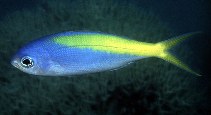 Paracaesio xanthurus
Afbeelding van Randall, J.E.
Afbeeldingen | video's | Google afbeelding
Afbeelding van Randall, J.E.
Classificatie / Namen Lokale namen | Synoniemen | Catalog of Fishes(Genus, Soort(en)) | ITIS | CoL | WoRMS | Cloffa
> Eupercaria/misc (Various families in series Eupercaria) > Lutjanidae (Snappers) > Apsilinae
Etymology: Paracaesio: Greek, para = the side of + Latin, caesium = bluish grey (Ref. 45335).
More on author: Bleeker.
Etymology: Paracaesio: Greek, para = the side of + Latin, caesium = bluish grey (Ref. 45335).
More on author: Bleeker.
Milieu: milieu / Klimaatzone / Diepte / verspreidingsgebied Ecologie
Verspreiding Gebieden | FAO regio's | Ecosystemen | Voorkomen | Verspreidingskaart | Introducties | Faunafri
Indo-Pacific: East Africa to the Austral Islands, north to southern Japan, south to southeastern Australia. Paracaesio xanthura, a complex of variable populations, may compose a single or two (or more) species. Paracaesio pedleyi, from Lord Howe Island, Middleton Reef, and eastern Australian waters, is included here with some reservation (Ref. 9821).
Grootte / Gewicht / Leeftijd
Korte beschrijving Determinatiesleutels | Morfologie | Morfometrie
Dorsale stekels (totaal) : 10; Dorsale zachte stralen (totaal) : 10 - 11; Anale stekels: 3; Anale zachte stralen: 8 - 9. This species is distinguished by the following characters: body relatively deep and laterally compressed, greatest body depth 2.5-2.8 in SL; interorbital region convex; mouth terminal, jaws about equal; anterior end of upper lip without a thick fleshy protrusion; maxilla with or without scales and without longitudinal ridges; teeth in jaws caniniform to villiform; gill rakers of first gill arch 5-11 + 18-20; soft rays of dorsal fin usually 10, in anal fin 8; lateral line scales 70-72; caudal fin forked. Colour bright blue; broad yellow band over most of dorsal half of body, including most of caudal pedincle fin (Ref. 9821, 90102).
Body shape (shape guide): fusiform / normal; Cross section: oval.
Body shape (shape guide): fusiform / normal; Cross section: oval.
Adults occur over rocky bottoms, sometimes forming large schools. They feed largely on zooplankton (Ref. 30573). Caught mainly with handlines and bottom longlines and marketed fresh or frozen (Ref. 9821).
Levenscyclus en paargedrag Maturiteit | Voortplanting | Paaien | Eieren | Fecunditeit | Larven
Hoofdreferentie
Upload uw referenties | Referenties | Coördinator | Medewerkers
Allen, G.R., 1985. FAO Species Catalogue. Vol. 6. Snappers of the world. An annotated and illustrated catalogue of lutjanid species known to date. FAO Fish. Synop. 125(6):208 p. Rome: FAO. (Ref. 55)
Status op de Rode Lijst van het IUCN (Ref. 130435: Version 2025-2 (Global))
Niet bedreigd (LC) ; Date assessed: 05 March 2015
CITES
Not Evaluated
Gevaar voor de mens
Harmless
Gebruik door de mens
Visserij: commercieel; sportvis: ja
FAO - Publication: search | FishSource | Sea Around Us
Meer informatie
Trofische ecologie
Voedsel (prooien)
Dieetsamenstelling
Voedselconsumptie
Voedselrantsoenen
Predatoren
Voedsel (prooien)
Dieetsamenstelling
Voedselconsumptie
Voedselrantsoenen
Predatoren
Populatiedynamica
Groeiparameters
Max. leeftijden / maten
Lengte-gewicht rel.
Lengte-lengte rel.
Lengtefrequenties
Massaconversie
Rekrutering
Abundantie
Groeiparameters
Max. leeftijden / maten
Lengte-gewicht rel.
Lengte-lengte rel.
Lengtefrequenties
Massaconversie
Rekrutering
Abundantie
Levenscyclus
Voortplanting
Maturiteit
Rijpheid/kieuwen rel.
Fecunditeit
Paaien
Paaibestanden
Eieren
Ontwikkeling van de eieren
Larven
Larvale populatiedynamiek
Voortplanting
Maturiteit
Rijpheid/kieuwen rel.
Fecunditeit
Paaien
Paaibestanden
Eieren
Ontwikkeling van de eieren
Larven
Larvale populatiedynamiek
Fysiologie
Lichaamssamenstelling
Voedingsstoffen
Zuurstofverbruik
Type zwemmen
Zwemsnelheid
Visuele pigmenten
Vis geluid
Ziekten en parasieten
Toxiciteit (LC50)
Lichaamssamenstelling
Voedingsstoffen
Zuurstofverbruik
Type zwemmen
Zwemsnelheid
Visuele pigmenten
Vis geluid
Ziekten en parasieten
Toxiciteit (LC50)
Genetica
genoom
Genetica
Heterozygositeit
Erfelijkheid
Genetische diversiteit
genoom
Genetica
Heterozygositeit
Erfelijkheid
Genetische diversiteit
Menselijk gerelateerd
Aquacultuursystemen
Aquacultuurprofielen
Kweeklijnen
Ciguatera gevallen
Postzegels, munten, diversen.
Aquacultuursystemen
Aquacultuurprofielen
Kweeklijnen
Ciguatera gevallen
Postzegels, munten, diversen.
Tools
Biologische quiz | E-boek | Veldgids | Determinatiesleutels | Lengtefrequentie Tool | Levenscyclus tool | Verspreidingskaart |
Vangst-MSY |
Speciale rapporten
Bekijk gegevens voor het houden in een aquarium | Bekijk Fact Sheets voor de soort | Bekijk Aquacultuur Fact Sheets
Download XML
Internetbronnen
AFORO (otoliths) | Aquatic Commons | BHL | Cloffa | Websites from users | Bekijk FishWatcher | CISTI | Catalog of Fishes: Genus, Soort(en) | DiscoverLife | ECOTOX | FAO - Publication: search | Faunafri | Fishipedia | Fishtrace | GloBI | Google Books | Google Scholar | Google | IGFA World Record | Nationale databanken | OneZoom | Open Tree of Life | Otolith Atlas of Taiwan Fishes | PubMed | Reef Life Survey | Socotra Atlas | TreeBase | Tree of Life | Wikipedia: ga naar, zoek | World Records Freshwater Fishing | Zoological Record
Schattingen op basis van modellen
Gewenste temperatuur (Ref. 123201): 19.9 - 28.3, mean 26.5 °C (based on 1214 cells).
Fylogenetische diversiteitsindex (Ref. 82804): PD50 = 0.5039 [Uniqueness, from 0.5 = low to 2.0 = high].
Bayesian length-weight: a=0.01905 (0.01027 - 0.03536), b=3.08 (2.91 - 3.25), in cm total length, based on LWR estimates for this species & (Sub)family-body (Ref. 93245).
Trofisch niveau (Ref. 69278): 3.4 ±0.45 se; based on food items.
Weerstandsvermogen (Ref. 120179): Gemiddeld, minimale populatieverdubbelingstijd 1,4-4,4 jaar (Preliminary K or Fecundity.).
Voedingsstoffen (Ref. 124155): Calcium = 35.2 [20.5, 63.3] mg/100g; Iron = 0.611 [0.323, 0.987] mg/100g; Protein = 18.6 [16.7, 20.3] %; Omega3 = 0.152 [0.096, 0.241] g/100g; Selenium = 46.7 [28.3, 84.0] μg/100g; VitaminA = 105 [37, 345] μg/100g; Zinc = 0.993 [0.700, 1.369] mg/100g (wet weight);