>
Eupercaria/misc (Various families in series Eupercaria) >
Lethrinidae (Emperors or scavengers) > Lethrininae
Etymology: Lethrinus: Greek, lethrinia, a fish pertaining to genus Pagellus.
Environment: milieu / climate zone / djupintervall / distribution range
Ekologi
marina; brackvatten revassocierade; ej vandrande; djupintervall 0 - 20 m (Ref. 9710). Tropical; 32°N - 32°S, 31°E - 155°W
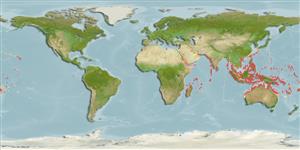
Indo-West Pacific: Red Sea and E ast Africa to Samoa, north to southern Japan, south to northeastern Australia.
Length at first maturity / Size / Vikt / Age
Könsmognad: Lm 19.5 range ? - 21.1 cm
Max length : 54.9 cm FL hane/ej könsbestämd; (Ref. 125599); common length : 30.0 cm TL hane/ej könsbestämd; (Ref. 30573); publicerad maxvikt: 2.9 kg (Ref. 125599); rapporterad maxålder: 15 år (Ref. 2293)
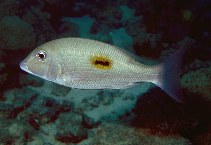
Taggstrålar i ryggfenan (totalt) : 10; Mjukstrålar i ryggfenan (totalt) : 9; Taggstrålar i analfenan: 3; Mjukstrålar i analfenan: 8. This species is distinguished by the following characters: body moderately deep, its depth 2.6-2.8 times in standard length; head length 0.9-1 times in body depth, 2.7-3.1 times in SL length, dorsal profile near eye distinctly or slightly convex; snout short and blunt, its length about 2.0-2.6 times in HL, measured without the lip the snout is 0.9-1 times in cheek height, its dorsal profile nearly straight, snout angle relative to upper jaw between 60° and 70°; interorbital space convex or almost flat; posterior nostril a narrow longitudinal slit, closer to orbit than anterior nostril; eye situated close to dorsal profile, its length 3.4-4.2 times in HL; cheek not very high, its height 2.3-3.1 times in HL; lateral teeth in jaws of adults molars or rounded; outer surface of maxilla smooth or with a longitudinal ridge; D X,9 the 4th or 5th dorsal-fin spine the longest, its length 2.5-3.1 times in body depth; A III,8 with the first soft ray usually the longest, its length almost equal to or longer or shorter than length of base of soft-rayed portion of anal fin and 1.2-1.6 times in length of entire anal-fin base; pectoral-fin rays 13; pelvic-fin membranes between rays closest to body without dense melanophores; cheek without scales; 46-47 lateral-line scales usually; usually 5 ½ (sometimes 4 ½) scale rows between lateral line and base of middle dorsal-fin spines; 14-16 scale rows in transverse series between origin of anal fin and lateral line; 13-14 rows in lower series of scales around caudal peduncle; 4-8 scales in supratemporal patch; inner surface of pectoral-fin base densely covered with scales; posterior angle of operculum fully scaly. Colour of body olive or grey above, shading to silvery white below; a large elliptical black spot, often broadly edged in yellow, on side directly below lateral line and centered at a vertical near the posterior tip of pectoral fins; sometimes light blue dots bordering lower rim of eye and around nostrils; pectoral, pelvic, dorsal, and anal fins white to pinkish; caudal fin orange or reddish; vertical fins sometimes lightly mottled or striped (Ref. 114226).
Body shape (shape guide): fusiform / normal; Cross section: oval.
Found solitary or in small schools over shallow sandy, coral rubble, mangroves, lagoons, channel and seagrass areas inshore and adjacent to coral reefs. Feeds on polychaetes, crustaceans, mollusks, echinoderms and small fish. Reported to spawn throughout the year during the first five days of the lunar month in large aggregations in Palau. Caught mostly by shore seine, gill nets, traps, and handline. Marketed mostly fresh (Ref. 171, 68703); flesh spoils rapidly (Ref. 4369).
Carpenter, K.E. and G.R. Allen, 1989. FAO Species Catalogue. Vol. 9. Emperor fishes and large-eye breams of the world (family Lethrinidae). An annotated and illustrated catalogue of lethrinid species known to date. FAO Fish. Synop. 125(9):118 p. Rome: FAO. (Ref. 2295)
IUCN Red List Status (Ref. 130435: Version 2025-1)
Threat to humans
Harmless
Human uses
Fiskeri: kommersiell
Verktyg
Special reports
Download XML
Internet-källor
Estimates based on models
Preferred temperature (Ref.
123201): 25.7 - 29.2, mean 28.5 °C (based on 3040 cells).
Phylogenetic diversity index (Ref.
82804): PD
50 = 0.5000 [Uniqueness, from 0.5 = low to 2.0 = high].
Bayesian length-weight: a=0.01479 (0.01239 - 0.01766), b=2.98 (2.94 - 3.02), in cm total length, based on LWR estimates for this species (Ref.
93245).
Trofisk nivå (Ref.
69278): 3.6 ±0.5 se; based on diet studies.
Resiliens (Ref.
120179): Mellan, lägsta populationsfördubblingstid 1,4-4,4 år (K=0.45-0.49; tmax=15).
Prior r = 0.58, 95% CL = 0.38 - 0.87, Based on 1 data-limited stock assessment.
Fishing Vulnerability (Ref.
59153): Low to moderate vulnerability (31 of 100).
🛈
Climate Vulnerability (Ref.
125649): Very high vulnerability (79 of 100).
🛈
Nutrients (Ref.
124155): Calcium = 49.7 [34.2, 75.8] mg/100g; Iron = 0.885 [0.562, 1.363] mg/100g; Protein = 20.5 [18.0, 22.8] %; Omega3 = 0.128 [0.087, 0.187] g/100g; Selenium = 34.2 [20.1, 62.6] μg/100g; VitaminA = 24.1 [4.9, 137.6] μg/100g; Zinc = 2.54 [1.84, 3.36] mg/100g (wet weight);