



Epinephelus striatus (Bloch, 1792)
Nassau grouper
Beobachtung melden im Fish Watcher
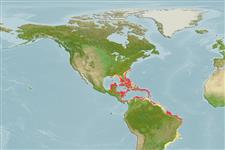
| Native range | All suitable habitat | Point map | Year 2050 |
|
| This map was computer-generated and has not yet been reviewed. |
| Epinephelus striatus AquaMaps Data sources: GBIF OBIS |
Hochladen Photos und videos
Bilder | videos | Laute | Briefmarken, Münzen, Verschiedenes. | Google Bild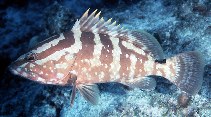 Epinephelus striatus
Photo von Randall, J.E.
Bilder | videos | Laute | Briefmarken, Münzen, Verschiedenes. | Google Bild
Photo von Randall, J.E.
Klassifizierung / Names Namen | Synonyme | Catalog of Fishes(Gattung, Arten) | ITIS | CoL | WoRMS | Cloffa
> Perciformes/Serranoidei (Groupers) > Epinephelidae (Groupers)
Etymology: Epinephelus: Greek, epinephelos = cloudy (Ref. 45335).
More on author: Bloch.
Etymology: Epinephelus: Greek, epinephelos = cloudy (Ref. 45335).
More on author: Bloch.
Umwelt: Milieu / Klimazone / Tiefenbereich / Verbreitungsgebiet Ökologie
seewasser riff-verbunden; ozeanodrom (Ref. 51243); tiefenbereich 1 - 90 m (Ref. 5217). Tropical; 35°N - 34°S, 92°W - 34°W (Ref. 5222)
Verbreitung Territorien | FAO Gebiete | Ökosysteme | Vorkommen | Punkt Karte | Einführungen | Faunafri
Western Atlantic: Bermuda, Florida, Bahamas, Yucatan Peninsula and throughout the Caribbean to southern Brazil. Not known from the Gulf of Mexico except at the Campeche Bank off the coast of Yucatan, at Tortugas and off Key West.
Länge bei der ersten Reifung / Größe / Gewicht / Alter
Geschlechtsreife: Lm 48.0 range ? - ? cm
Max length : 122 cm TL Männchen/unbestimmt; (Ref. 5227); max. veröff. Gewicht: 25.0 kg (Ref. 5222); max. veröff. Alter: 29 Jahre (Ref. 45400)
Max length : 122 cm TL Männchen/unbestimmt; (Ref. 5227); max. veröff. Gewicht: 25.0 kg (Ref. 5222); max. veröff. Alter: 29 Jahre (Ref. 45400)
Kurzbeschreibung Bestimmungsschlüssel | Morphologie | Morphometrie
Rückenflossenstacheln (insgesamt) : 11 - 12; Rückenflossenweichstrahlen (insgesamt) : 16 - 18; Afterflossenstacheln: 3; Afterflossenweichstrahlen: 8. Caudal fin rounded in juveniles. Dorsal fin notched between forward spines; 3rd or 4th spine the longest. Bases of soft dorsal and anal fins covered with scales and thick skin; scales small and greatly overlapping. Ground color tawny in individuals in shallow water, shading to pinkish or red in those from deeper water, sometimes with an orange cast. Can change color pattern in a few minutes from almost white to uniformly dark brown depending on mood. Third and fourth vertical bars branch above lateral line forming a W-shaped mark. Several distinct black spots below and behind eye and a characteristic `tuning-fork shaped stripe on top of head, dividing just behind the orbits. (see also Refs. 5221, 5222, 5227 and 2458).
Body shape (shape guide): fusiform / normal; Cross section: compressed.
Body shape (shape guide): fusiform / normal; Cross section: compressed.
Occurs from the shoreline to at least 90 m depth. Usually close to caves (Ref. 9710). Juveniles are common in seagrass beds. Diet comprises mainly of fishes (54%) and crabs (23%) and lesser amounts of other crustaceans and mollusks. It is solitary and mainly diurnal; but may sometimes form schools. Spawns near the new moon with up to 30,000 aggregating at certain spawning sites (Ref. 9710). The least wary and most friendly of all the groupers (Ref. 5226). Heavily fished and vulnerable to overfishing, particularly when migrating or aggregating to spawn (Ref. 9710). The most important commercial grouper in the West Indies. Marketed fresh, mostly between 2 to 10 kg (Ref. 3708).
Lebenszyklus und Paarungsverhalten Geschlechtsreife | Fortpflanzung | Ablaichen | Eier | Fruchtbarkeit | Larven
Most males and females display a bicolored pattern during spawning. Courtship behavior involves vertical spiral movement, short vertical runs followed by rapid aggregation then rapid dispersal and horizontal runs near the bottom. Sex reversal reportedly between 30 and 80 cm SL. Some primary males found recently (Ref. 5222). Protogyny was assumed in old literature, but dioecism (gonochorism) has been demonstrated. Pelagic spawner (Ref. 31572).
Hauptreferenz
Laden Sie Ihre Referenzen hoch | Referenzen | Koordinator | Partner
Heemstra, P.C. and J.E. Randall, 1993. FAO Species Catalogue. Vol. 16. Groupers of the world (family Serranidae, subfamily Epinephelinae). An annotated and illustrated catalogue of the grouper, rockcod, hind, coral grouper and lyretail species known to date. Rome: FAO. FAO Fish. Synop. 125(16):382 p. (Ref. 5222)
IUCN Rote Liste Status (Ref. 130435: Version 2025-2 (Global))
vom Aussterben bedroht (CR) (A4bd); Date assessed: 18 November 2016
CITES
Not Evaluated
Bedrohung für Menschen
Reports of ciguatera poisoning (Ref. 30303)
Nutzung durch Menschen
Fischereien: kommerziell; Sportfisch: ja; Aquarium: Öffentliche Aquarien
FAO - Fischereien: landungen; Publication: search | FishSource | Das Meer um uns herum
Mehr Information
Trophische Ökologie
Lebensmittel (Beutetiere)
Nahrungszusammensetzung
Nahrungsaufnahme
Lebensmittelrationen
Räuber
Lebensmittel (Beutetiere)
Nahrungszusammensetzung
Nahrungsaufnahme
Lebensmittelrationen
Räuber
Populationsdynamik
Wachstumsparameter
Max. Alter/Größen
Länge-Gewicht-Rel.
Länge-Länge-Verhältnis.
Längenhäufigkeiten
Massenkonvertierung
Rekrutierung
Dichte
Wachstumsparameter
Max. Alter/Größen
Länge-Gewicht-Rel.
Länge-Länge-Verhältnis.
Längenhäufigkeiten
Massenkonvertierung
Rekrutierung
Dichte
Lebenszyklus
Fortpflanzung
Geschlechtsreife
Reifung/Kiemen rel.
Fruchtbarkeit
Ablaichen
Laichaggregationen
Eier
Eientwicklung
Larven
Larven Pop.Dyn.
Fortpflanzung
Geschlechtsreife
Reifung/Kiemen rel.
Fruchtbarkeit
Ablaichen
Laichaggregationen
Eier
Eientwicklung
Larven
Larven Pop.Dyn.
Anatomie
Kiemenoberfläche
Gehirn
Otolith
Kiemenoberfläche
Gehirn
Otolith
Physiologie
Körperliche Zusammensetzung
Nährstoffe
Sauerstoffverbrauch
Schwimmart
Schwimmgeschwindigkeit
Visuelle Pigmente
Fischgeräusche
Krankheiten und Parasiten
Toxizität (LC50s)
Körperliche Zusammensetzung
Nährstoffe
Sauerstoffverbrauch
Schwimmart
Schwimmgeschwindigkeit
Visuelle Pigmente
Fischgeräusche
Krankheiten und Parasiten
Toxizität (LC50s)
Menschenbezogen
Aquakultur-Systeme
Aquakultur Profile
Zuchtlinien
Ciguatera-Fälle
Briefmarken, Münzen, Verschiedenes.
Aquakultur-Systeme
Aquakultur Profile
Zuchtlinien
Ciguatera-Fälle
Briefmarken, Münzen, Verschiedenes.
Tools
Bio-Quiz | E-Book | Feldführer | Bestimmungsschlüssel | Längenhäufigkeits Tool | Lebensdaten Tool | Punkt Karte |
Catch-MSY |
Zusatzinformationen
Download XML
Zusammenfassung | Punktdaten | Namen | Photos
Internet Quellen
AFORO (otoliths) | Aquatic Commons | BHL | Cloffa | Websites from users | FishWatcher Einträge suchen | CISTI | Catalog of Fishes: Gattung, Arten | DiscoverLife | DORIS | ECOTOX | FAO - Fischereien: landungen; Publication: search | Faunafri | Fishipedia | Fishtrace | GloBI | Google Books | Google Scholar | Google | IGFA World Record | Nationale Datenbanken | OneZoom | Open Tree of Life | Otolith Atlas of Taiwan Fishes | Öffentliche Aquarien | PubMed | Reef Life Survey | Socotra Atlas | TreeBase | Tree of Life | Wikipedia: Gehe zu, Suchen | World Records Freshwater Fishing | Zoologischer Rekord
Schätzungen auf der Grundlage von Modellen
Bevorzugte Temperatur (Ref. 123201): 22.8 - 28, mean 26.4 °C (based on 400 cells).
Phylogenetischer Diversitätsindex (Ref. 82804): PD50 = 0.5000 [Uniqueness, from 0.5 = low to 2.0 = high].
Bayesian length-weight: a=0.01148 (0.01001 - 0.01316), b=3.05 (3.03 - 3.07), in cm total length, based on LWR estimates for this species (Ref. 93245).
Trophische Ebene (Ref. 69278): 4.1 ±0.0 se; based on diet studies.
Widerstandsfähigkeit (Ref. 120179): niedrig, Verdopplung der Population dauert 4,5 - 14 Jahre. (Musick et al. 2000 (Ref. 36717)).
Prior r = 0.43, 95% CL = 0.28 - 0.64, Based on 1 data-limited stock assessment.
Nährstoffe (Ref. 124155): Calcium = 15.2 [7.2, 34.8] mg/100g; Iron = 0.444 [0.224, 0.890] mg/100g; Protein = 18.4 [16.8, 19.9] %; Omega3 = 0.106 [0.063, 0.178] g/100g; Selenium = 46.3 [23.9, 93.4] μg/100g; VitaminA = 201 [51, 791] μg/100g; Zinc = 0.995 [0.670, 1.432] mg/100g (wet weight);