Klassifizierung / Names
Namen | Synonyme | Catalog of Fishes(Gattung, Arten) | ITIS | CoL | WoRMS | Cloffa
>
Eupercaria/misc (Various families in series Eupercaria) >
Labridae (Wrasses)
Etymology: Symphodus: Greek, syn, symphysis = grown together + Greek, odous = teeth (Ref. 45335).
More on author: Linnaeus.
Issue
See nomenclatural details in Eschmeyer (CofF ver. Oct. 2012: Ref. 92135).
Environment: milieu / climate zone / Tiefenbereich / distribution range
Ökologie
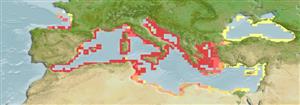
seewasser riff-verbunden; tiefenbereich 1 - 30 m. Subtropical; 47°N - 30°N, 6°W - 42°E
Eastern Atlantic: throughout the Mediterranean, Black Sea and Sea of Azov.
Length at first maturity / Size / Gewicht / Alter
Geschlechtsreife: Lm 4.0 range ? - ? cm
Max length : 18.5 cm TL Männchen/unbestimmt; (Ref. 122896); max. veröff. Gewicht: 81.69 g (Ref. 122896); max. veröff. Alter: 5 Jahre (Ref. 4742)
Kurzbeschreibung
Bestimmungsschlüssel | Morphologie | Morphometrie
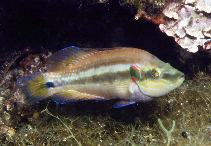
Adults are found near rocks and eel-grass beds. A nest of seaweed (Cystoseria) built and kept by male. Feed on bryozoans, hydroids, tubicolous, worms, shrimps, amphipods and mollusks. Males grow faster than females (Ref. 4742). Undergoes sex reversal (Ref. 4742). Oviparous, distinct pairing during breeding (Ref. 205).
Undergoes sex reversal (Ref. 4742). Oviparous, distinct pairing during breeding (Ref. 205). Males build dish shaped nests and guard the eggs (Ref. 205).
Quignard, J.-P. and A. Pras, 1986. Labridae. p. 919-942. In P.J.P. Whitehead, M.-L. Bauchot, J.-C. Hureau, J. Nielsen and E. Tortonese (eds.) Fishes of the north-eastern Atlantic and the Mediterranean. UNESCO, Paris. Vol. 2. (Ref. 4742)
IUCN Rote Liste Status (Ref. 130435: Version 2025-1)
Bedrohung für Menschen
Harmless
Nutzung durch Menschen
Fischereien: kommerziell; Aquarium: Kommerziell
Tools
Zusatzinformationen
Download XML
Internet Quellen
Estimates based on models
Preferred temperature (Ref.
123201): 16.5 - 21.1, mean 18.9 °C (based on 421 cells).
Phylogenetic diversity index (Ref.
82804): PD
50 = 0.5005 [Uniqueness, from 0.5 = low to 2.0 = high].
Bayesian length-weight: a=0.01202 (0.00993 - 0.01456), b=3.09 (3.05 - 3.13), in cm total length, based on LWR estimates for this species (Ref.
93245).
Trophic level (Ref.
69278): 3.5 ±0.0 se; based on diet studies.
Generation time: 1.7 ( na - na) years. Estimated as median ln(3)/K based on 1
growth studies.
Widerstandsfähigkeit (Ref.
120179): mittel, Verdopplung der Population dauert 1,4 - 4,4 Jahre. (K=0.64-0.95; tm=1-2; tmax=5).
Fishing Vulnerability (Ref.
59153): Low vulnerability (22 of 100).
🛈
Nutrients (Ref.
124155): Calcium = 71.6 [33.6, 157.3] mg/100g; Iron = 0.872 [0.452, 1.799] mg/100g; Protein = 19.2 [16.3, 21.4] %; Omega3 = 0.25 [0.13, 0.47] g/100g; Selenium = 11.8 [5.3, 25.3] μg/100g; VitaminA = 75.2 [20.7, 354.1] μg/100g; Zinc = 1.27 [0.76, 2.19] mg/100g (wet weight);