



Apterichtus caecus (Linnaeus, 1758)
European finless eel
Waarneming toevoegen in Fish Watcher
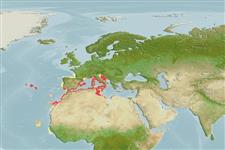
| Native range | All suitable habitat | Point map | Year 2050 |
|
| This map was computer-generated and has not yet been reviewed. |
| Apterichtus caecus AquaMaps Data sources: GBIF OBIS |
Uploaden van uw Foto's en video's
Afbeeldingen | Google afbeelding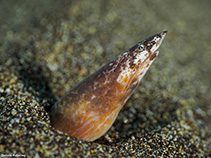 Apterichtus caecus
Afbeelding van Rabeling, D.
Afbeeldingen | Google afbeelding
Afbeelding van Rabeling, D.
Classificatie / Namen Lokale namen | Synoniemen | Catalog of Fishes(Genus, Soort(en)) | ITIS | CoL | WoRMS | Cloffa
> Anguilliformes (Eels and morays) > Ophichthidae (Snake eels) > Ophichthinae
Etymology: Apterichtus: From the Greek απτερόν (apteron), without fins, and ίχθύς (ichtus, more correctly written ichthys; masculine), fish.
More on author: Linnaeus.
Etymology: Apterichtus: From the Greek απτερόν (apteron), without fins, and ίχθύς (ichtus, more correctly written ichthys; masculine), fish.
More on author: Linnaeus.
Milieu: milieu / Klimaatzone / Diepte / verspreidingsgebied Ecologie
marien demersaal; diepte 0 - 85 m (Ref. 101270). Subtropical; 46°N - 4°S, 32°W - 17°E
Verspreiding Gebieden | FAO regio's | Ecosystemen | Voorkomen | Verspreidingskaart | Introducties | Faunafri
Eastern Atlantic: Western and eastern Mediterranean, eastern Atlantic south to Azores, Madeira, and the Canary islands.
Grootte / Gewicht / Leeftijd
Korte beschrijving Determinatiesleutels | Morfologie | Morfometrie
Wervels: 132 - 139. This species is distinguished by the following characters: tail 1.6-1.7, head 12-15, and body depth 56-83 in total length; preopercular pores 4 and there are 5 pores in supratemporal canal; teeth conical and uniserial on jaws, becoming biserial on vomer of large specimens, vomerine teeth 8-14; when fresh body ochre in color with numerous small dark brown spots, those spots forming a continuous mid-dorsal band, yellowish on ventral surface; the head with dark brown spots over a pale background, a prominent horizontal white patch beneath and behind the orbit; MVF 52-134, total vertebrae 132-139 (n=6) (Ref. 101270).
Body shape (shape guide): eel-like; Cross section: oval.
Body shape (shape guide): eel-like; Cross section: oval.
Levenscyclus en paargedrag Maturiteit | Voortplanting | Paaien | Eieren | Fecunditeit | Larven
Hoofdreferentie
Upload uw referenties | Referenties | Coördinator : McCosker, John E. | Medewerkers
McCosker, J.E. and Y. Hibino, 2015. A review of the finless snake eels of the genus Apterichtus (Anguilliformes: Ophichthidae), with the description of five new species. Zootaxa 3941(1):49-78. (Ref. 101270)
Status op de Rode Lijst van het IUCN (Ref. 130435: Version 2025-2 (Global))
Niet bedreigd (LC) ; Date assessed: 20 October 2011
CITES
Not Evaluated
Gevaar voor de mens
Harmless
Gebruik door de mens
FAO - Publication: search | FishSource |
Meer informatie
Trofische ecologie
Voedsel (prooien)
Dieetsamenstelling
Voedselconsumptie
Voedselrantsoenen
Predatoren
Voedsel (prooien)
Dieetsamenstelling
Voedselconsumptie
Voedselrantsoenen
Predatoren
Populatiedynamica
Groeiparameters
Max. leeftijden / maten
Lengte-gewicht rel.
Lengte-lengte rel.
Lengtefrequenties
Massaconversie
Rekrutering
Abundantie
Groeiparameters
Max. leeftijden / maten
Lengte-gewicht rel.
Lengte-lengte rel.
Lengtefrequenties
Massaconversie
Rekrutering
Abundantie
Anatomie
Kieuwoppervlak
Hersenen
Otoliet
Kieuwoppervlak
Hersenen
Otoliet
Fysiologie
Lichaamssamenstelling
Voedingsstoffen
Zuurstofverbruik
Type zwemmen
Zwemsnelheid
Visuele pigmenten
Vis geluid
Ziekten en parasieten
Toxiciteit (LC50)
Lichaamssamenstelling
Voedingsstoffen
Zuurstofverbruik
Type zwemmen
Zwemsnelheid
Visuele pigmenten
Vis geluid
Ziekten en parasieten
Toxiciteit (LC50)
Genetica
genoom
Genetica
Heterozygositeit
Erfelijkheid
Genetische diversiteit
genoom
Genetica
Heterozygositeit
Erfelijkheid
Genetische diversiteit
Menselijk gerelateerd
Aquacultuursystemen
Aquacultuurprofielen
Kweeklijnen
Ciguatera gevallen
Postzegels, munten, diversen.
Aquacultuursystemen
Aquacultuurprofielen
Kweeklijnen
Ciguatera gevallen
Postzegels, munten, diversen.
Tools
Biologische quiz | E-boek | Veldgids | Lengtefrequentie Tool | Levenscyclus tool | Verspreidingskaart |
Vangst-MSY |
Speciale rapporten
Bekijk gegevens voor het houden in een aquarium | Bekijk Fact Sheets voor de soort | Bekijk Aquacultuur Fact Sheets
Download XML
Internetbronnen
AFORO (otoliths) | Aquatic Commons | BHL | Cloffa | Websites from users | Bekijk FishWatcher | CISTI | Catalog of Fishes: Genus, Soort(en) | DiscoverLife | ECOTOX | FAO - Publication: search | Faunafri | Fishipedia | Fishtrace | GloBI | Google Books | Google Scholar | Google | IGFA World Record | Nationale databanken | OneZoom | Open Tree of Life | Otolith Atlas of Taiwan Fishes | PubMed | Reef Life Survey | Socotra Atlas | TreeBase | Tree of Life | Wikipedia: ga naar, zoek | World Records Freshwater Fishing | Zoological Record
Schattingen op basis van modellen
Gewenste temperatuur (Ref. 123201): 16.1 - 21, mean 19.1 °C (based on 58 cells).
Fylogenetische diversiteitsindex (Ref. 82804): PD50 = 0.5000 [Uniqueness, from 0.5 = low to 2.0 = high].
Bayesian length-weight: a=0.00093 (0.00041 - 0.00214), b=2.99 (2.79 - 3.19), in cm total length, based on LWR estimates for this (Sub)family-body shape (Ref. 93245).
Trofisch niveau (Ref. 69278): 4.1 ±0.64 se; based on food items.
Weerstandsvermogen (Ref. 120179): Gemiddeld, minimale populatieverdubbelingstijd 1,4-4,4 jaar (Preliminary K or Fecundity.).
Voedingsstoffen (Ref. 124155): Calcium = 48.4 [11.8, 142.6] mg/100g; Iron = 0.973 [0.362, 4.207] mg/100g; Protein = 18.9 [16.6, 21.3] %; Omega3 = 0.313 [0.144, 0.827] g/100g; Selenium = 23.7 [4.7, 65.6] μg/100g; VitaminA = 9.75 [2.86, 32.77] μg/100g; Zinc = 0.574 [0.292, 1.124] mg/100g (wet weight);