Coelorinchus caelorhincus, Hollowsnout grenadier : fisheries

Coelorinchus caelorhincus (Risso, 1810)

Hollowsnout grenadier
Añada su observación en Fish Watcher
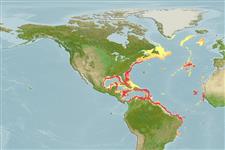
Native range | All suitable habitat | Point map | Year 2050
This map was computer-generated and has not yet been reviewed.
Coelorinchus caelorhincus   AquaMaps   Data sources: GBIF OBIS
Sube tu fotos y Vídeos
Imágenes | Google image
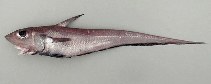
Image of Coelorinchus caelorhincus (Hollowsnout grenadier)
Coelorinchus caelorhincus
Female Foto de Cambraia Duarte, P.M.N. (c)ImagDOP

Clasificación / Nombres Nombres comunes | Sinónimos | Catalog of Fishes(Género, Especie) | ITIS | CoL | WoRMS | Cloffa

> Gadiformes (Cods) > Macrouridae (Grenadiers or rattails)
Etymology: Coelorinchus: Greek, koilos = a hollow + Greek, rhyngchos = jaw (Ref. 45335).
More on author: Risso.

Taxonomic Remarks
Eschmeyer and Bailey in Eschmeyer (1990:70) changed the spelling of the name from Coelorinchus coelorhincus (or Coelorhynchus coelorhynchus) to Caelorinchus caelorhincus, based on their interpretation of the name; caelo (an awl or engraving tool) made more sense than coelo (hollow). Iwamoto had followed their spelling since that time. However, Dr. Dirk Nolf (Institut royal des Sciences naturelles de Belgique) has informed him (in litt., 8 April 2003) that the name should be spelled with the dipthong oe based on the following logic: Giorna’s paper is in French, a language that does not have the dipthong 'ae'. Giorna (1810:179) writes: "Le Coelorinque-Coelorinchus, the first two words being French, the last Latin. The dipthong 'oe', logically must be the same in the two. Since the first name is in French, the second can only be spelled with an 'oe'. Nevertheless, revisiting the issue, Iwamoto, Eschmeyer and Fricke showed that the species should be written 'cae' (May 2008, email exhchanges).

Entorno: milieu / zona climática / rango de profundidad / gama de distribución Ecología

marino bentopelágico; no migratorio; rango de profundidad 90 - 1485 m (Ref. 104125), usually 200 - 500 m (Ref. 1371). Deep-water; 62°N - 18°S, 98°W - 17°W (Ref. 1371)

Distribución Territorios | Áreas FAO | Ecosistemas | Ocurrencias, apariciones | Mapa de puntos | Introducciones | Faunafri

Northeast Atlantic and Mediterranean Sea. A loose sort of southern limit for Caelorinchus caelorhincus caelorhincus is probably around Cape Verde; most specimens south and to the east into the Gulf of Guinea are likely to be Caelorinchus caelorhincus geronimoi (Iwamoto 1997, pers. Comm.). Northwest Atlantic: Canada (Ref. 5951).

Tamaño / Peso / Edad

Madurez: Lm ?  range ? - ? cm
Max length : 48.0 cm TL macho / no sexado; (Ref. 5951); common length : 30.0 cm TL macho / no sexado; (Ref. 2683); edad máxima reportada: 10 años (Ref. 58045)

Descripción breve Claves de identificación | Morfología | Morfometría

Espinas dorsales (total) : 0; Espinas anales: 0. Eyes large; snout short, moderately pointed, its anterolateral margin incompletely supported by bone. Head ridges strong but with rather fine spinules; terminal snout scute trifid, wider than long, small and blunt to large and pointed, with a terminal and two lateral arms of about equal size. Underside of the snout naked medially. Light organ large, a black naked fossa between and slightly anterior to the pelvic fin bases. Overall color is pale grayish-brown to swarthy, with a series of broad saddle marks in some; oral cavity pale to dark (Ref. 1371). Spiny fin ray of first dorsal fin with a smooth and rounded leading edge (Ref. 35388).
Body shape (shape guide): elongated; Cross section: circular.

Biología     Glosario (por ej. epibenthic)

Found commonly in about 200-500 m. Feeds on a variety of benthic organisms, such as polychaetes, gastropods, cephalopods, numerous crustacean groups (copepods, gammarians, isopods, cumaceans, Natantia) and fish. Minimum depth range taken from Ref. 1371.

Ciclo vital y comportamiento de apareamiento Madurez | Reproducción | Puesta | Huevos | Fecundidad | Larva

Referencia principal Suba sus referencias | Referencias | Coordinador : Iwamoto, Tomio | Colaboradores

Cohen, D.M., T. Inada, T. Iwamoto and N. Scialabba, 1990. FAO species catalogue. Vol. 10. Gadiform fishes of the world (Order Gadiformes). An annotated and illustrated catalogue of cods, hakes, grenadiers and other gadiform fishes known to date. FAO Fish. Synop. 125(10). Rome: FAO. 442 p. (Ref. 1371)

Situación en la Lista Roja de la UICN (Ref. 130435: Version 2025-2 (Global))

  Least Concern (LC) ; Date assessed: 14 May 2013

CITES

Not Evaluated

CMS (Ref. 116361)

Not Evaluated

Amenaza para el ser humano

  Harmless


Usos humanos

Pesquerías: escaso valor comercial
FAO - Publication: search | FishSource |

Más información

Ecología Trófica
Alimentos (presas)
Composición de la dieta
consumo de alimento
Raciones de comida
Despredadores
Ecología
Ecología
Ciclo de vida
Reproducción
Madurez
Madurez/Gills rel.
Fecundidad
Puesta
Agregaciones de desove
Huevos
Desarrollo de los huevos
Larva
Dinámica larvaria
Distribución
Territorios
Áreas FAO
Ecosistemas
Ocurrencias, apariciones
Introducciones
BRUVS - Vídeos
Anatomía
Superficie branquial
Cerebro
Otolito
Fisiología
Composición corporal
Nutrientes
Consumo del oxígeno
Tipo de natación
Velocidad de natación
Pigmentos visuales
Sonido de peces
Enfermedades y parásitos
Toxicidad (CL50)
Genética
Genoma
Genética
Heterocigosidad
heritabilidad
Diversidad genética
Relacionados con el ser humano
Sistemas de acuicultura
Perfiles de acuicultura
Razas
Ciguatera cases
Sellos, monedas, varios
Divulgación
Colaboradores
Referencias
Referencias

Herramientas

Informes especiales

Descargar XML

Fuentes de Internet

AFORO (otoliths) | Aquatic Commons | BHL | Cloffa | Websites from users | Check FishWatcher | CISTI | Catalog of Fishes: Género, Especie | DiscoverLife | ECOTOX | FAO - Publication: search | Faunafri | Fishipedia | Fishtrace | GloBI | GoMexSI (interaction data) | Google Books | Google Scholar | Google | IGFA World Record | Bases de datos nacionales | OneZoom | Open Tree of Life | Otolith Atlas of Taiwan Fishes | PubMed | Reef Life Survey | Socotra Atlas | TreeBase | Árbol de la vida | Wikipedia: Go, búsqueda | World Records Freshwater Fishing | Expediente Zoológico

Estimaciones basadas en modelos

Temperatura preferida (Referencia 123201): 8.6 - 19.6, mean 13.2 °C (based on 160 cells).
Índice de diversidad filogenética (Referencia 82804):  PD50 = 0.5000   [Uniqueness, from 0.5 = low to 2.0 = high].
Bayesian length-weight: a=0.00195 (0.00162 - 0.00234), b=3.15 (3.10 - 3.20), in cm total length, based on LWR estimates for this species (Ref. 93245).
Nivel trófico (Referencia 69278):  3.5   ±0.2 se; based on diet studies.
Resiliencia (Referencia 120179):  Bajo, población duplicada en un tiempo mínimo de 4.5-14 años (K=0.13-0.15; tmax=8).
Vulnerabilidad pesquera (Ref. 59153):  Moderate vulnerability (38 of 100). 🛈
Categoría de precios (Ref. 80766):   Medium.
Nutrientes (Ref. 124155):  Calcium = 16.7 [8.0, 38.2] mg/100g; Iron = 0.302 [0.148, 0.621] mg/100g; Protein = 15.4 [13.3, 17.9] %; Omega3 = 0.222 [0.093, 0.498] g/100g; Selenium = 25.6 [9.1, 65.5] μg/100g; VitaminA = 17.1 [3.3, 84.4] μg/100g; Zinc = 0.495 [0.309, 0.805] mg/100g (wet weight);