Environment: milieu / climate zone / ระดับความลึก / distribution range
นิเวศวิทยา
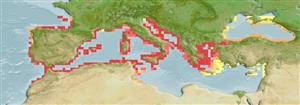
เกี่ยวกับทะเล,น้ำเค็ม; กร่อย สัตว์น้ำหน้าดิน. Subtropical; 46°N - 33°N, 10°W - 42°E
Eastern Atlantic: Atlantic coast from France to Morocco; also in the Mediterranean and Black seas and in the Suez Canal.
ขนาด / น้ำหนัก / Age
วัยเจริญพันธุ์: Lm ? range ? - ? cm
Max length : 13.8 cm TL เพศผู้/กระเทย; (Ref. 118193)
เงี่ยงครีบหลัง (รวม) : 11 - 13; ก้านครีบอ่อนที่หาง (รวม) : 22 - 25; เงี่ยงครีบก้น: 2; ก้านครีบอ่อนที่ก้น: 23 - 26. Diagnosis: Mature males with well-developed head-crest and anal gland in the first two anal-fin rays; sneaker males much smaller than nesting males and do not display male secondary sexual characters (Ref. 94108).
Body shape (shape guide): fusiform / normal.
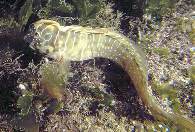
Facultative air-breathing (Ref. 126274); Adults occur in the intertidal zone and shallow bottoms, on rocks or sand between pebbles and vegetation (Ref. 5981). Often in brackish waters down to 5 ppt (Ref. 5981). Inhabit crevices or piddock holes, males remain in cavities above water-level during low tide (Ref. 5981). Feed on benthic invertebrates, mainly mollusks, also algae (Ref. 5981). Also ingest large amounts of aquatic insects and pupae (Ref. 94105). Oviparous (Ref. 205). Mature males adopt a passive role during courtship, rarely court females, do not defend nest territory, but provide parental care to eggs. Sneaker males assume a female-like behavior in order to approach the nests of nesting males and parasitically fertilize the eggs (Ref. 94113). Eggs are demersal and adhesive (Ref. 205). Has been reared in captivity (Ref. 35421).
Males court by nodding and undulating movements and drive females to spawning place by biting and butting (Ref. 5981) though this event is rarely done by the males, more or less adopting a passive role in the courtship (Ref 94113). Additionally, males don't defend a territory around the nest (Ref. 94113) though they guard eggs from several females (Ref. 5981, 94113).
Zander, C.D., 1986. Blenniidae. p. 1096-1112. In P.J.P. Whitehead, M.-L. Bauchot, J.-C. Hureau, J. Nielsen and E. Tortonese (eds.) Fishes of the North-eastern Atlantic and the Mediterranean, volume 3. UNESCO, Paris. (Ref. 5981)
IUCN Red List Status (Ref. 130435: Version 2025-1)
Threat to humans
Harmless
Human uses
การประมง: การประมงยังชีพ
เครื่องมือ
Special reports
Download XML
แหล่งที่มาจากอินเตอร์เน็ต
Estimates based on models
Preferred temperature (อ้างอิง
123201): 15 - 21.2, mean 18.8 °C (based on 615 cells).
Phylogenetic diversity index (อ้างอิง
82804): PD
50 = 0.7500 [Uniqueness, from 0.5 = low to 2.0 = high].
Bayesian length-weight: a=0.01096 (0.00857 - 0.01402), b=3.00 (2.93 - 3.07), in cm total length, based on LWR estimates for this species (Ref.
93245).
ระดับชั้นอาหาร (อ้างอิง
69278): 3.6 ±0.0 se; based on diet studies.
Generation time: 2.2 ( na - na) years. Estimated as median ln(3)/K based on 1
growth studies.
ความสามารถในการกลับคืนสู่ปกติ (อ้างอิง
120179): ความสูง, เวลาต่ำสุดที่จะทำให้ประชากรเพิ่มขึ้นเป็น 2 เท่าใช้เวลาน้อยกว่า 15 เดือน (K=0.50).
Fishing Vulnerability (Ref.
59153): Low to moderate vulnerability (25 of 100).
🛈
Nutrients (Ref.
124155): Calcium = 127 [21, 405] mg/100g; Iron = 1.39 [0.52, 4.55] mg/100g; Protein = 4.16 [0.45, 7.88] %; Omega3 = 0.443 [0.183, 1.088] g/100g; Selenium = 8.2 [1.8, 25.0] μg/100g; VitaminA = 25.1 [8.9, 69.6] μg/100g; Zinc = 1.24 [0.59, 2.46] mg/100g (wet weight);