>
Lophiiformes (Anglerfishes) >
Oneirodidae (Dreamers)
Etymology: Pentherichthys: Greek, 'penthos' = sorrow or mournfulness + Greek, 'ichthys' = fish (probably alluding to its "sad look": "mournful fish") (Ref. 86949).
More on authors: Regan & Trewavas.
Environment: milieu / climate zone / Mức độ sâu / distribution range
Sinh thái học
Biển Tầng nổi biển sâu; Mức độ sâu ? - 2500 m (Ref. 86949). Deep-water
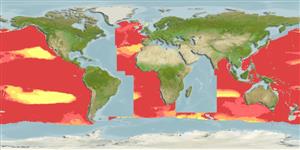
Atlantic, Indian and Pacific oceans.
Bộ gần gũi / Khối lượng (Trọng lượng) / Age
Chín muồi sinh dục: Lm ? range ? - ? cm
Max length : 12.2 cm SL (female)
Short description
Khóa để định loại | Hình thái học | Sinh trắc học
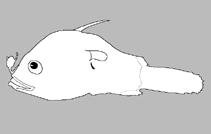
Các vây lưng mềm (tổng cộng) : 6 - 7; Tia mềm vây hậu môn: 5 - 7. Characterized by having large melanophores inside the rays of the caudal fin; metamorphosed females have ethmoid region of the cranium extremely flattened dorsoventrally; deep and wide illicial trough, nasal foramina narrow and elongate; absence of symphysial spine of lower jaw; dentaries forming thick, broad, posteriorly directed flange immediately lateral to their union on the midline, ventral margin of lower jaw at symphysis concave when viewed anteriorly; short illicium of pterygiophore, posterior part broad and dorsoventrally flattened; metamorphosed females having wide ethmoid cartilage and vomer, width about equal to distance between anterolateral tips of lateral ethmoids and frontals; absence of vomerine teeth; short frontals, anterior end overhanging and extending past anterior limits of the ethmoid cartilage and vomer, convex dorsal margin; well developed first ray of dorsal fin; dorsal fin rays 6-7; anal fin rays 5-7; short and broad pectoral fin lobe, shorter than the longest rays of pectoral fin; pectoral fin rays 21-27; coracoid lacking posteroventral process; pelvic bones, simple and expanded distally; skin naked, without dermal spinules; darkly pigmented skin of caudal peduncle extends well past base of caudal fin; metamorphosed males have posterior nostril contiguous with the eye, nasal area is white and with 18 olfactory lamellae, 7-9 upper denticular teeth fused at bases and 4 lower denticular teeth (Ref. 86949).
Also mesopelagic. Males dwarfed and non-parasitic (Ref. 10524).
Life cycle and mating behavior
Chín muồi sinh dục | Sự tái sinh sản | Đẻ trứng | Các trứng | Sự sinh sản | Ấu trùng
Bertelsen, E., 1990. Oneirodidae. p. 498-507. In J.C. Quero, J.C. Hureau, C. Karrer, A. Post, and L. Saldanha (eds.) Check-list of the fishes of the eastern tropical Atlantic (CLOFETA). JNICT, Lisbon; SEI, Paris; and UNESCO, Paris. Vol. 1. (Ref. 10524)
IUCN Red List Status (Ref. 130435: Version 2025-1)
Threat to humans
Harmless
Human uses
Các công cụ
Special reports
Download XML
Các nguồn internet
Estimates based on models
Preferred temperature (Tài liệu tham khảo
123201): 2 - 3.3, mean 2.9 °C (based on 404 cells).
Phylogenetic diversity index (Tài liệu tham khảo
82804): PD
50 = 1.0000 [Uniqueness, from 0.5 = low to 2.0 = high].
Bayesian length-weight: a=0.01995 (0.00906 - 0.04395), b=3.01 (2.83 - 3.19), in cm total length, based on all LWR estimates for this body shape (Ref.
93245).
Mức dinh dưỡng (Tài liệu tham khảo
69278): 3.8 ±0.5 se; based on size and trophs of closest relatives
Thích nghi nhanh (Tài liệu tham khảo
120179): Trung bình, thời gian nhân đôi của chủng quần tối thiểu là 1.4 - 4.4 năm (Fecundity assumed < 1000).
Fishing Vulnerability (Ref.
59153): Low vulnerability (10 of 100).
🛈