



Waarneming toevoegen in Fish Watcher
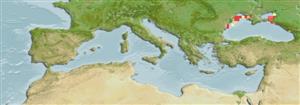
| Native range | All suitable habitat | Point map | Year 2050 |
|
| This map was computer-generated and has not yet been reviewed. |
| Alosa caspia AquaMaps Data sources: GBIF OBIS |
Uploaden van uw Foto's en video's
Afbeeldingen | Google afbeelding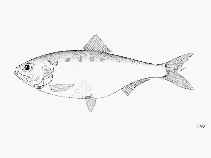 Alosa caspia
Afbeelding van FAO
Afbeeldingen | Google afbeelding
Afbeelding van FAO
Classificatie / Namen Lokale namen | Synoniemen | Catalog of Fishes(Genus, Soort(en)) | ITIS | CoL | WoRMS | Cloffa
> Clupeiformes (Herrings) > Alosidae (Shads and Sardines)
Etymology: Alosa: Latin, alausa = a fish cited by Ausonius and Latin, halec = pickle, dealing with the Greek word hals = salt; it is also the old Saxon name for shad = "alli" ; 1591 (Ref. 45335).
Etymology: Alosa: Latin, alausa = a fish cited by Ausonius and Latin, halec = pickle, dealing with the Greek word hals = salt; it is also the old Saxon name for shad = "alli" ; 1591 (Ref. 45335).
Milieu: milieu / Klimaatzone / Diepte / verspreidingsgebied Ecologie
marien; zoet water; brak water pelagic-neritic; anadroom (Ref. 138126). Temperate; 48°N - 37°N, 27°E - 54°E
Verspreiding Gebieden | FAO regio's | Ecosystemen | Voorkomen | Verspreidingskaart | Introducties | Faunafri
Eurasia: Black Sea, Sea of Azov and Caspian Sea.
Grootte / Gewicht / Leeftijd
Maturiteit: Lm ? range ? - ? cm
Max length : 32.0 cm TL mannelijk / geslacht onbekend; (Ref. 593); common length : 20.0 cm SL mannelijk / geslacht onbekend; (Ref. 188); max. gepubliceerd gewicht: 250.00 g (Ref. 593); max. gerapporteerde leeftijd: 7 Jaren (Ref. 10549)
Max length : 32.0 cm TL mannelijk / geslacht onbekend; (Ref. 593); common length : 20.0 cm SL mannelijk / geslacht onbekend; (Ref. 188); max. gepubliceerd gewicht: 250.00 g (Ref. 593); max. gerapporteerde leeftijd: 7 Jaren (Ref. 10549)
Korte beschrijving Determinatiesleutels | Morfologie | Morfometrie
Dorsale stekels (totaal) : 0; Anale stekels: 0. Body `shad-like', usually rather deep and compressed. Total gill rakers 50 to 180, long and thin, distinctly longer than filaments. Teeth poorly developed in jaws, sometimes barely detectable. A black spot posterior to gill opening and occasionally further black spots on flank in some cases.
Body shape (shape guide): fusiform / normal; Cross section: compressed.
Body shape (shape guide): fusiform / normal; Cross section: compressed.
Schooling and migratory (Ref. 188); at sea, pelagic in coastal waters with steady current and avoids areas with stable salinity; migrates from sea to mouth of large rives and spawns in fresh- or slightly brackish-water at shallow sites washed by flow of large rivers. Males migrate upriver at 2-3 years, females at 4-5; many individuals reproduce 2-4 seasons. Two migration peaks, one in late April (mostly males), one in early May (mostly females), entering rivers when temperature rises above 10°C. Spawns when temperature is at least 15°C, in May to June. Spawning usually occurs in the upper 3 m. Eggs semi-pelagic and demersal. Spent fish migrate back to the sea; juveniles migrate to sea during first summer, remaining there until they mature. Feeds mainly on zooplankton (copepods and mysids) when at sea (Ref. 59043). Depending on the subspecies (10 subspecies known), some are semi-anadromous and spawn in fresh or slightly saline waters, mainly in the lower reaches, whereas others are practically marine and spawn in brackish or even fully saline oceanic waters. One of the most warm-loving Alosa of the Caspian. Only A. a. caspia of the Caspian Sea is of commercial importance (Ref. 188).
Levenscyclus en paargedrag Maturiteit | Voortplanting | Paaien | Eieren | Fecunditeit | Larven
Depending on the subspecies some are semi-anadromous and spawn in fresh or slightly saline waters, mainly in the lower reaches, whereas others are practically marine and spawn in brackish or even fully saline oceanic waters (Ref.188).There are two migration peaks, one in late April (mostly males) and one in early May (mostly females). Spent fish migrate back to sea. Juveniles migrate to sea during first summer, remaining at sea until they mature (Ref. 59043).
Hoofdreferentie
Upload uw referenties | Referenties | Coördinator | Medewerkers
Whitehead, P.J.P., 1985. FAO Species Catalogue. Vol. 7. Clupeoid fishes of the world (suborder Clupeoidei). An annotated and illustrated catalogue of the herrings, sardines, pilchards, sprats, shads, anchovies and wolf-herrings. FAO Fish. Synop. 125(7/1):1-303. Rome: FAO. (Ref. 188)
Status op de Rode Lijst van het IUCN (Ref. 130435: Version 2025-2 (Global))
Niet bedreigd (LC) ; Date assessed: 28 June 2022
CITES
Not Evaluated
Gevaar voor de mens
Harmless
Gebruik door de mens
Visserij: van groot commercieel belang
FAO - Publication: search | FishSource | Sea Around Us
Meer informatie
Trofische ecologie
Voedsel (prooien)
Dieetsamenstelling
Voedselconsumptie
Voedselrantsoenen
Predatoren
Voedsel (prooien)
Dieetsamenstelling
Voedselconsumptie
Voedselrantsoenen
Predatoren
Populatiedynamica
Groeiparameters
Max. leeftijden / maten
Lengte-gewicht rel.
Lengte-lengte rel.
Lengtefrequenties
Massaconversie
Rekrutering
Abundantie
Groeiparameters
Max. leeftijden / maten
Lengte-gewicht rel.
Lengte-lengte rel.
Lengtefrequenties
Massaconversie
Rekrutering
Abundantie
Levenscyclus
Voortplanting
Maturiteit
Rijpheid/kieuwen rel.
Fecunditeit
Paaien
Paaibestanden
Eieren
Ontwikkeling van de eieren
Larven
Larvale populatiedynamiek
Voortplanting
Maturiteit
Rijpheid/kieuwen rel.
Fecunditeit
Paaien
Paaibestanden
Eieren
Ontwikkeling van de eieren
Larven
Larvale populatiedynamiek
Fysiologie
Lichaamssamenstelling
Voedingsstoffen
Zuurstofverbruik
Type zwemmen
Zwemsnelheid
Visuele pigmenten
Vis geluid
Ziekten en parasieten
Toxiciteit (LC50)
Lichaamssamenstelling
Voedingsstoffen
Zuurstofverbruik
Type zwemmen
Zwemsnelheid
Visuele pigmenten
Vis geluid
Ziekten en parasieten
Toxiciteit (LC50)
Genetica
genoom
Genetica
Heterozygositeit
Erfelijkheid
Genetische diversiteit
genoom
Genetica
Heterozygositeit
Erfelijkheid
Genetische diversiteit
Menselijk gerelateerd
Aquacultuursystemen
Aquacultuurprofielen
Kweeklijnen
Ciguatera gevallen
Postzegels, munten, diversen.
Aquacultuursystemen
Aquacultuurprofielen
Kweeklijnen
Ciguatera gevallen
Postzegels, munten, diversen.
Tools
E-boek | Veldgids | Determinatiesleutels | Lengtefrequentie Tool | Levenscyclus tool | Verspreidingskaart |
Vangst-MSY |
Speciale rapporten
Bekijk gegevens voor het houden in een aquarium | Bekijk Fact Sheets voor de soort | Bekijk Aquacultuur Fact Sheets
Download XML
Internetbronnen
AFORO (otoliths) | Aquatic Commons | BHL | Cloffa | Websites from users | Bekijk FishWatcher | CISTI | Catalog of Fishes: Genus, Soort(en) | DiscoverLife | ECOTOX | FAO - Publication: search | Faunafri | Fishipedia | Fishtrace | GloBI | Google Books | Google Scholar | Google | IGFA World Record | Nationale databanken | OneZoom | Open Tree of Life | Otolith Atlas of Taiwan Fishes | PubMed | Reef Life Survey | Socotra Atlas | TreeBase | Tree of Life | Wikipedia: ga naar, zoek | World Records Freshwater Fishing | Zoological Record
Schattingen op basis van modellen
Fylogenetische diversiteitsindex (Ref. 82804): PD50 = 0.5000 [Uniqueness, from 0.5 = low to 2.0 = high].
Bayesian length-weight: a=0.00692 (0.00574 - 0.00834), b=3.09 (3.05 - 3.13), in cm total length, based on LWR estimates for this species (Ref. 93245).
Trofisch niveau (Ref. 69278): 3.5 ±0.46 se; based on food items.
Generation time: 3.7 ( na - na) years. Estimated as median ln(3)/K based on 1 growth studies.
Weerstandsvermogen (Ref. 120179): Gemiddeld, minimale populatieverdubbelingstijd 1,4-4,4 jaar (tmax=7).
Voedingsstoffen (Ref. 124155): Calcium = 16.7 [7.1, 87.1] mg/100g; Iron = 0.673 [0.290, 1.421] mg/100g; Protein = 19.1 [16.5, 21.8] %; Omega3 = 1.43 [0.76, 2.77] g/100g; Selenium = 10.4 [5.1, 20.6] μg/100g; VitaminA = 29.1 [7.3, 113.9] μg/100g; Zinc = 0.372 [0.231, 0.630] mg/100g (wet weight);