Environment: milieu / climate zone / djupintervall / distribution range
Ekologi
marina; brackvatten bottenlevande; djupintervall 30 - 240 m (Ref. 9824). Temperate
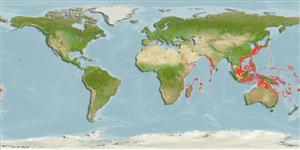
Indo-West Pacific: from Saya de Malha Bank; north to southern Japan, Taiwan, South China Sea to Coral Sea.
Size / Vikt / Age
Könsmognad: Lm ? range ? - ? cm
Max length : 16.0 cm SL hane/ej könsbestämd; (Ref. 48637)
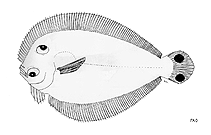
Mjukstrålar i ryggfenan (totalt) : 88 - 98; Mjukstrålar i analfenan: 60 - 77; Ryggkotor: 35 - 37. This species is distinguished by the following characters: gill rakers 0-6 + 13-18; anterior margin of head is anterior to both eyes with about 4-5 pale blotches margined by dark bands; compared to.body scales, the scales on front margin of head more strongly ctenoid and are non-deciduous (Ref. 126076).
Description. D 92 (88–98, from other localities), A 65 (60–77), pectoral-fin rays on ocular-side 12 (12–13), on blind-side 9 (10–12), caudal-fin rays 3 + 11 + 3 (3 + 11 + 3), ocular-side pelvic-fin rays 6 (6), blind-side pelvic-fin rays 6 (6), scales in lateral line 40 (39–50), gill rakers 0 + 13 (0–6 + 13–18), vertebrae 10 + 26 (10 + 25–27) (Ref. 126076).
Cross section: flattened.
Inhabits muddy substrates in shallow estuaries and still bays to about 30 meters depth. Active at night and usually burries itself in the sand during the day (Ref. 48637). Feeds on small benthic animals. Rarely caught by bottom trawls.
Life cycle and mating behavior
Könsmognad | Reproduktion | Lek | Ägg | Fecundity | Larver
Hensley, D.A. and K. Amaoka, 2001. Bothidae. Lefteye flounders. p. 3799-3841. In K.E. Carpenter and V. Niem (eds.) FAO species identification guide for fishery purposes. The living marine resources of the Western Central Pacific. Vol. 6. Bony fishes part 4 (Labridae to Latimeriidae), estuarine crocodiles. FAO, Rome. (Ref. 9824)
IUCN Red List Status (Ref. 130435: Version 2025-1)
Threat to humans
Harmless
Human uses
Verktyg
Special reports
Download XML
Internet-källor
Estimates based on models
Preferred temperature (Ref.
123201): 16 - 27.7, mean 23.7 °C (based on 402 cells).
Phylogenetic diversity index (Ref.
82804): PD
50 = 0.5000 [Uniqueness, from 0.5 = low to 2.0 = high].
Bayesian length-weight: a=0.00912 (0.00408 - 0.02036), b=3.04 (2.85 - 3.23), in cm total length, based on LWR estimates for this (Sub)family-body shape (Ref.
93245).
Trofisk nivå (Ref.
69278): 3.5 ±0.37 se; based on food items.
Resiliens (Ref.
120179): Mellan, lägsta populationsfördubblingstid 1,4-4,4 år (Preliminary K or Fecundity.).
Fishing Vulnerability (Ref.
59153): Low vulnerability (10 of 100).
🛈