Teleostei (teleosts) >
Pleuronectiformes (Flatfishes) >
Bothidae (Lefteye flounders)
Etymology: Crossorhombus: Greek krossoi = tassel + Greek, rhombos = paralelogram (Ref. 45335).
More on authors: Jordan & Starks.
Environment: milieu / climate zone / depth range / distribution range
Ecology
Marine; demersal; depth range 50 - 275 m (Ref. 9824). Temperate
Northwest Pacific: Japan, Formosa Strait, northern part of the South China Sea. Possibly occurring in the Western Central Pacific.
Size / Weight / Age
Maturity: Lm ? range ? - ? cm
Max length : 12.0 cm TL male/unsexed; (Ref. 9824)
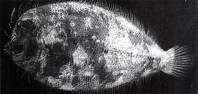
Dorsal spines (total): 0; Dorsal soft rays (total): 79 - 86; Anal spines: 0; Anal soft rays: 59 - 67. Tip of isthmus below middle of lower eye. Scales on ocular side ctenoid, armed with a row of hairlike spines. Caudal fin with 3 simple rays on upper and lower margins respectively. Pectoral fin elongated into a filament, longer than head. Caudal fin without a dark band. In male, body on blind side stained with dark-blue except for head, interorbital width broader and pectoral fin longer than in female.
Body shape (shape guide): short and / or deep; Cross section: compressed.
Lives on sand and shell bottoms and feeds on bottom-living animals. Sexually dimorphic characters develop at about 5 cm SL.
Life cycle and mating behavior
Maturity | Reproduction | Spawning | Eggs | Fecundity | Larvae
Hensley, D.A. and K. Amaoka, 2001. Bothidae. Lefteye flounders. p. 3799-3841. In K.E. Carpenter and V. Niem (eds.) FAO species identification guide for fishery purposes. The living marine resources of the Western Central Pacific. Vol. 6. Bony fishes part 4 (Labridae to Latimeriidae), estuarine crocodiles. FAO, Rome. (Ref. 9824)
IUCN Red List Status (Ref. 130435: Version 2025-2)
Threat to humans
Harmless
Human uses
Fisheries: of no interest
Tools
Special reports
Download XML
Internet sources