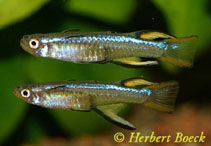
Pseudomugil cyanodorsalis, Blueback blue-eye : aquarium

You can sponsor this page

Pseudomugil cyanodorsalis Allen & Sarti, 1983

Blueback blue-eye
ارفع صور و مقاطع فيديو
صور | صور قوقل
Image of Pseudomugil cyanodorsalis (Blueback blue-eye)
Pseudomugil cyanodorsalis
صورة بواسطة Boeck, H.

التصنيف / Names الأسماء الشائعة | مرادفات | Catalog of Fishes(جنس, الانواع) | ITIS | CoL | WoRMS | Cloffa

> Atheriniformes (Silversides) > Pseudomugilidae (Blue eyes)
Etymology: Pseudomugil: Greek, pseudes = false + Latin, mugil, -is = grey mullet (Ref. 45335).

Issue
Placed under family Pseudomugilidae in Ref. 9837.

Environment: milieu / climate zone / نطاق العمق / distribution range البيئة

بحري; مياه مخلوطة pelagic-neritic. Tropical; 22°C - 31°C

التوزيع دول | مناطق الفاو | النظام البيئي | الظهور | نقطة علي الخريطة | مقدمة | Faunafri

Western Pacific: northern Australia, near Broome and between Darwin and Wyndham, Northern Territory.

الحجم / وزن / العمر

النضج: Lm ?  range ? - ? cm
Max length : 3.5 cm TL ذكر/ مختلط الجنس; (Ref. 9786)

وصف مختصر مفاتيح التعريف | الوصف الخارجي | قياسات المظهر الخارجي

الأشواك الظهرية (المجموع) : 3 - 5; الأشعة الظهرية الناعمة (المجموع) : 4 - 7; شوكة شرجية: 1; أشعه شرجية لينه: 9 - 13. Premaxilla wide, its ascending process short and lateral process absent. Vomer wide and slightly curved. Mesethmoid absent. Second dorsal fin with no spines and 4-7 soft rays. Pectoral fins with no spines. Midlateral scales 22-26. Elongated rays and base of second dorsal fin black.
Body shape (shape guide): elongated.

أحياء     المصطلحات (على سبيل المثال epibenthic)

Inhabits mangrove swamps and highly saline creeks flowing into estuaries, usually swimming over muddy bottom. Often congregate in large numbers. May be found in hypersaline waters (28-40 ppt) and in relatively high temperatures (22-31°C). Breeding has been achieved in aquaria; the eggs take about two weeks to hatch and young fish reach adulthood in only three months (Ref. 44894). A small but attractive species.

Life cycle and mating behavior النضج | التكاثر | وضع البيض | بيض | الخصوبة | Larvae

المرجع الرئيسي Upload your references | مراجع | المنظم | المتعاونين

Ivantsoff, W., 1999. Order Atheriniformes. Pseudomugilidae. Blue eyes. p. 2109-2112. In K.E. Carpenter and V.H. Niem (eds.) FAO species identification guide for fishery purposes. The living marine resources of the Western Central Pacific. Volume 4. Bony fishes part 2 (Mugilidae to Carangidae). FAO, Rome. (Ref. 9786)

IUCN Red List Status (Ref. 130435: Version 2025-1)


CITES

Not Evaluated

CMS (Ref. 116361)

Not Evaluated

خطر للأنسان

  Harmless


استخدامات بشرية

مصائد: غير ذات اهمية; حوض مائي: محتملة
FAO - Publication: search | FishSource |

مزيد من المعلومات

علم البيئة الغذائية
Food items (preys)
التركيبة الغذائية
استهلاك الأغذية
Food rations
مفتريسات
البيئة
البيئة
Home ranges
Population dynamics
معاملات النمو
Max. ages / sizes
Length-weight rel.
Length-length rel.
الطول- الترددات
Mass conversion
توظيف
الوفرة
Life cycle
التكاثر
النضج
Maturity/Gills rel.
الخصوبة
وضع البيض
Spawning aggregations
بيض
تطور البيضة
Larvae
حركة انتقال اليرقات
التوزيع
دول
مناطق الفاو
النظام البيئي
الظهور
مقدمة
BRUVS - Videos
Anatomy
منطقة الخياشيم
Brain
Otolith
Physiology
Body composition
Nutrients
استهلاك الأوكسجين
نوع السباحة
سرعة السباحة
Visual pigments
Fish sound
Diseases & Parasites
Toxicity (LC50s)
جيني
الوراثة
جيني
Heterozygosity
التوريث
Human related
Aquaculture systems
ملامح تربية الأحياء المائية
سلالات
Ciguatera cases
Stamps, coins, misc.
مراجع
مراجع

أدوات

تقارير خاصة

Download XML

مصادر علي الأنترنت

AFORO (otoliths) | Aquatic Commons | BHL | Cloffa | Websites from users | البحث في مراقبي الأسماك | CISTI | Catalog of Fishes: جنس, الانواع | DiscoverLife | ECOTOX | FAO - Publication: search | Faunafri | Fishipedia | Fishtrace | GloBI | Google Books | Google Scholar | Google | IGFA World Record | OneZoom | Open Tree of Life | Otolith Atlas of Taiwan Fishes | PubMed | Reef Life Survey | Socotra Atlas | TreeBase | شجرة الحياة | Wikipedia: ذهب, بحث | Zoobank | سجلات علم الحيوانات

Estimates based on models

Phylogenetic diversity index (مرجع 82804):  PD50 = 0.5000   [Uniqueness, from 0.5 = low to 2.0 = high].
Bayesian length-weight: a=0.00389 (0.00180 - 0.00842), b=3.12 (2.94 - 3.30), in cm total length, based on all LWR estimates for this body shape (Ref. 93245).
مستوى غذائي (مرجع 69278):  3.2   ±0.4 se; based on size and trophs of closest relatives
Fishing Vulnerability (Ref. 59153):  Low vulnerability (10 of 100). 🛈