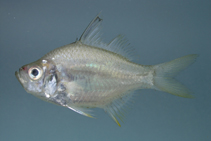
>
Ovalentaria/misc (Various families in series Ovalentaria) >
Ambassidae (Asiatic glassfishes)
Etymology: Ambassis: Derived from Greek, anabasis = climbing up (Ref. 45335).
More on author: Hamilton.
Environment: milieu / climate zone / rango de profundidad / distribution range
Ecología
marino; agua dulce; salobre demersal; anfidromo (Ref. 51243). Tropical
Asia and Oceania: India to New Guinea and Australia (Ref. 40509).
Tamaño / Peso / Age
Madurez: Lm ? range ? - ? cm
Max length : 12.5 cm TL macho / no sexado; (Ref. 7050)
Usually found in brackish waters of bays and estuaries, entering freshwater and mangrove-lined tidal creeks (Ref. 4833).
Life cycle and mating behavior
Madurez | Reproducción | Puesta | Huevos | Fecundidad | Larva
Paxton, J.R., D.F. Hoese, G.R. Allen and J.E. Hanley, 1989. Pisces. Petromyzontidae to Carangidae. Zoological Catalogue of Australia, Vol. 7. Australian Government Publishing Service, Canberra, 665 p. (Ref. 7300)
IUCN Red List Status (Ref. 130435: Version 2025-1)
Threat to humans
Harmless
Human uses
Herramientas
Special reports
Download XML
Fuentes de Internet
Estimates based on models
Preferred temperature (Referencia
123201): 26.4 - 29, mean 28 °C (based on 550 cells).
Phylogenetic diversity index (Referencia
82804): PD
50 = 0.5000 [Uniqueness, from 0.5 = low to 2.0 = high].
Bayesian length-weight: a=0.01202 (0.00496 - 0.02912), b=3.02 (2.83 - 3.21), in cm total length, based on LWR estimates for this Genus-body shape (Ref.
93245).
Nivel trófico (Referencia
69278): 3.4 ±0.4 se; based on size and trophs of closest relatives
Resiliencia (Referencia
120179): Alto, población duplicada en un tiempo mínimo inferior a 15 meses (Assuming Fec > 10,000).
Fishing Vulnerability (Ref.
59153): Low vulnerability (10 of 100).
🛈