



Sardinella melanura (Cuvier, 1829)
Blacktip sardinella
Adicionar sua observação em Fish Watcher
| Native range | All suitable habitat | Point map | Year 2050 |

|
| This map was computer-generated and has not yet been reviewed. |
| Sardinella melanura AquaMaps Data sources: GBIF OBIS |
Carregue seu(sua) Fotos e vídeos
Fotos | Imagem do Google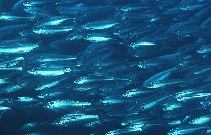 Sardinella melanura
Foto de Randall, J.E.
Fotos | Imagem do Google
Foto de Randall, J.E.
Classificação / Nomes Nomes comuns | Sinônimos | Catalog of Fishes(Gênero, Espécies) | ITIS | CoL | WoRMS | Cloffa
> Clupeiformes (Herrings) > Dorosomatidae (Gizzard shads and sardinellas)
Etymology: Sardinella: Latin and Greek, sarda = sardine; name related to the island of Sardinia; diminutive (Ref. 45335).
More on author: Cuvier.
Etymology: Sardinella: Latin and Greek, sarda = sardine; name related to the island of Sardinia; diminutive (Ref. 45335).
More on author: Cuvier.
Meio ambiente: milieu / Zona climática / intervalo de profundidade / faixa de distribuição Ecologia
marinhas pelagic-neritic; anfídromo (Ref. 51243); intervalo de profundidade 0 - 50 m (Ref. 188). Tropical; 37°N - 27°S, 33°E - 149°W
Distribuição Territórios | Áreas da FAO | Ecossistemas | Ocorrências | Mapa de pontos | Introduções | Faunafri
Indo-West Pacific: Gulf of Aden south to Inhaca Island, Mozambique and Madagascar and east to the Arabian Sea and northwestern India (apparently not found south of Bombay nor in northern Bay of Bengal), north to Ibaraki Prefecture Japan; then from Indonesia (but not in South China Sea) to Tahiti.
Tamanho / Peso / Idade
Maturidade: Lm ? range ? - ? cm
Max length : 20.3 cm SL macho/indeterminado; (Ref. 3605); common length : 10.0 cm SL macho/indeterminado; (Ref. 188)
Max length : 20.3 cm SL macho/indeterminado; (Ref. 3605); common length : 10.0 cm SL macho/indeterminado; (Ref. 188)
Descrição suscinta Chaves de identificação | Morfologia | Morfometria
Espinhos dorsais (total) : 0; Raios dorsais (total) : 13 - 21; Espinhos anais: 0; Raios anais : 12 - 23. Body depth usually not much more than 30% of standard length; scutes 27 to 31. The jet black caudal tips distinguish S. melanura from all other species of Sardinella except S. atricauda (scutes 32 to 35), S. hualiensis (dark spot at dorsal fin origin, scales fimbriated and with small perforations) and S. fijiense (gill rakers 87 to 134).
Body shape (shape guide): fusiform / normal; Cross section: compressed.
Body shape (shape guide): fusiform / normal; Cross section: compressed.
Form schools in coastal waters (Ref. 188, 75154). Regarded a robust and very good bait in the tuna fishery.
Ciclo de vida ou comportamento de acasalamento Maturidade | Reprodução | Desova | Ovos | Fecundidade | Larvas
Referência principal
Carregar suas referências | Referências | Coordenador | Colaboradores
Whitehead, P.J.P., 1985. FAO Species Catalogue. Vol. 7. Clupeoid fishes of the world (suborder Clupeoidei). An annotated and illustrated catalogue of the herrings, sardines, pilchards, sprats, shads, anchovies and wolf-herrings. FAO Fish. Synop. 125(7/1):1-303. Rome: FAO. (Ref. 188)
Status na Lista Vermelha da UICN (Ref. 130435: Version 2025-2 (Global))
Segura ou pouco preocupante (LC) ; Date assessed: 28 February 2017
CITES
Not Evaluated
Ameaça para os humanos
Harmless
Uso pelos humanos
Pescarias: pouco comercial; isca: usually
FAO - Publication: search | FishSource |
Mais informação
Ecologia Trófica
Itens alimentares (presas)
Composição da dieta
Consumo alimentar
Rações alimentares
Predadores
Itens alimentares (presas)
Composição da dieta
Consumo alimentar
Rações alimentares
Predadores
Dinâmica populacional
Parâmetros de crescimento
Idade máxima / tamanhos
Relação comprimento-peso.
Relação comprimento-comprimento.
Frequências de comprimento
Conversão de massa
Recrutamento
Abundância
Parâmetros de crescimento
Idade máxima / tamanhos
Relação comprimento-peso.
Relação comprimento-comprimento.
Frequências de comprimento
Conversão de massa
Recrutamento
Abundância
Ciclo de vida
Reprodução
Maturidade
Maturidade/Rel. das guelras
Fecundidade
Desova
Agregações de desova
Ovos
Desenvolvimento dos ovos
Larvas
Dinâmica larval
Reprodução
Maturidade
Maturidade/Rel. das guelras
Fecundidade
Desova
Agregações de desova
Ovos
Desenvolvimento dos ovos
Larvas
Dinâmica larval
Fisiologia
Composição corporal
Nutrientes
Consumo de oxigênio
Tipo de natação
Velocidade de natação
Pigmentos visuais
Som de peixe
Doenças e Parasitas
Toxicidade (LC50s)
Composição corporal
Nutrientes
Consumo de oxigênio
Tipo de natação
Velocidade de natação
Pigmentos visuais
Som de peixe
Doenças e Parasitas
Toxicidade (LC50s)
Relacionado a humanos
Sistemas de aquicultura
Perfis para aquacultura
Estirpes
Casos de Ciguatera
Selos, moedas, diversos.
Sistemas de aquicultura
Perfis para aquacultura
Estirpes
Casos de Ciguatera
Selos, moedas, diversos.
Ferramentas
Livro eletrônico | Guia de campo | Chaves de identificação | Ferramenta auxiliar de frequências de comprimento | Ferramenta sobre a história de vida | Mapa de pontos |
Catch-MSY |
Relatórios especiais
Checar Manutenção em Aquário | Checar Planilhas de Fatos sobre as Espécies | Checar Planilhas de Fatos sobre Aquicultura
Baixar XML
Fontes da internet
AFORO (otoliths) | Aquatic Commons | BHL | Cloffa | Websites from users | Checar Observador de Peixes (FishWatcher) | CISTI | Catalog of Fishes: Gênero, Espécies | DiscoverLife | ECOTOX | FAO - Publication: search | Faunafri | Fishipedia | Fishtrace | GloBI | Google Books | Google Scholar | Google | IGFA World Record | Bases de dados nacionais | OneZoom | Open Tree of Life | Otolith Atlas of Taiwan Fishes | PubMed | Reef Life Survey | Socotra Atlas | TreeBase | Árvore da vida | Wikipedia: Ir para, procura | World Records Freshwater Fishing | Registro zoológico
Estimativas baseadas em modelos
Temperatura preferida (Ref. 123201): 25.2 - 29.1, mean 28.2 °C (based on 1254 cells).
Índice de diversidade filogenética (Ref. 82804): PD50 = 0.5000 [Uniqueness, from 0.5 = low to 2.0 = high].
Bayesian length-weight: a=0.00851 (0.00713 - 0.01016), b=3.05 (3.02 - 3.08), in cm total length, based on LWR estimates for this species (Ref. 93245).
Generation time: 1.6 ( na - na) years. Estimated as median ln(3)/K based on 2 growth studies.
Resiliência (Ref. 120179): Elevada, tempo mínimo de duplicação da população menor que 15 meses (tmax=4; k >0.7).
Nutrientes (Ref. 124155): Calcium = 252 [133, 380] mg/100g; Iron = 1.82 [1.07, 3.32] mg/100g; Protein = 20.5 [19.6, 21.5] %; Omega3 = 0.293 [0.141, 0.586] g/100g; Selenium = 85.8 [44.9, 169.5] μg/100g; VitaminA = 32 [10, 96] μg/100g; Zinc = 1.17 [0.84, 1.62] mg/100g (wet weight);