



Epinephelus guttatus (Linnaeus, 1758)
Red hind
Hochladen Photos und videos
Bilder | videos | Laute | Briefmarken, Münzen, Verschiedenes. | Google Bild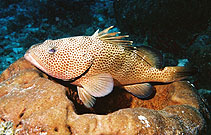 Epinephelus guttatus
Photo von Bryan, D.
Bilder | videos | Laute | Briefmarken, Münzen, Verschiedenes. | Google Bild
Photo von Bryan, D.
Klassifizierung / Names Namen | Synonyme | Catalog of Fishes(Gattung, Arten) | ITIS | CoL | WoRMS | Cloffa
> Perciformes/Serranoidei (Groupers) > Epinephelidae (Groupers)
Etymology: Epinephelus: Greek, epinephelos = cloudy (Ref. 45335).
More on author: Linnaeus.
Etymology: Epinephelus: Greek, epinephelos = cloudy (Ref. 45335).
More on author: Linnaeus.
Umwelt: Milieu / Klimazone / Tiefenbereich / Verbreitungsgebiet Ökologie
seewasser riff-verbunden; ozeanodrom (Ref. 51243); tiefenbereich 1 - 100 m (Ref. 89707). Tropical; 36°N - 8°N, 98°W - 58°W (Ref. 5222)
Verbreitung Territorien | FAO Gebiete | Ökosysteme | Vorkommen | Punkt Karte | Einführungen | Faunafri
Western Atlantic: North Carolina, USA to Paraíba, Brazil (Ref. 57756). The most common species of Epinephelus in the West Indies.
Länge bei der ersten Reifung / Größe / Gewicht / Alter
Geschlechtsreife: Lm 25.0 range ? - ? cm
Max length : 76.0 cm TL Männchen/unbestimmt; (Ref. 5222); common length : 40.0 cm TL Männchen/unbestimmt; (Ref. 5217); max. veröff. Gewicht: 25.0 kg (Ref. 5217); max. veröff. Alter: 22 Jahre (Ref. 31471)
Max length : 76.0 cm TL Männchen/unbestimmt; (Ref. 5222); common length : 40.0 cm TL Männchen/unbestimmt; (Ref. 5217); max. veröff. Gewicht: 25.0 kg (Ref. 5217); max. veröff. Alter: 22 Jahre (Ref. 31471)
Kurzbeschreibung Bestimmungsschlüssel | Morphologie | Morphometrie
Rückenflossenstacheln (insgesamt) : 11; Rückenflossenweichstrahlen (insgesamt) : 15 - 16; Afterflossenstacheln: 3; Afterflossenweichstrahlen: 8. Scales cycloid except for a ctenoid patch of variable size in the pectoral region. Greenish gray to light brown on the back grading to white ventrally, with numerous well-spaced dull orange-red to brown spots on the head, body and fins. Five faint diagonal bars formed by darker spots on the sides. No saddle-shaped blotch on caudal peduncle or along base of dorsal fin (Ref. 26938); further characterized by having body depth contained 2.7-3.1 times in standard length; head length 2.3-2.4 times in standard length; evenly serrate preopercle, without salient angle; posterior nostril larger than anterior nostril (Ref. 89707).
Body shape (shape guide): fusiform / normal; Cross section: oval.
Body shape (shape guide): fusiform / normal; Cross section: oval.
Found in shallow reefs and rocky bottoms, occurring down to depths of at least 100 meters (Ref. 89707). Usually solitary and territorial. Feed mainly on crabs (Calapa and Mithrax) and other crustaceans (alpheid shrimps and scyllarid lobsters), fishes (labrids and haemulids), and octopus. Some undergo sexual inversion at 28 cm TL; most fish larger than 40 cm are males. Important in terms of numbers caught and total weight of landings in the Caribbean.
Easily approached by divers (Ref. 9710). Hermaphrodite species. Excellent food fish (Ref. 26938). Readily caught on hook and line and easily speared (Ref. 13442).
Lebenszyklus und Paarungsverhalten Geschlechtsreife | Fortpflanzung | Ablaichen | Eier | Fruchtbarkeit | Larven
Females rest on or close to the bottom, while males patrol around an area that consists of 1 to 5 females and defend this territory from other males. Form aggregation and reproduce almost exclusively within the aggregation period (Ref. 8557).
Hauptreferenz
Laden Sie Ihre Referenzen hoch | Referenzen | Koordinator | Partner
Heemstra, P.C. and J.E. Randall, 1993. FAO Species Catalogue. Vol. 16. Groupers of the world (family Serranidae, subfamily Epinephelinae). An annotated and illustrated catalogue of the grouper, rockcod, hind, coral grouper and lyretail species known to date. Rome: FAO. FAO Fish. Synop. 125(16):382 p. (Ref. 5222)
IUCN Rote Liste Status (Ref. 130435: Version 2025-2 (Global))
nicht bedroht (LC) ; Date assessed: 22 November 2016
CITES
Not Evaluated
Bedrohung für Menschen
Reports of ciguatera poisoning (Ref. 31172)
Nutzung durch Menschen
Fischereien: hoch kommerziell; Sportfisch: ja
FAO - Fischereien: landungen; Publication: search | FishSource | Das Meer um uns herum
Mehr Information
Trophische Ökologie
Lebensmittel (Beutetiere)
Nahrungszusammensetzung
Nahrungsaufnahme
Lebensmittelrationen
Räuber
Lebensmittel (Beutetiere)
Nahrungszusammensetzung
Nahrungsaufnahme
Lebensmittelrationen
Räuber
Populationsdynamik
Wachstumsparameter
Max. Alter/Größen
Länge-Gewicht-Rel.
Länge-Länge-Verhältnis.
Längenhäufigkeiten
Massenkonvertierung
Rekrutierung
Dichte
Wachstumsparameter
Max. Alter/Größen
Länge-Gewicht-Rel.
Länge-Länge-Verhältnis.
Längenhäufigkeiten
Massenkonvertierung
Rekrutierung
Dichte
Lebenszyklus
Fortpflanzung
Geschlechtsreife
Reifung/Kiemen rel.
Fruchtbarkeit
Ablaichen
Laichaggregationen
Eier
Eientwicklung
Larven
Larven Pop.Dyn.
Fortpflanzung
Geschlechtsreife
Reifung/Kiemen rel.
Fruchtbarkeit
Ablaichen
Laichaggregationen
Eier
Eientwicklung
Larven
Larven Pop.Dyn.
Anatomie
Kiemenoberfläche
Gehirn
Otolith
Kiemenoberfläche
Gehirn
Otolith
Physiologie
Körperliche Zusammensetzung
Nährstoffe
Sauerstoffverbrauch
Schwimmart
Schwimmgeschwindigkeit
Visuelle Pigmente
Fischgeräusche
Krankheiten und Parasiten
Toxizität (LC50s)
Körperliche Zusammensetzung
Nährstoffe
Sauerstoffverbrauch
Schwimmart
Schwimmgeschwindigkeit
Visuelle Pigmente
Fischgeräusche
Krankheiten und Parasiten
Toxizität (LC50s)
Menschenbezogen
Aquakultur-Systeme
Aquakultur Profile
Zuchtlinien
Ciguatera-Fälle
Briefmarken, Münzen, Verschiedenes.
Aquakultur-Systeme
Aquakultur Profile
Zuchtlinien
Ciguatera-Fälle
Briefmarken, Münzen, Verschiedenes.
Tools
Bio-Quiz | E-Book | Feldführer | Bestimmungsschlüssel | Längenhäufigkeits Tool | Lebensdaten Tool | Punkt Karte |
Catch-MSY |
Zusatzinformationen
Download XML
Zusammenfassung | Punktdaten | Namen | Photos
Internet Quellen
AFORO (otoliths) | Alien/Invasive Species database | Aquatic Commons | BHL | Cloffa | Websites from users | FishWatcher Einträge suchen | CISTI | Catalog of Fishes: Gattung, Arten | DiscoverLife | ECOTOX | FAO - Fischereien: landungen; Publication: search | Faunafri | Fishipedia | Fishtrace | GloBI | GoMexSI (interaction data) | Google Books | Google Scholar | Google | IGFA World Record | Nationale Datenbanken | OneZoom | Open Tree of Life | Otolith Atlas of Taiwan Fishes | Öffentliche Aquarien | PubMed | Reef Life Survey | Socotra Atlas | TreeBase | Tree of Life | Wikipedia: Gehe zu, Suchen | World Records Freshwater Fishing | Zoologischer Rekord
Schätzungen auf der Grundlage von Modellen
Phylogenetischer Diversitätsindex (Ref. 82804): PD50 = 0.5000 [Uniqueness, from 0.5 = low to 2.0 = high].
Bayesian length-weight: a=0.01148 (0.01017 - 0.01296), b=3.04 (3.02 - 3.06), in cm total length, based on LWR estimates for this species (Ref. 93245).
Trophische Ebene (Ref. 69278): 3.8 ±0.3 se; based on diet studies.
Widerstandsfähigkeit (Ref. 120179): mittel, Verdopplung der Population dauert 1,4 - 4,4 Jahre. (K=0.12-0.24; tm=3; tmax=17; Fec=96,000).
Prior r = 0.43, 95% CL = 0.28 - 0.64, Based on 2 data-limited stock assessments.
Nährstoffe (Ref. 124155): Calcium = 21 [10, 46] mg/100g; Iron = 0.452 [0.243, 0.903] mg/100g; Protein = 18.5 [17.0, 19.9] %; Omega3 = 0.126 [0.078, 0.201] g/100g; Selenium = 47.2 [27.8, 83.6] μg/100g; VitaminA = 141 [40, 485] μg/100g; Zinc = 1.15 [0.81, 1.60] mg/100g (wet weight);