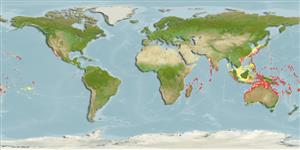
Environment: milieu / Zona climática / intervalo de profundidade / distribution range
Ecologia
marinhas associadas(os) a recifes; intervalo de profundidade 0 - 82 m (Ref. 57178), usually 0 - 15 m (Ref. 90102). Tropical
Indo-Pacific: from East Africa and the Red Sea to French Polynesia; north to Japan and south to Australia.
Tamanho / Peso / Idade
Maturidade: Lm ? range ? - ? cm
Max length : 3.5 cm SL macho/indeterminado; (Ref. 37816)
Espinhos dorsais (total) : 9; Raios dorsais (total) : 9; Espinhos anais: 2; Raios anais : 8; Vértebras: 24. This species is distinguished by the following characters: usually 8-12 pored lateral-line scales and 13-15 gill rakers and rudiments; body scales margins uniform to pale edging; body mottled brownish with 5 darker irregular bars, the first anterior to origin of first dorsal fin, the second bar from posterior half of first dorsal fin through posterior half of pelvic fin, the third narrow bar between soft dorsal and soft anal fins, the fourth on caudal peduncle, and the fifth at base of caudal fin; axil of pectoral fin with a whitish spot; 3 whitish basicaudal spots partially in darkish basicaudal bar; whitish spot behind posterior base of soft dorsal fin; second dorsal fin, anal fin and caudal fin pale with darkish banding (Ref. 93673).
Body shape (shape guide): short and / or deep; Cross section: oval.
Nocturnal species; occurs inshore (Ref. 7300). Enters estuaries and quiet coastal bays, usually on mud or silty substrate with algae-rock outcrops or isolated soft corals (Ref. 48635). Solitary or in small groups (Ref 90102).
Ciclo de vida ou comportamento de acasalamento
Maturidade | Reprodução | Desova | Ovos | Fecundidade | Larvas
Are mouthbrooders (Ref. 240). Distinct pairing during courtship and spawning (Ref. 205).
Fraser, T.H. and J.E. Randall, 2011. Two new species of Foa (Apogonidae) from the Pacific Plate, with redescriptions of Foa brachygramma and Foa fo. Zootaxa 2988:1-27. (Ref. 93673)
Status na Lista Vermelha da UICN (Ref. 130435: Version 2025-1)
Ameaça para os humanos
Harmless
Uso pelos humanos
Ferramentas
Relatórios especiais
Baixar XML
Fontes da internet
Estimates based on models
Preferred temperature (Ref.
123201): 24.2 - 29.2, mean 28 °C (based on 2296 cells).
Índice de diversidade filogenética (Ref.
82804): PD
50 = 0.5039 [Uniqueness, from 0.5 = low to 2.0 = high].
Bayesian length-weight: a=0.01445 (0.00680 - 0.03071), b=3.07 (2.89 - 3.25), in cm total length, based on LWR estimates for this (Sub)family-body shape (Ref.
93245).
Nível Trófico (Ref.
69278): 3.2 ±0.4 se; based on size and trophs of closest relatives
Resiliência (Ref.
120179): Elevada, tempo mínimo de duplicação da população menor que 15 meses (Preliminary K or Fecundity.).
Fishing Vulnerability (Ref.
59153): Low vulnerability (10 of 100).
🛈
Nutrients (Ref.
124155): Calcium = 347 [134, 967] mg/100g; Iron = 1.91 [0.85, 4.38] mg/100g; Protein = 18.3 [16.6, 19.9] %; Omega3 = 0.15 [0.05, 0.49] g/100g; Selenium = 60.5 [16.7, 192.3] μg/100g; VitaminA = 40.1 [7.0, 242.5] μg/100g; Zinc = 3.52 [1.80, 6.38] mg/100g (wet weight);