



Adicionar as suas observações no Fish Watcher
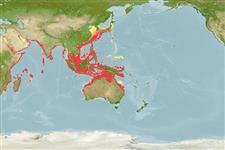
| Native range | All suitable habitat | Point map | Year 2050 |
|
| This map was computer-generated and has not yet been reviewed. |
| Thunnus tonggol AquaMaps Data sources: GBIF OBIS |
Adicionar o seu Fotografias e vídeos
Fotografias | Imagem do Google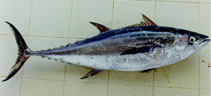 Thunnus tonggol
Fotografia de Hermosa, Jr., G.V.
Fotografias | Imagem do Google
Fotografia de Hermosa, Jr., G.V.
Classificação / Nomes Nomes comuns | Sinónimos | Catalog of Fishes(Género, Espécies) | ITIS | CoL | WoRMS | Cloffa
> Scombriformes (Mackerels) > Scombridae (Mackerels, tunas, bonitos) > Scombrinae
Etymology: Thunnus: Greek, thynnos = tunna (Ref. 45335).
More on author: Bleeker.
Etymology: Thunnus: Greek, thynnos = tunna (Ref. 45335).
More on author: Bleeker.
Ambiente: milieu / zona climática / intervalo de profundidade / gama de distribuição Ecologia
marinhas pelagic-neritic; oceanódromo (Ref. 51243); intervalo de profundidade 10 - ? m. Tropical; 47°N - 31°S, 34°E - 154°E (Ref. 54923)
Distribuição Territórios | Áreas FAO | Ecossistemas | Ocorrências | Mapa dos pontos | Introduções | Faunafri
Indo-West Pacific: Red Sea and East Africa to New Guinea, north to Japan, south to Australia. Reported in New Zealand (Ref. 89192).
Comprimento na primeira maturidade / Tamanho / Peso / Idade
Maturidade: Lm 60.7 range ? - ? cm
Max length : 145 cm FL macho/indeterminado; (Ref. 40637); common length : 70.0 cm FL macho/indeterminado; (Ref. 168); peso máx. Publicado: 35.9 kg (Ref. 168); Idade máx. registada: 19 anos (Ref. 97108)
Max length : 145 cm FL macho/indeterminado; (Ref. 40637); common length : 70.0 cm FL macho/indeterminado; (Ref. 168); peso máx. Publicado: 35.9 kg (Ref. 168); Idade máx. registada: 19 anos (Ref. 97108)
Descrição breve Chaves de identificação | Morfologia | Morfometria
Vértebras: 39. A small species, deepest near the middle of the first dorsal fin base. The second dorsal fin is higher than the first dorsal fin; the pectoral fins are short to moderately long; swim bladder is absent or rudimentary. Lower sides and belly silvery white with colorless elongate oval spots arranged in horizontally oriented rows. The dorsal, pectoral and pelvic fins are blackish; the tip of the second dorsal and anal fins are washed with yellow; the anal fin is silvery; the dorsal and anal finlets are yellow with grayish margins; the caudal fin is blackish, with streaks of yellow green.
Body shape (shape guide): fusiform / normal; Cross section: oval.
Body shape (shape guide): fusiform / normal; Cross section: oval.
Predominantly neritic species avoiding very turbid waters and areas with reduced salinity such as estuaries. May form schools of varying size. Feeds on a variety of fishes, cephalopods, and crustaceans, particularly stomatopod larvae and prawns (Ref. 9684). Marketed mainly fresh and dried salted (Ref. 9684), but also smoked, canned and frozen (Ref. 9987).
Ciclo de vida e comportamento de acasalamento Maturidade | Reprodução | Desova | Ovos | Fecundidade | Larvas
Referência principal
Carregar as suas referências | Referências | Coordenador : Collette, Bruce B. | Colaboradores
Collette, B.B. and C.E. Nauen, 1983. FAO Species Catalogue. Vol. 2. Scombrids of the world. An annotated and illustrated catalogue of tunas, mackerels, bonitos and related species known to date. Rome: FAO. FAO Fish. Synop. 125(2):137 p. (Ref. 168)
Categoria na Lista Vermelha da IUCN (Ref. 130435: Version 2025-2 (Global))
Dados insuficientes (DD) ; Date assessed: 01 July 2021
CITES
Not Evaluated
Ameaça para o homem
Harmless
Utilização humana
Pescarias: altamente comercial; peixe desportivo: sim
FAO - pescarias: desembarques, perfil da espécie; Publication: search | FIRMS - Stock assessments | FishSource | Sea Around Us
Mais informação
Ecologia Trófica
Produtos alimentares (presas)
Composição da dieta
Consumo alimentar
Rações alimentares
Predadores
Produtos alimentares (presas)
Composição da dieta
Consumo alimentar
Rações alimentares
Predadores
Dinâmica das populações
Parâmetros de crescimento
Idades / tamanhos máximos
Comprimento-peso rel.
Comprimento-comprimento rel.
Frequência de comprimento
Conversão de massa
Recrutamento
Abundância
Parâmetros de crescimento
Idades / tamanhos máximos
Comprimento-peso rel.
Comprimento-comprimento rel.
Frequência de comprimento
Conversão de massa
Recrutamento
Abundância
Ciclo de vida
Reprodução
Maturidade
Maturidade/Rel. das guelras
Fecundidade
Desova
Agregações de desova
Ovos
Desenvolvimento dos ovos
Larvas
Dinâmica larvar
Reprodução
Maturidade
Maturidade/Rel. das guelras
Fecundidade
Desova
Agregações de desova
Ovos
Desenvolvimento dos ovos
Larvas
Dinâmica larvar
Anatomia
Área branquial
Cérebro
Otólitos
Área branquial
Cérebro
Otólitos
Fisiologia
Composição corporal
Nutrientes
Consumo de oxigénio
Tipo de natação
Velocidade de natação
Pigmentos visuais
Som de peixe
Doenças e Parasitas
Toxicidade (LC50s)
Composição corporal
Nutrientes
Consumo de oxigénio
Tipo de natação
Velocidade de natação
Pigmentos visuais
Som de peixe
Doenças e Parasitas
Toxicidade (LC50s)
Relacionado com o ser humano
Sistemas de aquacultura
Perfis para aquacultura
Estirpes
Casos de Ciguatera
Selos, moedas, diversos.
Sistemas de aquacultura
Perfis para aquacultura
Estirpes
Casos de Ciguatera
Selos, moedas, diversos.
Ferramentas
E-book | Guia de campo | Chaves de identificação | Ferramenta auxiliar de frequências de comprimento | Ferramenta sobre a história de vida | Mapa dos pontos |
Captura-MSY |
Relatórios especiais
Descarregue XML
Fontes da internet
AFORO (otoliths) | Aquatic Commons | BHL | Cloffa | Websites from users | Consultar FishWatcher | CISTI | Catalog of Fishes: Género, Espécies | DiscoverLife | ECOTOX | FAO - pescarias: desembarques, perfil da espécie; Publication: search | Faunafri | Fishipedia | Fishtrace | GloBI | Google Books | Google Scholar | Google | IGFA World Record | Bases de dados nacionais | OneZoom | Open Tree of Life | Otolith Atlas of Taiwan Fishes | PubMed | Reef Life Survey | Socotra Atlas | TreeBase | Árvore da vida | Wikipedia: ir para, procurar | World Records Freshwater Fishing | Registo zoológico
Estimativas baseadas em modelos
Temperatura preferida (Ref. 123201): 13 - 28.4, mean 26.5 °C (based on 1398 cells).
Índice de diversidade filogenética (Ref. 82804): PD50 = 0.5039 [Uniqueness, from 0.5 = low to 2.0 = high].
Bayesian length-weight: a=0.01413 (0.00818 - 0.02439), b=3.00 (2.86 - 3.14), in cm total length, based on LWR estimates for this species & Genus-body shape (Ref. 93245).
Nível Trófico (Ref. 69278): 4.5 ±0.6 se; based on diet studies.
Resiliência (Ref. 120179): Médio, tempo mínimo de duplicação da população 1,4 - 4,4 anos (K=0.36; assumed tm>2; tmax=19).
Prior r = 0.79, 95% CL = 0.52 - 1.18, Based on 2 full stock assessments.
Nutrientes (Ref. 124155): Calcium = 48.2 [25.8, 117.5] mg/100g; Iron = 3.01 [1.19, 7.29] mg/100g; Protein = 23.2 [21.8, 24.6] %; Omega3 = 0.316 [0.191, 0.535] g/100g; Selenium = 101 [27, 327] μg/100g; VitaminA = 44 [6, 332] μg/100g; Zinc = 0.489 [0.265, 0.931] mg/100g (wet weight);