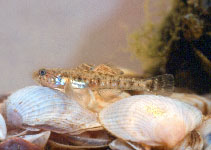
>
Gobiiformes (Gobies) >
Gobiidae (Gobies) > Gobionellinae
Etymology: Knipowitschia: Because of N.M.Knipowitsch, a zoologist and Russian ichthyologist from the Academy of Sciences. Expeditions in "Pomor" and "Pervosvanniy" ships to Azov and Black sea (1898-1908).
Eponymy: Nikolai Mikhailovich Knipovich (also given as Knipowitsch) (1862–1939) was a Russian oceanographer, marine zoologist and ichthyologist. [...] (Ref. 128868), visit book page.
More on author: Berg.
Issue
Kavraiskii 1916 is a nomen nudum (M. Kottelat, pers. comm.)
Environment: milieu / climate zone / kisaran kedalaman / distribution range
Ekologi
laut; air tawar; payau dasar (demersal); amphidromus (Ref. 46888); kisaran kedalaman 0 - 2 m (Ref. 12215). Temperate; 47°N - 38°N, 12°E - 61°E
Eurasia: along the coasts of Black, Azov, Caspian and Aegean seas west to Aliakmon drainage (Greece). Identity of the population along the eastern shore of Adriatic is questionable. Introduced in the Aral Sea and is now extirpated.
Length at first maturity / Size / Weight / umur
Kematangan: Lm 2.2, range 2 - 2.3 cm
Max length : 5.0 cm TL jantan/; (Ref. 4696); Umur maksimum dilaporkan: 2.00 Tahun (Ref. 126411)
deskripsi pendek
Kunci identifiaksi (pengenalan) | Morfologi | Morfometrik
Duri punggung (Keseluruhan (total)) : 7; duri punggung lunak (Keseluruhan (total)) : 7 - 8; Duri dubur: 1; Sirip dubur lunak: 7 - 9; vertebrata, bertulang belakang: 31 - 32. Anterior oculoscapular, preopercular, and sometimes posterior oculoscapular, canals present; body squamation complete on caudal peduncle and along at least lateral midline to axil. Males with 4-5 major vertical bars.
Body shape (shape guide): elongated.
Inhabit fresh to hyper-saline waters (to 55 ppt) of lakes, estuaries and lagoons, in shallow areas with much weed. Feed on small crustaceans and chironomid larvae (Ref.12215); larvae of the mussel Dreissena polymorpha (Ref. 59043). Lives less than 2 years. Spawns after first winter. Eggs are attached to the roof of a cavity under stones, plant material or shells and are defended by male. Postlarvae are pelagic. (Ref.59043).
Spawns up to 4 portions of eggs (Ref. 59043).
Miller, P.J., 1986. Gobiidae. p. 1019-1085. In P.J.P. Whitehead, M.-L. Bauchot, J.-C. Hureau, J. Nielsen and E. Tortonese (eds.) Fishes of the North-eastern Atlantic and the Mediterranean. Volume 3. UNESCO, Paris. (Ref. 4696)
Status IUCN Red List (Ref. 130435: Version 2025-1)
ancaman kepada manusia
Harmless
penggunaan manusia
Alat, peralatan
laporan khas
muat turun XML
Sumber internet
Estimates based on models
Preferred temperature (Acuan
123201): 14.4 - 18.7, mean 17.6 °C (based on 188 cells).
Phylogenetic diversity index (Acuan
82804): PD
50 = 0.5000 [Uniqueness, from 0.5 = low to 2.0 = high].
Bayesian length-weight: a=0.00724 (0.00616 - 0.00851), b=3.04 (3.00 - 3.08), in cm total length, based on LWR estimates for this species (Ref.
93245).
Trophic level (Acuan
69278): 3.3 ±0.45 se; based on food items.
Generation time: 0.7 ( na - na) years. Estimated as median ln(3)/K based on 1
growth studies.
Daya lenting (Acuan
120179): Tinggi, Waktu penggandaan populasi minimum kurang dari 15 bulan (Preliminary K or Fecundity.).
Fishing Vulnerability (Ref.
59153): Low vulnerability (10 of 100).
🛈