>
Tetraodontiformes (Puffers and filefishes) >
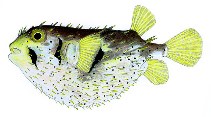
Diodontidae (Porcupinefishes (burrfishes))
Etymology: Dicotylichthys: Greek, di = two + Greek, kotyle = cup + Greek, ichthys = fish.
More on author: Kaup.
Environment: milieu / climate zone / Tiefenbereich / distribution range
Ökologie
seewasser; brackwasser riff-verbunden; tiefenbereich ? - 50 m (Ref. 9680). Subtropical; 27°S - 40°S
Western Pacific: Moreton Bay to Bass Strait in Australia.
Size / Gewicht / Alter
Geschlechtsreife: Lm ? range ? - ? cm
Max length : 40.0 cm SL Männchen/unbestimmt; (Ref. 9680); common length : 18.0 cm TL Männchen/unbestimmt; (Ref. 5450)
Found in estuarine, coastal and offshore reefs to a depth of 50 m. Nocturnal and solitary. Feeds on hard-shelled invertebrates. Not usually marketed.
Life cycle and mating behavior
Geschlechtsreife | Fortpflanzung | Ablaichen | Eier | Fecundity | Larven
Leis, J.M., 2001. Diodontidae. Porcupine fishes (burrfishes). p. 3958-3965. In K.E. Carpenter and V. Niem (eds.) FAO species identification guide for fishery purposes. The living marine resources of the Western Central Pacific. Vol. 6. Bony fishes part 4 (Labridae to Latimeriidae), estuarine crocodiles. FAO, Rome. (Ref. 9680)
IUCN Rote Liste Status (Ref. 130435: Version 2025-1)
Bedrohung für Menschen
Harmless
Nutzung durch Menschen
Fischereien: nicht kommerziell
Tools
Zusatzinformationen
Download XML
Internet Quellen
Estimates based on models
Phylogenetic diversity index (Ref.
82804): PD
50 = 1.0000 [Uniqueness, from 0.5 = low to 2.0 = high].
Bayesian length-weight: a=0.04677 (0.01905 - 0.11483), b=2.82 (2.61 - 3.03), in cm total length, based on LWR estimates for this (Sub)family-body shape (Ref.
93245).
Trophic level (Ref.
69278): 3.5 ±0.37 se; based on food items.
Widerstandsfähigkeit (Ref.
120179): mittel, Verdopplung der Population dauert 1,4 - 4,4 Jahre. (Preliminary K or Fecundity.).
Fishing Vulnerability (Ref.
59153): Moderate vulnerability (39 of 100).
🛈
Nutrients (Ref.
124155): Calcium = 23.9 [9.0, 86.4] mg/100g; Iron = 0.596 [0.291, 1.394] mg/100g; Protein = 19.3 [17.1, 21.5] %; Omega3 = 0.183 [0.092, 0.353] g/100g; Selenium = 17.6 [7.2, 39.3] μg/100g; VitaminA = 25.5 [6.4, 121.0] μg/100g; Zinc = 0.803 [0.501, 1.280] mg/100g (wet weight);