



Neosebastes pandus (Richardson, 1842)
Bighead gurnard perch
Thêm quan sát của bạn vào Fish Watcher
| Native range | All suitable habitat | Point map | Year 2050 |

|
| This map was computer-generated and has not yet been reviewed. |
| Neosebastes pandus AquaMaps Data sources: GBIF OBIS |
Tải lên của bạn hình ảnh Và Video
Các tranh (Ảnh) | Google image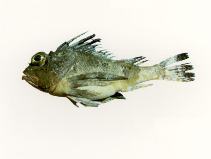 Neosebastes pandus
Hình ảnh của CSIRO
Các tranh (Ảnh) | Google image
Hình ảnh của CSIRO
Phân loại / Tên Tên thường gặp | Các synonym ( Các tên trùng) | Catalog of Fishes(Giống, Các loài) | ITIS | CoL | WoRMS | Cloffa
> Perciformes/Scorpaenoidei (Scorpionfishes) > Neosebastidae (Gurnard scorpionfishes)
Etymology: Neosebastes: Greek, neos = new + Greek, sebastes = august, venerable (Ref. 45335).
More on author: Richardson.
Etymology: Neosebastes: Greek, neos = new + Greek, sebastes = august, venerable (Ref. 45335).
More on author: Richardson.
Môi trường: môi trường / vùng khí hậu / Mức độ sâu / phạm vi phân phối Sinh thái học
biển cùng sống ở rạn san hô; mức độ sâu 15 - 593 m (Ref. 54394), usually 50 - 200 m (Ref. 33839). Subtropical; 28°S - 39°S
Sự phân bố Lãnh thổ | Các khu vực của FAO | Các hệ sinh thái | Những lần xuất hiện | Bản đồ điểm | Những chỉ dẫn | Faunafri
Eastern Indian Ocean: southern and southwestern coasts of Australia.
Bộ gần gũi / Khối lượng (Trọng lượng) / Tuổi
Chín muồi sinh dục: Lm ? range ? - ? cm
Max length : 50.0 cm TL con đực/không giới tính; (Ref. 9563)
Max length : 50.0 cm TL con đực/không giới tính; (Ref. 9563)
Mô tả ngắn gọn Khóa để định loại | Hình thái học | Sinh trắc học
Các tia vây lưng cứng (tổng cộng) : 8; Các vây lưng mềm (tổng cộng) : 8 - 9; Tia cứng vây hậu môn: 3; Tia mềm vây hậu môn: 5; Động vật có xương sống: 26. Diagnosis: Dorsal fin XIII, 8 (9 in 1 of 56 specimens), third spine longest. Anal rays III, 5. Pectoral rays 20-23 (mode 21), distal margin rounded. Pored lateral-line scales 36-43 (40); longitudinal scale series 60-72 (62); scale rows between base of last dorsal spine and lateral line 5-7 (6). Well-developed gill rakers on upper limb 0 or 1 (1), lower limb 4-7 (6), total 5-8 (7); rudimentary gill rakers on upper limb 3-5 (4), lower limb 4-8 (5). Swim bladder weakly bilobed anteriorly and posteriorly, lobes separated by a concavity (length 16% of SL, width 13% of SL). Dorsal profile of snout steep, forming angle of about 65-750 to horizontal axis of head and body. Nasal spine simple, directed upward or slightly forward, length of former approximately equal to or slightly greater than anterior nostril diameter. Posterior margin of premaxilla ascending process reaching or extending slightly beyond level of anterior margin of posterior nostril when mouth closed. Interorbital ridge indistinct; no scales on mid interorbital space, but small embedded scales present on supraorbital above interorbital ridge; interorbital space extremely deep, about one-third to a half of orbit extending above dorsal profile of head. Preocular with a small simple spine, its length less than that of nasal spine. Supraocular ridge with 3-11 pointed spines (sometimes serrated), canted laterally; supraocular ridge much closer to orbit than interorbital ridge in dorsal view; preocular and supraocular spines indistinct in larger specimens. Sphenotic with 3-13 minute pointed spines. Postorbital spine flattened and serrated. Long, narrow and extremely deep transversal occipital pit, not covered with scales. Nuchal and pterotic spines simple (sometimes pterotic spine with 2-4 points), distal margins serrated or smooth; origin of pterotic spine slightly posterior to that of nuchal spine, base slightly smaller than or equal to that of latter. Upper posttemporal spine flattened and serrated; lower posttemporal spine simple (sometimes with 2 points). Supracleithral spine simple. Posterior margin of maxilla not reaching a vertical at posterior margin of orbit; maxilla with scales extending posteriorly from between anterior and posterior lacrimal spines, but no scales on posterior margin. Underside of mandible smooth with 3 distinct pores on each side. Lacrimal ridge distinct with 1-6 points, sometimes smooth; anterior lacrimal spine simple (sometimes with 2 points), directed downward; posterior lacrimal spine with 2-5 points, directed ventroposteriorly; length of anterior lacrimal spine 2 times or more in that of posterior lacrimal spine. Suborbital pit present, front rimmed by a vertical (sometimes oblique) ridge on lacrimal to ventroanterior margin of orbit; no scales on anterior part of suborbital pit; suborbital ridge with 2 pointed spines in line with lacrimal ridge, spines separated at bases, directed backward; a spine sometimes arising from each suborbital spine; suborbital ridge indistinct in larger specimens; embedded scales 3-5 present between ventral margin of orbit and suborbital ridge; suborbital scales not extending onto eye membrane; preopercle with 5 spines (rarely 6 or 7 spines), 4 lower spines simple, lacking a median ridge, uppermost spine with a median ridge and with a spine distally. Length of uppermost preopercular spine less than pupil diameter; upper opercular spine simple, lacking a median ridge; lower opercular spine with a median ridge and a spine arising from latter; pectoral fin long, posterior tip extending well beyond a vertical at middle of base of dorsal-fin soft rays. Small distinct black spots on the lateral surface of head (except opercle), interorbital space, occipital pit, on lateral line and around lateral line posteriorly on body and caudal peduncle (Ref. 54394).
Body shape (shape guide): short and / or deep.
Body shape (shape guide): short and / or deep.
Vòng đời và hành vi giao phối Chín muồi sinh dục | Sự tái sinh sản | Đẻ trứng | Các trứng | Sự sinh sản | Ấu trùng
Tài liệu tham khảo chính
Tải lên tài liệu tham khảo của bạn | Các tài liệu tham khảo | Người điều phối | Người cộng tác
Motomura, H., 2003. Revision of the scorpionfish genus Neosebastes (Scorpaeniformes: Neosebastidae), with descriptions of five new species. Indo-Pac. Fish. (37):46 p. (Ref. 54394)
CITES
Not Evaluated
Mối đe dọa đối với con người
Venomous (Ref. 9563)
Sử dụng của con người
FAO - Publication: search | FishSource |
Thêm thông tin
Sinh thái dinh dưỡng
Thức ăn (con mồi)
Thành phần thức ăn
Thành phần thức ăn
Khẩu phần ăn
Các động vật ăn mồi
Thức ăn (con mồi)
Thành phần thức ăn
Thành phần thức ăn
Khẩu phần ăn
Các động vật ăn mồi
Biến động dân số
Các thông số tăng trưởng
Độ tuổi / kích thước tối đa
Chiều dài-trọng lượng tương đối
Chiều dài-chiều dài tương đối.
Chiều dài-tần số
Chuyển đổi khối lượng
Bổ xung
Sự phong phú
Các thông số tăng trưởng
Độ tuổi / kích thước tối đa
Chiều dài-trọng lượng tương đối
Chiều dài-chiều dài tương đối.
Chiều dài-tần số
Chuyển đổi khối lượng
Bổ xung
Sự phong phú
Vòng đời
Sự tái sinh sản
Chín muồi sinh dục
Độ trưởng thành/Mang liên quan
Sự sinh sản
Đẻ trứng
Tập hợp sinh sản
Các trứng
Sự phát triển của trứng
Ấu trùng
Sự biến động ấu trùng
Sự tái sinh sản
Chín muồi sinh dục
Độ trưởng thành/Mang liên quan
Sự sinh sản
Đẻ trứng
Tập hợp sinh sản
Các trứng
Sự phát triển của trứng
Ấu trùng
Sự biến động ấu trùng
Sự phân bố
Lãnh thổ
Các khu vực của FAO
Các hệ sinh thái
Những lần xuất hiện
Những chỉ dẫn
BRUVS - Video
Lãnh thổ
Các khu vực của FAO
Các hệ sinh thái
Những lần xuất hiện
Những chỉ dẫn
BRUVS - Video
Giải phẫu
Vùng mang
Não
sỏi tai
Vùng mang
Não
sỏi tai
Sinh lý học
Thành phần cơ thể
Chất dinh dưỡng
Thành phần ô-xy
Kiểu bơi
Tốc độ bơi
Sắc tố thị giác
Tiếng cá
Bệnh tật & Ký sinh trùng
Độc tính (LC50)
Thành phần cơ thể
Chất dinh dưỡng
Thành phần ô-xy
Kiểu bơi
Tốc độ bơi
Sắc tố thị giác
Tiếng cá
Bệnh tật & Ký sinh trùng
Độc tính (LC50)
Di truyền
Bộ gen
Di truyền
Sự dị hợp tử
Di sản
Đa dạng di truyền
Bộ gen
Di truyền
Sự dị hợp tử
Di sản
Đa dạng di truyền
Liên quan đến con người
Hệ thống nuôi trồng thủy sản
Các tổng quan nuôi trồng thủy sản
Các giống
Các trường hợp ngộ độc Ciguatera
Tem, tiền xu, v.v.
Hệ thống nuôi trồng thủy sản
Các tổng quan nuôi trồng thủy sản
Các giống
Các trường hợp ngộ độc Ciguatera
Tem, tiền xu, v.v.
Các công cụ
Sách điện tử | Hướng dẫn hiện trường | Tần suất chiều dài Wizard | Công cụ của vòng đời | Bản đồ điểm |
Bắt-MSY |
Báo cáo đặc biệt
Kiểm tra bảo trì bể cá | Kiểm tra các tờ thông tin về loài | Kiểm tra các tờ thông tin về nuôi trồng thủy sản
Tải xuống XML
Các nguồn internet
AFORO (otoliths) | Aquatic Commons | BHL | Cloffa | Websites from users | Check FishWatcher | CISTI | Catalog of Fishes: Giống, Các loài | DiscoverLife | ECOTOX | FAO - Publication: search | Faunafri | Fishipedia | Fishtrace | GloBI | Google Books | Google Scholar | Google | IGFA World Record | OneZoom | Open Tree of Life | Otolith Atlas of Taiwan Fishes | PubMed | Reef Life Survey | Socotra Atlas | TreeBase | Cây Đời sống | Wikipedia: Go, tìm | World Records Freshwater Fishing | Tạp chí Zoological Record
Ước tính dựa trên mô hình
Nhiệt độ ưa thích (Tài liệu tham khảo 123201): 14.3 - 18.2, mean 16.6 °C (based on 64 cells).
Chỉ số đa dạng phát sinh loài (Tài liệu tham khảo 82804): PD50 = 0.5002 [Uniqueness, from 0.5 = low to 2.0 = high].
Bayesian length-weight: a=0.01995 (0.00906 - 0.04395), b=3.01 (2.83 - 3.19), in cm total length, based on all LWR estimates for this body shape (Ref. 93245).
Mức dinh dưỡng (Tài liệu tham khảo 69278): 3.9 ±0.4 se; based on size and trophs of closest relatives
Chất dinh dưỡng (Ref. 124155): Calcium = 23.8 [9.4, 67.1] mg/100g; Iron = 0.549 [0.254, 1.115] mg/100g; Protein = 18.2 [16.6, 19.8] %; Omega3 = 0.27 [0.11, 0.88] g/100g; Selenium = 31.9 [14.2, 76.5] μg/100g; VitaminA = 26.8 [6.3, 117.6] μg/100g; Zinc = 0.65 [0.42, 1.01] mg/100g (wet weight);