>
Eupercaria/misc (Various families in series Eupercaria) >
Haemulidae (Grunts) > Haemulinae
Etymology: Haemulon: Greek, haimaleos = bloody (Ref. 45335).
More on author: Gill.
Environment: milieu / climate zone / rango de profundidad / distribution range
Ecología
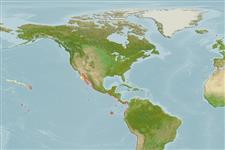
marino demersal. Tropical; 38°N - 1°S
Eastern Pacific: Mexico to Ecuador.
Tamaño / Peso / Age
Madurez: Lm ? range ? - ? cm
Max length : 42.0 cm TL macho / no sexado; (Ref. 9114); common length : 35.0 cm TL macho / no sexado; (Ref. 9114)
Short description
Claves de identificación | Morfología | Morfometría
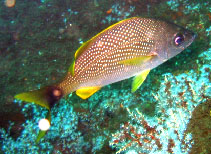
Body oblong, compressed, and fairly deep (depth contained 3.0 to 3.1 times in standard length); mouth large, terminal, and oblique, its anterior edge located at the same level as the center of the eye; first gill arch with 26 to 36 gill rakers; dorsal fin notched, with 10 to 12 spines and 15 to 18 soft rays (X-XII, 15-18); second anal spine longer and stronger than third; scale series above lateral line oblique; body light brown; each scale bearing a pearly blue spot, the spots appearing to form lines following the scale series; fins yellowish (Ref. 55763).
Body shape (shape guide): short and / or deep.
Benthic in coastal waters. Forms schools over rocky and sandy bottoms. Feeds at night. Marketed fresh.
Life cycle and mating behavior
Madurez | Reproducción | Puesta | Huevos | Fecundidad | Larva
Oviparous, distinct pairing during breeding (Ref. 205).
McKay, R.J. and M. Schneider, 1995. Haemulidae. Burros, corocoros, chulas, gallinazos, roncos. p. 1136-1173. In W. Fischer, F. Krupp, W. Schneider, C. Sommer, K.E. Carpenter and V. Niem (eds.) Guia FAO para Identification de Especies para lo Fines de la Pesca. Pacifico Centro-Oriental. 3 Vols. FAO, Rome. (Ref. 9114)
IUCN Red List Status (Ref. 130435: Version 2025-1)
Threat to humans
Harmless
Human uses
Pesquerías: escaso valor comercial
Herramientas
Special reports
Download XML
Fuentes de Internet
Estimates based on models
Preferred temperature (Referencia
123201): 20.6 - 28.5, mean 25.8 °C (based on 56 cells).
Phylogenetic diversity index (Referencia
82804): PD
50 = 0.5000 [Uniqueness, from 0.5 = low to 2.0 = high].
Bayesian length-weight: a=0.01479 (0.00653 - 0.03348), b=3.02 (2.84 - 3.20), in cm total length, based on LWR estimates for this Genus-body shape (Ref.
93245).
Nivel trófico (Referencia
69278): 4.2 ±0.73 se; based on food items.
Generation time: 9.6 ( na - na) years. Estimated as median ln(3)/K based on 1
growth studies.
Resiliencia (Referencia
120179): Bajo, población duplicada en un tiempo mínimo de 4.5-14 años (K=0.12).
Fishing Vulnerability (Ref.
59153): High vulnerability (58 of 100).
🛈
Nutrients (Ref.
124155): Calcium = 88.6 [26.8, 228.3] mg/100g; Iron = 0.978 [0.480, 2.078] mg/100g; Protein = 18 [16, 20] %; Omega3 = 0.164 [0.075, 0.330] g/100g; Selenium = 47.1 [18.8, 107.3] μg/100g; VitaminA = 32.3 [8.3, 127.5] μg/100g; Zinc = 0.894 [0.552, 1.381] mg/100g (wet weight);