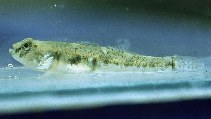
Pomatoschistus microps, Common goby : aquarium

You can sponsor this page

Pomatoschistus microps (Krøyer, 1838)

Common goby
Add your observation in Fish Watcher
Native range | All suitable habitat | Point map | Year 2050
This map was computer-generated and has not yet been reviewed.
Pomatoschistus microps   AquaMaps   Data sources: GBIF OBIS
Upload your photos and videos
Imágenes | Videos | Google image
Image of Pomatoschistus microps (Common goby)
Pomatoschistus microps
Picture by Busse, K.

Classification / Names Nombres comunes | Sinónimos | Catalog of Fishes(Género, Especie) | ITIS | CoL | WoRMS | Cloffa

> Gobiiformes (Gobies) > Gobiidae (Gobies) > Gobionellinae
Etymology: Pomatoschistus: Greek, poma, -atos = cover, operculum + Greek, schistos = divided (Ref. 45335).

Environment: milieu / climate zone / rango de profundidad / distribution range Ecología

marino; agua dulce; salobre demersal; anfidromo (Ref. 51243); rango de profundidad 0 - 12 m (Ref. 35388). Temperate; 8°C - 24°C (Ref. 4944); 64°N - 20°N, 19°W - 31°E

Distribución Países | Áreas FAO | Ecosistemas | Ocurrencias, apariciones | Mapa de puntos | Introducciones | Faunafri

Eastern Atlantic: Norway to Morocco, including Baltic Sea (to southern Portugal) (Ref. 4696) and western Mediterranean. Also in Mauritania and the Canary Islands.

Length at first maturity / Tamaño / Peso / Age

Madurez: Lm ?, range 3 - ? cm
Max length : 9.0 cm TL macho / no sexado; (Ref. 6303); edad máxima reportada: 2.60 años (Ref. 40230)

Short description Claves de identificación | Morfología | Morfometría

Espinas dorsales (total) : 6 - 8; Radios blandos dorsales (total) : 8 - 11; Espinas anales: 1; Radios blandos anales: 7 - 10; Vértebra: 30 - 32. This species is distinguished from other gobies in European freshwaters by the following characters: males with conspicuous dark proximal posterior spot on first dorsal; with cephalic lateral line canals; anterior oculoscapular canal extending to snout; branched rays in second dorsal 8-10.5; anal origin below simple of first branched ray of D2; total scales in midlateral series 39-52; completely scaled postdorsal body; caudal rounded (Ref. 59043). No scales in front of the first dorsal fin (Ref. 35388); body shape is terete, slightly depressed; eyes situated dorso-laterally; reduced swim bladders (Ref. 92840).
Body shape (shape guide): elongated.

Biología     Glosario (por ej. epibenthic)

Enters estuaries, salt marshes and pools (Ref. 4343); usually on sand or mud (Ref. 59043). Lives in sea as well as brackish waters and migrates into limnetic sections of rivers (Ref. 92840). Also rock pools where it feeds mainly on epibenthic meiofauna like harpacticoids and small amphipods (Ref. 92840); small crustaceans, worms, chironomid larvae and mites (Ref. 4696). Its burrowing habit allows it to survive low water levels and to avoid predators (Ref. 30508). Spawns after first winter, at sea, in February - September, depending on latitude; individual females spawn several times during a season. Adhesive eggs (0.9 x 0.7 mm) are deposited under or between stones, shells and aquatic plants and males guard the eggs until hatching. Juveniles enter freshwater habitats in late summer to forage (Ref. 59043). The male defends and aerates the eggs for about 9 days.

Life cycle and mating behavior Madurez | Reproducción | Puesta | Huevos | Fecundidad | Larva

Benthic spawner (Ref. 32023).

Main reference Upload your references | Referencias | Coordinador | Colaboradores

Maugé, L.A., 1986. Gobiidae. p. 358-388. In J. Daget, J.-P. Gosse and D.F.E. Thys van den Audenaerde (eds.) Check-list of the freshwater fishes of Africa (CLOFFA). ISNB, Brussels; MRAC, Tervuren; and ORSTOM, Paris. Vol. 2. (Ref. 4343)

IUCN Red List Status (Ref. 130435: Version 2025-1)

  Least Concern (LC) ; Date assessed: 18 January 2023

CITES

Not Evaluated

CMS (Ref. 116361)

Not Evaluated

Threat to humans

  Harmless


Human uses

Pesquerías: sin interés; Acuario: Comercial
FAO - Publication: search | FishSource |

Más información

Ecología
Ecología
Home ranges
Population dynamics
Coeficiente del crecimiento para
Max. ages / sizes
Length-weight rel.
Length-length rel.
Length-frequencies
Mass conversion
Reclutamiento
Abundancia
Life cycle
Reproducción
Madurez
Maturity/Gills rel.
Fecundidad
Puesta
Spawning aggregations
Huevos
Egg development
Larva
Dinámica larvaria
Distribución
Países
Áreas FAO
Ecosistemas
Ocurrencias, apariciones
Introducciones
BRUVS - Videos
Anatomy
Superficie branquial
Brain
Otolith
Physiology
Body composition
Nutrients
Consumo del oxígeno
Tipo de natación
Velocidad de natación
Visual pigments
Fish sound
Diseases & Parasites
Toxicity (LC50s)
Genética
Genome
Genética
Heterozygosity
heritabilidad
Human related
Aquaculture systems
Perfiles de acuicultura
Razas
Ciguatera cases
Stamps, coins, misc.
Outreach
Colaboradores
Referencias
Referencias

Herramientas

Special reports

Download XML

Fuentes de Internet

Estimates based on models

Preferred temperature (Referencia 123201): 9 - 16.1, mean 10.8 °C (based on 450 cells).
Phylogenetic diversity index (Referencia 82804):  PD50 = 0.5001   [Uniqueness, from 0.5 = low to 2.0 = high].
Bayesian length-weight: a=0.00776 (0.00407 - 0.01480), b=3.08 (2.92 - 3.24), in cm total length, based on LWR estimates for this species & Genus-body shape (Ref. 93245).
Nivel trófico (Referencia 69278):  3.3   ±0.3 se; based on diet studies.
Generation time: 3.7 ( na - na) years. Estimated as median ln(3)/K based on 1 growth studies.
Resiliencia (Referencia 120179):  Medio, población duplicada en un tiempo mínimo de 1.4-4.4 años (K=0.29; tm=0.8; tmax=2.6; Assuming fec < 10,000).
Fishing Vulnerability (Ref. 59153):  Low to moderate vulnerability (33 of 100). 🛈
Nutrients (Ref. 124155):  Calcium = 97.2 [44.2, 272.7] mg/100g; Iron = 0.439 [0.228, 0.911] mg/100g; Protein = 18.1 [16.1, 19.7] %; Omega3 = 0.61 [0.23, 1.37] g/100g; Selenium = 4.9 [2.0, 12.3] μg/100g; VitaminA = 38.6 [9.8, 137.2] μg/100g; Zinc = 1.18 [0.76, 1.86] mg/100g (wet weight);