>
Pleuronectiformes (Flatfishes) >
Soleidae (Soles)
Etymology: Pegusa: The old name of the Cnidus, the city in Asia minos where the Atheniasn defeated Spartans in a naval battle near 394 BC.
More on author: Risso.
Environment: milieu / climate zone / rango de profundidad / distribution range
Ecología
marino; salobre demersal; rango de profundidad 5 - 350 m (Ref. 4710), usually 20 - 50 m (Ref. 26999). Subtropical; 57°N - 17°S, 18°W - 42°E
Eastern Atlantic: northeastern to southeastern Atlantic; perhaps Gulf of Guinea; the Mediterranean Sea and Black Sea; reported from Suez Canal (Ref. 32649); and Sea of Azov (Ref. 4710).
Length at first maturity / Tamaño / Peso / Age
Madurez: Lm ?, range 22 - ? cm
Max length : 40.0 cm SL macho / no sexado; (Ref. 4710); common length : 30.0 cm TL macho / no sexado; (Ref. 2714); edad máxima reportada: 15 años (Ref. 32766)
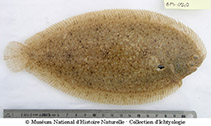
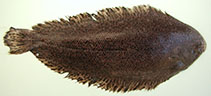
Espinas dorsales (total) : 0; Radios blandos dorsales (total) : 69 - 87; Espinas anales: 0; Radios blandos anales: 53 - 73; Vértebra: 40 - 48. Last ray of dorsal and anal fins joined by a low membrane to the base of the caudal fin. Supratemporal branch of lateral line forming an arch. Anterior nostril on the blind side prominent forming a large round rosette, its diameter equal to that of the eye. Lower lip on ocular side undulated with about 6 lobes. Length of both nasal tubes and scales above it on the ocular side about equal. Pectoral fin on the ocular side with a black botch with a white margin except at its base; this blotch often interrupted by light space or accompanied by dots or streaks on one side or the other (present in fresh specimens from coast of Israel (Ref. 32649). Brownish yellow or reddish brown in color with obscure pale blotches and specks (Ref. 3200).
Body shape (shape guide): short and / or deep.
Found on gravel, sand or mud. Feeds on a wide range of small marine bivalves; mainly on crustaceans such as amphipods, mysids, shrimps, decapods, bivalves and polychaetes (Ref. 4710).
Ben-Tuvia, A., 1990. A taxonomic reappraisal of the Atlanto-Mediterranean soles Solea solea, S. senegalensis and S. lascaris. J. Fish Biol. 36(6):947-960. (Ref. 32649)
IUCN Red List Status (Ref. 130435: Version 2025-1)
Threat to humans
Harmless
Human uses
Pesquerías: escaso valor comercial
Herramientas
Special reports
Download XML
Fuentes de Internet
Estimates based on models
Preferred temperature (Referencia
123201): 10.6 - 27.6, mean 18.1 °C (based on 512 cells).
Phylogenetic diversity index (Referencia
82804): PD
50 = 0.5312 [Uniqueness, from 0.5 = low to 2.0 = high].
Bayesian length-weight: a=0.00891 (0.00758 - 0.01048), b=3.06 (3.01 - 3.11), in cm total length, based on LWR estimates for this species (Ref.
93245).
Nivel trófico (Referencia
69278): 3.3 ±0.1 se; based on diet studies.
Resiliencia (Referencia
120179): Medio, población duplicada en un tiempo mínimo de 1.4-4.4 años (K=0.41; tm=4; tmax=15).
Fishing Vulnerability (Ref.
59153): Low to moderate vulnerability (29 of 100).
🛈
Climate Vulnerability (Ref.
125649): Low vulnerability (18 of 100).
🛈
Nutrients (Ref.
124155): Calcium = 133 [47, 301] mg/100g; Iron = 1.03 [0.42, 2.11] mg/100g; Protein = 18.5 [16.7, 20.5] %; Omega3 = 0.175 [0.082, 0.365] g/100g; Selenium = 38.4 [18.7, 82.5] μg/100g; VitaminA = 9.21 [3.14, 27.04] μg/100g; Zinc = 0.885 [0.576, 1.305] mg/100g (wet weight); based on
nutrient studies.