This website uses cookies to enhance your browsing experience and ensure the functionality of our site. For more detailed information about the types of cookies we use and how we protect your privacy, please visit our Privacy Information page.
×
Cookie Settings
This website uses different types of cookies to enhance your experience. Please select your preferences below:
> Beryciformes (Sawbellies) > Berycidae (Alfonsinos)
Etymology: Beryx:Greek, beryx or berys = a name of a fish. Cuvier & Valenciennes (1829:221) precise that the name was used by Gesner from Varinus, but with no indication whatsoever helping identifying any species. After D'Arcy Wentworth Thompson (A glossary of Greek fishes, 1947), the name actually seems to come originally from Hesychius, but perhaps the name was not originally a fish name. Thompson compares it to meryx (ruminant), applied on skaros (Scarus), so it may have been applied on a parrot fish referring to its browsing/grazing behavior described by Aristoteles and followers. More on author: Lowe.
Environnement : milieu / zone climatique / profondeur / gamme de distribution Écologie
marin benthopélagique; océanodrome (Ref. 87829); profondeur 25 - 1300 m (Ref. 9833), usually 400 - 600 m (Ref. 27121). Subtropical; 45°N - 43°S, 180°W - 180°E
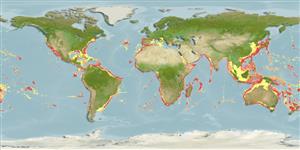
Circumglobal, excluding the northeast Pacific and Mediterranean Sea (Ref. 9833). Western Atlantic: Gulf of Maine to the Gulf of Mexico (Ref. 6743). Eastern Atlantic: off southwestern Europe and the Canary Islands (Ref. 7413) to South Africa (Ref. 4179). Indo-Pacific: East Africa (including Saya de Malha Bank, Ref. 33390) to Japan, Hawaii, Australia, and New Zealand (Ref. 5755). The limited number of records in the western Pacific is doubtless the result of limited fishing effort below 200 m (Ref. 9833). Eastern Pacific: Chile (Ref. 27363).
Longueur à la première maturité / Taille / Poids / Âge
Maturité: Lm33.2 range ? - ? cm Max length : 70.0 cm TL mâle / non sexé; (Ref. 30573); common length : 40.0 cm TL mâle / non sexé; (Ref. 30573); poids max. publié: 4.0 kg (Ref. 43448); âge max. reporté: 23 années (Ref. 35874)
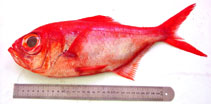
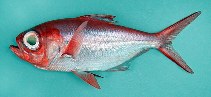
Épines dorsales (Total) : 4; Rayons mous dorsaux (Total) : 13 - 16; Épines anales: 4; Rayons mous anaux: 26 - 30. First infraorbital bone with a spine projecting laterally on anterior end. Lateral line extends to caudal fin. A fleshy disk on inner face of exposed area of scale. In young fishes, the 2nd dorsal ray is elongate (Ref. 559). Ref. 27363 notes pectoral fins with one spine and 17 soft rays (Ref. 27363). Body shape (shape guide): fusiform / normal; Cross section: compressed.
Adults inhabit the outer shelf (180 m) and slope to at least 1,300 m depth, probably moving further from the bottom at night; often found over seamounts (Ref. 9833) and underwater ridges (Ref. 33648). Are considered as one of the straddling stocks in the northwest Pacific (Ref. 87829). They feed mainly on fish, crustaceans and cephalopods (Ref. 33648). Oviparous, spawn in batches (Ref. 30291). Juveniles (Ref. 9072), eggs and larvae are pelagic (Ref. 30291). Marketed frozen and eaten steamed, fried, broiled, boiled, microwaved and baked (Ref. 9988).
Maul, G.E., 1990. Berycidae. p. 626. In J.C. Quero, J.C. Hureau, C. Karrer, A. Post and L. Saldanha (eds.) Check-list of the fishes of the eastern tropical Atlantic (CLOFETA). JNICT, Lisbon; SEI, Paris; and UNESCO, Paris. Vol. 2. (Ref. 7413)
Statut dans la liste rouge de l'IUCN (Ref. 130435: Version 2025-2 (Global))
Physiologie Composition corporelle Nutriments Consommation d'oxygène Type de natation Vitesse de nage Pigments visuels Son de poisson Maladies et parasites Toxicité (CL50)