>
Scombriformes (Mackerels) >
Scombridae (Mackerels, tunas, bonitos) > Scombrinae
Etymology: Scomberomorus: Latin, scomber = mackerel + Greek, moros = silly, stupid (Ref. 45335).
Environment: milieu / climate zone / profondeur / distribution range
Écologie
marin pelagic-neritic; océanodrome (Ref. 51243); profondeur 50 - 200 m. Subtropical; 1°S - 37°S, 23°E - 59°E (Ref. 168)
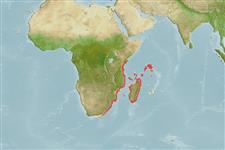
Western Indian Ocean: Seychelles, Kenya and Zanzibar to South Africa and along the west coast of Madagascar. This species has been confused with Scomberomorus lineolatus and with Scomberomorus guttatus (and also one of its junior synonyms Scomberomorus leopardus).
Length at first maturity / Taille / Poids / Âge
Maturité: Lm ?, range 80 - ? cm
Max length : 120 cm FL mâle / non sexé; (Ref. 168); poids max. publié: 12.5 kg (Ref. 40637)
Description synthétique
Clés d'identification | Morphologie | Morphométrie
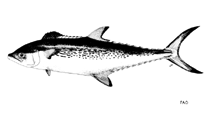
Épines dorsales (Total) : 15 - 17; Rayons mous dorsaux (Total) : 19 - 21; Rayons mous anaux: 19 - 22; Vertèbres: 45 - 46. Interpelvic process small and bifid. Body covered with small scales. Lateral line without auxiliary branches anteriorly, gradually curving down toward caudal peduncle. Intestine with 2 folds and 3 limbs. Juveniles have spots but develop adult pattern of interrupted lines by the time they reach 40 cm.
Body shape (shape guide): fusiform / normal; Cross section: oval.
Neritic species (Ref. 5313). Forms large schools in the Zanzibar Channel from March to September. Feeds mainly on anchovies (Anchoviella sp.), clupeids (Amblygaster sp., Sardinella fimbriata, Sardinella perforata [= Sardinella albella), other small fishes, squids, and mantis shrimps.
Life cycle and mating behavior
Maturité | Reproduction | Frai | Œufs | Fécondité | Larves
Collette, B.B. and C.E. Nauen, 1983. FAO Species Catalogue. Vol. 2. Scombrids of the world. An annotated and illustrated catalogue of tunas, mackerels, bonitos and related species known to date. Rome: FAO. FAO Fish. Synop. 125(2):137 p. (Ref. 168)
Statut dans la liste rouge de l'IUCN (Ref. 130435: Version 2025-1)
Menace pour l'homme
Harmless
Utilisations par l'homme
Pêcheries: commercial; pêche sportive: oui
Outils
Articles particuliers
Télécharger en XML
Sources Internet
Estimates based on models
Preferred temperature (Réf.
123201): 20.4 - 25.4, mean 21.8 °C (based on 19 cells).
Phylogenetic diversity index (Réf.
82804): PD
50 = 0.5000 [Uniqueness, from 0.5 = low to 2.0 = high].
Bayesian length-weight: a=0.00871 (0.00439 - 0.01729), b=3.02 (2.86 - 3.18), in cm total length, based on LWR estimates for this species & Genus-body shape (Ref.
93245).
Niveau trophique (Réf.
69278): 4.2 ±0.77 se; based on food items.
Generation time: 1.9 ( na - na) years. Estimated as median ln(3)/K based on 1
growth studies.
Résilience (Réf.
120179): Milieu, temps minimum de doublement de population : 1,4 à 4,4 années (tm=2).
Fishing Vulnerability (Ref.
59153): Moderate vulnerability (39 of 100).
🛈
Nutrients (Ref.
124155): Calcium = 20.3 [8.9, 71.4] mg/100g; Iron = 0.893 [0.392, 2.210] mg/100g; Protein = 21.3 [20.0, 22.6] %; Omega3 = 0.411 [0.259, 0.665] g/100g; Selenium = 36.9 [13.0, 113.7] μg/100g; VitaminA = 9.34 [2.03, 46.45] μg/100g; Zinc = 0.419 [0.273, 0.700] mg/100g (wet weight);