Issue
Genus placement in Ref. 1830.
Environment: milieu / climate zone / kisaran kedalaman / distribution range
Ekologi
; air tawar bentopelagis; potamodromous (Ref. 51243). Tropical
Asia: India.
Size / Weight / umur
Kematangan: Lm ? range ? - ? cm
Max length : 120 cm TL jantan/; (Ref. 4832)
deskripsi pendek
Kunci identifiaksi (pengenalan) | Morfologi | Morfometrik
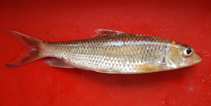
This species is distinguished from its congeners by the following combination of characters: with maxillary barbels, but no rostral barbels; last simple dorsal ray is weak and smooth; complete lateral line with 41-43 +1 pored scales; transverse scales from dorsal-fin origin to pelvic fin origin 9-10/1/4½-5; scales between lateral line and anal-fin origin 5½-6; gill rakers are long and branched; proximal end of fifth ceratobranchial hook shaped, with 5+3+2 teeth; behind opercle is a black bar, prominent in juvenile specimens (less than ca 10.0 cm SL), and becoming progressively fainter in mature specimens; all fins pale yellow, red pigments on interradial membranes in large (more than ca 20.0 cm SL) individuals (Ref. 94728).
Body shape (shape guide): elongated; Cross section: compressed.
Occurs in rivers, usually in deep pools and shady parts in the hilly regions. Lives and breeds in hilly terrain but comes down to tidal reaches for feeding. Spawns in small streams with sandy and weedy bottoms. Feeds mainly on algae and occasionally on insect larvae.
Life cycle and mating behavior
Kematangan | Reproduksi, perkembang biakan | Pemijahan | telur-telur | Fecundity | Larva
Knight, J.D.M., A. Rai and R.K.P. D'Souza, 2013. On the identities of Barbus mussullah Sykes and Cyprinus curmuca Hamilton with notes on the status of Gobio canarensis Jerdon (Teleostei: Cyprinidae). Zootaxa 3750(3):201-215. (Ref. 94728)
Status IUCN Red List (Ref. 130435: Version 2025-1)
ancaman kepada manusia
Harmless
penggunaan manusia
Perikanan: komersial; Budidaya air: kemungkinan penggunaan kedepan
Alat, peralatan
laporan khas
muat turun XML
Sumber internet
Estimates based on models
Phylogenetic diversity index (Acuan
82804): PD
50 = 0.5000 [Uniqueness, from 0.5 = low to 2.0 = high].
Bayesian length-weight: a=0.00427 (0.00195 - 0.00935), b=3.11 (2.90 - 3.32), in cm total length, based on LWR estimates for this (Sub)family-body shape (Ref.
93245).
Trophic level (Acuan
69278): 2.6 ±0.26 se; based on food items.
Daya lenting (Acuan
120179): Rendah, Waktu penggandaan populasi minimum 4.5 - 14 tahun (Assuming tm>4).
Fishing Vulnerability (Ref.
59153): High to very high vulnerability (72 of 100).
🛈