Environment: milieu / climate zone / rango de profundidad / distribution range
Ecología
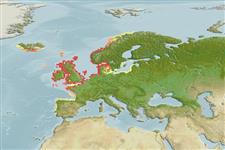
marino demersal; oceanodromo (Ref. 51243); rango de profundidad 17 - 22 m (Ref. 57178). Temperate; 72°N - 38°N, 25°W - 22°E
Northeast Atlantic: Lisbon north to Finnmark, around the British Isles, in the Skagerrak and Kattegat and Iceland.
Tamaño / Peso / Age
Madurez: Lm ? range ? - ? cm
Max length : 25.0 cm TL macho / no sexado; (Ref. 1371); common length : 17.0 cm TL macho / no sexado; (Ref. 1371); common length :20 cm TL (female); edad máxima reportada: 3.00 años (Ref. 1371)
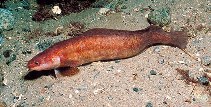
Espinas dorsales (total) : 0; Espinas anales: 0. Head relatively small, more than five times in SL. No lobed fold of skin above the upper lip. First fin ray followed by a row of small, fleshy filaments. Dark brown dorsally, reddish to blackish grading to pale gray-brown ventrally (Ref. 1371). One barbel on the lower jaw and four on the snout (Ref. 35388).
Body shape (shape guide): elongated; Cross section: oval.
A resident intertidal species with homing behavior (Ref. 32612). Generally close to the shore, not descending to great depths beyond the limits of the distribution of green algae (20 m), preferring rock bottoms but also living on sandy, muddy, and shell gravel bottoms. Feed mainly on crustaceans, sometimes also on algae, polychaetes, gastropods and occasionally, small fish. Occurs in temperatures ranging from 8 to 24°C (Ref. 4944).
Eggs and larvae are pelagic.
Cohen, D.M., T. Inada, T. Iwamoto and N. Scialabba, 1990. FAO species catalogue. Vol. 10. Gadiform fishes of the world (Order Gadiformes). An annotated and illustrated catalogue of cods, hakes, grenadiers and other gadiform fishes known to date. FAO Fish. Synop. 125(10). Rome: FAO. 442 p. (Ref. 1371)
IUCN Red List Status (Ref. 130435: Version 2025-1)
Threat to humans
Harmless
Human uses
Pesquerías: comercial
Herramientas
Special reports
Download XML
Fuentes de Internet
Estimates based on models
Preferred temperature (Referencia
123201): 8.4 - 11.8, mean 10.3 °C (based on 52 cells).
Phylogenetic diversity index (Referencia
82804): PD
50 = 0.6250 [Uniqueness, from 0.5 = low to 2.0 = high].
Bayesian length-weight: a=0.00525 (0.00273 - 0.01010), b=3.11 (2.94 - 3.28), in cm total length, based on LWR estimates for this species & (Sub)family-body (Ref.
93245).
Nivel trófico (Referencia
69278): 3.5 ±0.3 se; based on diet studies.
Generation time: 1.7 ( na - na) years. Estimated as median ln(3)/K based on 1
growth studies.
Resiliencia (Referencia
120179): Alto, población duplicada en un tiempo mínimo inferior a 15 meses (tm=1; tmax=3; Fec=9,000-30,000).
Fishing Vulnerability (Ref.
59153): Low vulnerability (22 of 100).
🛈
Climate Vulnerability (Ref.
125649): Low to moderate vulnerability (35 of 100).
🛈
Nutrients (Ref.
124155): Calcium = 78.7 [38.0, 196.9] mg/100g; Iron = 0.469 [0.234, 1.058] mg/100g; Protein = 17.5 [15.5, 19.4] %; Omega3 = 0.342 [0.157, 0.717] g/100g; Selenium = 10.9 [4.9, 24.7] μg/100g; VitaminA = 11.9 [2.5, 52.7] μg/100g; Zinc = 0.701 [0.465, 1.075] mg/100g (wet weight);