



Periophthalmus barbarus (Linnaeus, 1766)
Atlantic mudskipper
เพิ่มการสังเกตของคุณใน Fish Watcher
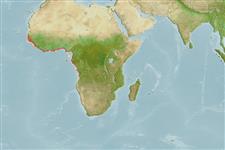
| Native range | All suitable habitat | Point map | Year 2050 |
|
| This map was computer-generated and has not yet been reviewed. |
| Periophthalmus barbarus AquaMaps Data sources: GBIF OBIS |
อัพโหลดของคุณ ภาพถ่าย และ วิดีโอ
รูปภาพหลายรูป | Google image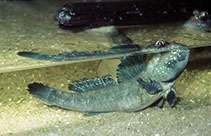 Periophthalmus barbarus
ภาพโดย Muséum-Aquarium de Nancy/D. Terver
รูปภาพหลายรูป | Google image
ภาพโดย Muséum-Aquarium de Nancy/D. Terver
การจำแนกประเภท / ชื่อ ชื่อสามัญ | ชื่อพ้อง | Catalog of Fishes(สกุล, ชนิด) | ITIS | CoL | WoRMS | Cloffa
> Gobiiformes (Gobies) > Oxudercidae (Mudskippers) > Periophthalminae
Etymology: Periophthalmus: Greek, peri = around + Greek, ophthalmos = eye (Ref. 45335).
More on author: Linnaeus.
Etymology: Periophthalmus: Greek, peri = around + Greek, ophthalmos = eye (Ref. 45335).
More on author: Linnaeus.
สิ่งแวดล้อม : สิ่งแวดล้อม / เขตภูมิอากาศ / ระดับความลึก / ระยะการกระจายสินค้า นิเวศวิทยา
เกี่ยวกับทะเล,น้ำเค็ม; น้ำจืด; กร่อย เกี่ยวกับหินโสโครก; สัตว์น้ำที่อพยพไปๆมาๆ ระหว่างแหล่งน้ำจืดกับทะเล ที่เป็นไปตามช่วงชีวิต (Ref. 51243). Tropical; 25°C - 30°C (Ref. 1672); 21°N - 18°S, 18°W - 14°E
การแพร่กระจาย อาณาเขต | พื้นที่จำแนกตาม FAO | ระบบนิเวศหลายระบบ | การปรากฏขึ้น,การเกิดขึ้น,พบ | ตำแหน่งบนแผนที่ | การแนะนำ | Faunafri
Africa: West-African coast, from Senegal to Angola (Ref. 57403, 79590), including most offshore islands - Macias Nguema, São Tomé, and Principe islands (Ref. 10814). Also reported from Mauritania (Ref. 5377). Western Central Pacific: Guam (Ref. 35720).
Reports from India (Ref. 29108), Thailand (Ref. 37773), Bangladesh (Ref. 39989), Philippines (Ref. 6956) and Australia (Ref. 38544) need confirmation.
ความยาวเมื่อครบกำหนดครั้งแรก / ขนาด / น้ำหนัก / อายุ
คำอธิบายสั้นๆ เครื่องมือที่ใช้ในการแยกชนิดสัตว์,สิ่งมีชีวิตออกจากกัน | สัณฐานวิทยา | ความยาวต่างๆ
เงี่ยงครีบหลัง (รวม) : 11 - 15; ก้านครีบอ่อนที่หาง (รวม) : 10 - 13; เงี่ยงครีบก้น: 1; ก้านครีบอ่อนที่ก้น: 8 - 10. Diagnosis: large adult size, approaching 150 mm SL; head width 15.4-21.8% SL (Ref. 5218). Upper lip covered by a skin fold; anterior nostrils conical and tubular, reaching to level of lower lip; posterior nostrils small, slit-like (Ref. 57403, 79590). Snout deep (Ref. 3657). Mouth horizontal (Ref. 3657), large, its gape extending to below center of eye (Ref. 57403, 79590). Eyes protruding and close together with lower eyelid fold (Ref. 3657). Predorsal scales extending anteriorly to level of hind margin of eye; upper margin of operculum, preoperculum and sub-/infraorbital regions, as well as pectoral-fin bases, covered with small, cycloid scales; 86-107 scales in longitudinal series (including usually 3 or 4 scales on caudal fin base) (Ref. 5218, 57403, 79590). First dorsal fin high (Ref. 3657), with 10-14 spines (Ref. 57403, 79590) that are flexible (Ref. 3657). Second dorsal fin with 1 spine and 10-13 soft rays (Ref. 57403, 79590), its base longer than the distance from end to caudal fin origin (Ref. 3657), length of 2nd dorsal fin base 20.9-24. 1 %SL (Ref. 5218). Length of anal fin base 14.1-17.7% SL (Ref. 5218). Pectoral fins with a long muscular lobe (Ref. 3657). Pelvic fins joined by a transverse membrane connecting the bases of the 5th pair of segmented rays (Ref. 57403, 79590). Pelvic fin length 14.2-16.0% SL; no frenum uniting pelvic fins (Ref. 5218). Caudal fin asymmetrical, upper ray longest (Ref. 57403, 79590), lower rays shorter and stout (Ref. 3657). TRDB 20-34 (Ref. 5218).
Coloration: in life: fish olive-green or rusty-brown dorsally, paler ventrally; small, blue ocelli scattered over flanks and dorsum, and some oblique, black bands may be present on dorsal part of flanks (Ref. 57403, 79590). 1st dorsal fin is dark on its anterior margin and has a bright blue longitudinal band near its distal margin; 2nd dorsal fin has 2, narrow, bluish-white longitudinal bands on its upper half (Ref. 57403). Anal fin pale or white, and sometimes slightly mottled with fine, dark spots (Ref. 79590). Pectoral fins dark on outer (lateral) surface, with pale distal margins, and lighter on inner (medial) surface, particularly ventrally; pelvic fins whitish on ventral surface but darker on dorsal surface, with pale margins; caudal fin dark (Ref. 57403, 79590). Preserved specimens: dark brown/violet on head, dorsum and flanks; chin pale or mottled gray; ventral body surface pale whitish-yellow (Ref. 57403, 79590). 1st dorsal fin grayish with a black band near distal margin, bordered dorsally and ventrally by a narrow white band; 2nd dorsal fin with a brown margin and a black stripe running along upper portion of fin, this stripe bordered dorsally and ventrally by a narrow white band (Ref. 57403). Anal fin pale or white (Ref. 57403), sometimes slightly mottled with fine, dark spots (Ref. 57403). Caudal fin dark brown on its dorsal part, whitish on its ventral part (Ref. 57403).
Body shape (shape guide): fusiform / normal; Cross section: circular.
Body shape (shape guide): fusiform / normal; Cross section: circular.
Facultative air-breathing (Ref. 126274); Found on muddy substrates and in brackish waters of estuaries, lagoons and mangrove swamps (Ref. 79590). Occasionally found in freshwater, but always close to the shore (Ref. 57403, 79590). Amphibious air-breather (Ref. 31184) that skips or walks on sand or mud in search of food; that is, on exposed intertidal mud flats of estuarine mangrove swamps. Adult feed chiefly on arthropods (crabs, insects, etc.) of the mud surface. Also included in the diet is the white mangrove, Avicennia nitida (Ref. 3026). Spawn in burrows (Ref. 3657). Maximum reported total length 165 mm; reports of larger specimens, up to 250 mm TL, are probably misidentifications of other species (Ref. 79590).
วงจรชีวิตและพฤติกรรมการผสมพันธุ์ วัยเจริญพันธุ์ | การสืบพันธุ์ | การวางไข่ | เซลสืบพันธ์ของเพศเมีย(ไข่) | ความดกของไข่ | ตัวอ่อน
Probably a multiple spawner (Ref. 58481).
อ้างอิงหลัก
อัพโหลดข้อมูลอ้างอิงของคุณ | อ้างอิง | ผู้ประสานงาน | ผู้ร่วมมือ
Harrison, I.J., P.J. Miller and F. Pezold, 2003. Gobiidae. p. 625-666 In C. Lévêque, D. Paugy and G.G. Teugels (eds.) Faune des poissons d'eaux douce et saumâtres de l'Afrique de l'Ouest, Tome 2. Coll. Faune et Flore tropicales 40. Musée Royal de l'Afrique Centrale, Tervuren, Belgique, Museum National d'Histoire Naturalle, Paris, France and Institut de Recherche pour le Développement, Paris, France. 815 p. (Ref. 57403)
สถานะบัญชีแดงของ IUCN (Ref. 130435: Version 2025-2 (Global))
Least Concern (LC) ; Date assessed: 20 October 2019
CITES
Not Evaluated
ภัยคุกคามต่อมนุษย์
Harmless
การใช้ของมนุษย์
การประมง: การประมงยังชีพ; สถานที่แสดงสัตว์และพืชน้ำ: การค้า
FAO - Publication: search | FishSource |
ข้อมูลเพิ่มเติม
พลวัตของประชากร
พารามิเตอร์การเจริญเติบโต
อายุสูงสุด / ขนาด
ความยาว-น้ำหนักสัมพันธ์
ความยาว-ความยาวสัมพันธ์
ความยาว-ความถี่
การแปลงมวล
การทดแทนที่
อุดมสมบรูณ์
พารามิเตอร์การเจริญเติบโต
อายุสูงสุด / ขนาด
ความยาว-น้ำหนักสัมพันธ์
ความยาว-ความยาวสัมพันธ์
ความยาว-ความถี่
การแปลงมวล
การทดแทนที่
อุดมสมบรูณ์
วงจรชีวิต
การสืบพันธุ์
วัยเจริญพันธุ์
ความสมบูรณ์พันธุ์/เหงือกที่เกี่ยวข้อง
ความดกของไข่
การวางไข่
การรวมตัวของสปอน
เซลสืบพันธ์ของเพศเมีย(ไข่)
การพัฒนาไข่
ตัวอ่อน
พลวัตของสัตว์น้ำวัยอ่อน
การสืบพันธุ์
วัยเจริญพันธุ์
ความสมบูรณ์พันธุ์/เหงือกที่เกี่ยวข้อง
ความดกของไข่
การวางไข่
การรวมตัวของสปอน
เซลสืบพันธ์ของเพศเมีย(ไข่)
การพัฒนาไข่
ตัวอ่อน
พลวัตของสัตว์น้ำวัยอ่อน
การแพร่กระจาย
อาณาเขต
พื้นที่จำแนกตาม FAO
ระบบนิเวศหลายระบบ
การปรากฏขึ้น,การเกิดขึ้น,พบ
การแนะนำ
BRUVS - วิดีโอ
อาณาเขต
พื้นที่จำแนกตาม FAO
ระบบนิเวศหลายระบบ
การปรากฏขึ้น,การเกิดขึ้น,พบ
การแนะนำ
BRUVS - วิดีโอ
สรีรวิทยา
องค์ประกอบของร่างกาย
สารอาหาร
การใช้ออกซิเจน
ประเภทการว่ายน้ำ
ระดับความเร็วในการว่ายน้ำ
เม็ดสีที่มองเห็นได้
เสียงปลา
โรคและปรสิต
ความเป็นพิษ (LC50s)
องค์ประกอบของร่างกาย
สารอาหาร
การใช้ออกซิเจน
ประเภทการว่ายน้ำ
ระดับความเร็วในการว่ายน้ำ
เม็ดสีที่มองเห็นได้
เสียงปลา
โรคและปรสิต
ความเป็นพิษ (LC50s)
เกี่ยวข้องกับมนุษย์
ระบบการเพาะเลี้ยงสัตว์น้ำ
ประวัติการเพาะเลี้ยงสัตว์น้ำ
สายพันธุ์
กรณีซิเกวเทอรา
แสตมป์ เหรียญ อื่นๆ
ระบบการเพาะเลี้ยงสัตว์น้ำ
ประวัติการเพาะเลี้ยงสัตว์น้ำ
สายพันธุ์
กรณีซิเกวเทอรา
แสตมป์ เหรียญ อื่นๆ
เครื่องมือ
แบบทดสอบชีววิทยา | หนังสืออิเล็กทรอนิกส์ | คู่มือภาคสนาม | เครื่องมือที่ใช้ในการแยกชนิดสัตว์,สิ่งมีชีวิตออกจากกัน | ผู้มีความชำนาญในเรื่องความถี่ของความยาว | เครื่องมือในการศึกษาชีวประวัติ | ตำแหน่งบนแผนที่ |
จับ-MSY |
รายงานพิเศษ
ตรวจสอบการบำรุงรักษาตู้ปลา | ตรวจสอบเอกสารข้อเท็จจริงเกี่ยวกับสายพันธุ์ | ตรวจสอบเอกสารข้อเท็จจริงเกี่ยวกับการเพาะเลี้ยงสัตว์น้ำ
ดาวน์โหลด XML
หน้าสรุป | ข้อมูลสำคัญ | ชื่อสามัญ | ภาพถ่าย
แหล่งที่มาจากอินเตอร์เน็ต
AFORO (otoliths) | Aquatic Commons | BHL | Cloffa | Websites from users | Check FishWatcher | CISTI | Catalog of Fishes: สกุล, ชนิด | DiscoverLife | ECOTOX | FAO - Publication: search | Faunafri | Fishipedia | Fishtrace | GloBI | Google Books | Google Scholar | Google | IGFA World Record | OneZoom | Open Tree of Life | Otolith Atlas of Taiwan Fishes | สถานแสดงสัตว์น้ำของรัฐ | PubMed | Reef Life Survey | Socotra Atlas | TreeBase | แผนภูมิชีวิตแบบต้นไม้ | Wikipedia: Go, ค้นหา | World Records Freshwater Fishing | บันทึกทางด้านสัตววิทยา
การประมาณค่าตามแบบจำลอง
อุณหภูมิที่ต้องการ (อ้างอิง 123201): 25.1 - 28, mean 27.3 °C (based on 187 cells).
ดัชนีความหลากหลายทางวิวัฒนาการ (อ้างอิง 82804): PD50 = 0.5000 [Uniqueness, from 0.5 = low to 2.0 = high].
Bayesian length-weight: a=0.01072 (0.00706 - 0.01626), b=3.00 (2.88 - 3.12), in cm total length, based on LWR estimates for this species & Genus-body shape (Ref. 93245).
ระดับชั้นอาหาร (อ้างอิง 69278): 3.4 ±0.39 se; based on food items.
ความสามารถในการกลับคืนสู่ปกติ (อ้างอิง 120179): ขนาดกลาง, เวลาต่ำสุดที่จะทำให้ประชากรเพิ่มขึ้นเป็น 2 เท่าใช้เวลา 1.4 - 4.4 ปี (K=0.89; Fec=2,100; assuming tm= 2.5 years based on growth curve).