>
Blenniiformes (Blennies) >
Blenniidae (Combtooth blennies) > Blenniinae
Etymology: Plagiotremus: Greek, plagios = oblique + Greek, trema = hole (Ref. 45335).
Eponymy: Frederick William Townsend (1887–1948) was Captain of the Indian cable-ship ‘Patrick Stewart’, which he used for dredging as well as repairing telegraph cables in the Indian Ocean and Persian Gulf. [...] (Ref. 128868), visit book page.
More on author: Regan.
Environment: milieu / climate zone / distribuzione batimetrica / distribution range
Ecologia
marino associati a barriera corallina; distribuzione batimetrica 7 - 55 m (Ref. 9710). Tropical
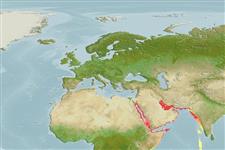
Western Indian Ocean: Red Sea and Gulf of Oman.
Size / Peso / Age
Maturità: Lm ? range ? - ? cm
Max length : 6.0 cm TL maschio/sesso non determinato; (Ref. 2272)
Short description
Chiavi di identificazione | Morfologia | Morfometria
Adults inhabit coral reefs. Oviparous. Eggs are demersal and adhesive (Ref. 205), and are attached to the substrate via a filamentous, adhesive pad or pedestal (Ref. 94114). Larvae are planktonic, often found in shallow, coastal waters (Ref. 94114). They mimic Meiacanthus nigrolineatus (Ref. 9710).
Life cycle and mating behavior
Maturità | Riproduzione | Deposizione | Uova | Fecundity | Larve
Oviparous, distinct pairing (Ref. 205).
Smith-Vaniz, W.F., 1987. The saber-toothed blennies, tribe Nemophini (Pisces: Bleniidae): an update. Proc. Acad. Nat. Sci. Philad. 139:1-52. (Ref. 7401)
IUCN Red List Status (Ref. 130435: Version 2025-1)
Threat to humans
Harmless
Human uses
Strumenti
Special reports
Download XML
Fonti Internet
Estimates based on models
Preferred temperature (Fonte Biblio.
123201): 23.8 - 29.3, mean 27.1 °C (based on 188 cells).
Phylogenetic diversity index (Fonte Biblio.
82804): PD
50 = 0.5005 [Uniqueness, from 0.5 = low to 2.0 = high].
Bayesian length-weight: a=0.00389 (0.00180 - 0.00842), b=3.12 (2.94 - 3.30), in cm total length, based on all LWR estimates for this body shape (Ref.
93245).
Trophic level (Fonte Biblio.
69278): 3.8 ±0.7 se; based on size and trophs of closest relatives
Resilienza (Fonte Biblio.
120179): Alto, tempo minimo di raddoppiamento della popolazione meno di 15 mesi (Preliminary K or Fecundity.).
Fishing Vulnerability (Ref.
59153): Low vulnerability (10 of 100).
🛈
Nutrients (Ref.
124155): Calcium = 188 [94, 361] mg/100g; Iron = 1.04 [0.59, 1.82] mg/100g; Protein = 18.3 [17.1, 19.4] %; Omega3 = 0.123 [0.064, 0.235] g/100g; Selenium = 27.3 [11.9, 63.4] μg/100g; VitaminA = 241 [85, 709] μg/100g; Zinc = 1.99 [1.25, 2.93] mg/100g (wet weight);