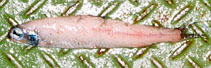
>
Argentiniformes (Marine smelts) >
Bathylagidae (Deep-sea smelts)
Etymology: Lipolagus: Greek, lipos = fat + Greek, lagos = hare (Ref. 45335); ochotensis: ochotensis which means bearing ears (Ref. 6885).
Environment: milieu / climate zone / profondeur / distribution range
Écologie
marin bathypélagique; profondeur 930 - 6100 m (Ref. 50550). Deep-water; 66°N - 36°S, 135°E - 114°W
Northwest Pacific: Suruga Bay in Japan, Sea of Okhotsk (Ref. 6885) and the Bering Sea. Northeast Pacific: off British Columbia, Canada to northern Baja California, Mexico (Ref. 6885). Southwest Pacific: Australia (Ref. 7300).
Taille / Poids / Âge
Maturité: Lm ? range ? - ? cm
Max length : 17.3 cm TL mâle / non sexé; (Ref. 80637)
Description synthétique
Clés d'identification | Morphologie | Morphométrie
Épines dorsales (Total) : 0; Rayons mous dorsaux (Total) : 10 - 12; Épines anales: 0; Rayons mous anaux: 13 - 16. Body slender and compressed. Anal fin base slightly shorter than dorsal fin base or caudal peduncle. Eye diameter longer than snout. dorsal end of gill slit reaching above midline of side of body. Traces of detached scales are not marked. Branchiostegal rays: 2 (Ref. 35604).
Body shape (shape guide): elongated; Cross section: compressed.
Oviparous. With planktonic eggs and larvae (Ref. 35604). Adults generally within mesopelagic depths (Ref. 96339).
Life cycle and mating behavior
Maturité | Reproduction | Frai | Œufs | Fécondité | Larves
Masuda, H., K. Amaoka, C. Araga, T. Uyeno and T. Yoshino, 1984. The fishes of the Japanese Archipelago. Vol. 1. Tokai University Press, Tokyo, Japan. 437 p. (text). (Ref. 559)
Statut dans la liste rouge de l'IUCN (Ref. 130435: Version 2025-1)
Menace pour l'homme
Harmless
Utilisations par l'homme
Outils
Articles particuliers
Télécharger en XML
Sources Internet
Estimates based on models
Preferred temperature (Réf.
123201): 1.6 - 2.4, mean 1.8 °C (based on 915 cells).
Phylogenetic diversity index (Réf.
82804): PD
50 = 1.0000 [Uniqueness, from 0.5 = low to 2.0 = high].
Bayesian length-weight: a=0.00617 (0.00298 - 0.01275), b=2.99 (2.80 - 3.18), in cm total length, based on LWR estimates for this species & (Sub)family-body (Ref.
93245).
Niveau trophique (Réf.
69278): 3.3 ±0.0 se; based on diet studies.
Résilience (Réf.
120179): Milieu, temps minimum de doublement de population : 1,4 à 4,4 années (Preliminary K or Fecundity.).
Fishing Vulnerability (Ref.
59153): Low vulnerability (10 of 100).
🛈