أشلاق (القروش و الشفانين) (sharks and rays) >
Myliobatiformes (Stingrays) >
Aetobatidae (Pacific eagle rays)
Etymology: Aetobatus: Greek, aetos = eagle + Greek, batis, batidos = a ray (Raja sp.) (Ref. 45335).
Eponymy: Narinari was a word used in Brazil in the 17th and 18th centuries and means ‘stingray’. [...] (Ref. 128868), visit book page.
Issue
Status of Aetobatus latirostris Duméril, 1861 requires further investigation. Species information (common names) should be linked to correct species (see Ref. 114963).
Environment: milieu / climate zone / نطاق العمق / distribution range
البيئة
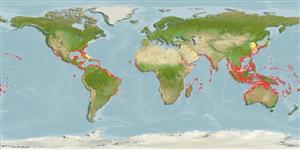
بحري; مياه مخلوطة قاعية التغذية و المعيشة; مهاجرة بين الياه الملحه و الحلوة لكن ليس للتزاوج (Ref. 51243); نطاق العمق 1 - 80 m (Ref. 9710). Subtropical; 36°N - 24°S, 98°W - 15°E
Western Atlantic and probably Eastern Atlantic. Indo-Pacific species refer to Aetobatus ocellatus; Eastern Pacific species refers to A. laticeps.
Length at first maturity / الحجم / وزن / العمر
النضج: Lm 107.4, range 110 - 120 cm
Max length : 230 cm WD ذكر/ مختلط الجنس; (Ref. 114953); common length : 140 cm WD ذكر/ مختلط الجنس; (Ref. 114953); أعلا وزن تم نشرة: 230.0 kg (Ref. 7251)
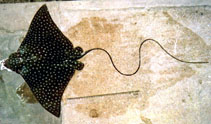
الأشواك الظهرية (المجموع) : 0; شوكة شرجية: 0. An eagleray with a long snout, flat and rounded like a duck's bill, a thick head, and a pectoral disc with sharply curved, angular corners, and no caudal fin; jaws usually with single row of flat, chevron-shaped teeth (Ref. 5578). Each tooth a crescent-shaped plate joined into a band (Ref. 26938). Numerous white spots on black or bluish disc; white below (Ref. 5578). Long whiplike tail, with a long spine near the base, behind small dorsal fin. No spines on disk (Ref. 7251).
Body shape (shape guide): other; Cross section: flattened.
Commonly found in coastal habitats to at least 60 m depth (Ref. 114953). Swims close to the surface, occasionally leaping out of the water, or close to the bottom (Ref. 3175). Frequently forming large schools during the non-breeding season (Ref. 7251). Feeds on polychaetes, bivalves, gastropods, cepahlopods, shrimps and small fishes (Ref. 114953). Ovoviviparous (Ref. 50449). Bears young in litters of 2-4 (Ref. 26938, 114953).
Life cycle and mating behavior
النضج | التكاثر | وضع البيض | بيض | الخصوبة | Larvae
Exhibit ovoviparity (aplacental viviparity), with embryos feeding initially on yolk, then receiving additional nourishment from the mother by indirect absorption of uterine fluid enriched with mucus, fat or protein through specialised structures (Ref. 50449). Bears up to 4 young (Ref. 5578, 6871, 37816). Width at birth 17-35 cm (Ref. 37816).
According to Uchida et al (1990) (Ref. 51119) 'the male chases the female in mid water, then nibbles on her dorsal surface. The female stops swimming to begin copulation. The male bites the female on a pectoral fin and bends one clasper forward, then attempts an abdomen to abdomen copulation with either clasper, usually mid-water' (Ref. 49562). Copulation lasted for 20 seconds to 1 minute (Ref. 49562).
Last, P.R., W.T. White, M.R. de Carvalho, B. Séret, M.F.W. Stehmann and G.J.P. Naylor, 2016. Rays of the world. CSIRO Publishing, Comstock Publishing Associates. i-ix + 1-790. (Ref. 114953)
IUCN Red List Status (Ref. 130435: Version 2025-1)
خطر للأنسان
Traumatogenic (Ref. 4690)
استخدامات بشرية
مصائد: غير مهمة تجارياً
أدوات
تقارير خاصة
Download XML
مصادر علي الأنترنت
Estimates based on models
Preferred temperature (مرجع
123201): 22.3 - 29, mean 27.5 °C (based on 4014 cells).
Phylogenetic diversity index (مرجع
82804): PD
50 = 0.5625 [Uniqueness, from 0.5 = low to 2.0 = high].
Bayesian length-weight: a=0.01000 (0.00244 - 0.04107), b=3.04 (2.81 - 3.27), in cm total length, based on all LWR estimates for this body shape (Ref.
93245).
مستوى غذائي (مرجع
69278): 4.2 ±0.1 se; based on diet studies.
المرونه (مرجع
120179): منخفظ جدا, الحد الزمني الأدني لتضاعف عدد أفراد المجتمع أكثر من 14 سنة (tm=4-6; Fec=1-2).
Prior r = 0.06, 95% CL = 0.04 - 0.09, Based on 1 data-limited stock assessment.
Fishing Vulnerability (Ref.
59153): Very high vulnerability (84 of 100).
🛈
Nutrients (Ref.
124155): Calcium = 9.92 [1.89, 44.45] mg/100g; Iron = 0.495 [0.123, 1.361] mg/100g; Protein = 22 [17, 27] %; Omega3 = 0.253 [0.077, 0.713] g/100g; Selenium = 25.2 [7.7, 73.8] μg/100g; VitaminA = 8.16 [2.83, 22.84] μg/100g; Zinc = 0.526 [0.255, 0.991] mg/100g (wet weight);