>
Gobiiformes (Gobies) >
Gobiidae (Gobies) > Gobiinae
Etymology: Macrodontogobius: Greek, makros = great + Greek, odous = teeth + Latin, gobius = gudgeon (Ref. 45335).
Eponymy: Dr Ray Lyman Wilbur (1875–1949) was an American physician who became the third President of Stanford University (1916–1943), which had awarded his BA (1896) and MA (1897), and the 31st US Secretary of the Interior (1929–1933) appointed by Hoover. [...] (Ref. 128868), visit book page.
More on author: Herre.
Environment: milieu / climate zone / rango de profundidad / distribution range
Ecología
marino; salobre asociado a arrecife; rango de profundidad 0 - 20 m (Ref. 48637), usually 1 - 10 m (Ref. 90102). Tropical; 15°N - 30°S
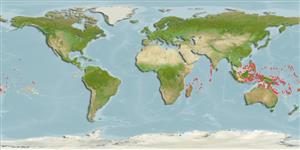
Indo-Pacific: Seychelles eastward into Oceania, including Micronesia, Fanning, and Phoenix islands.
Tamaño / Peso / Age
Madurez: Lm ? range ? - ? cm
Max length : 6.5 cm SL macho / no sexado; (Ref. 48637)
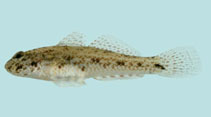
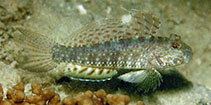
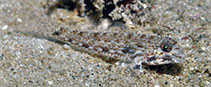
Espinas dorsales (total) : 7; Radios blandos dorsales (total) : 9 - 11; Espinas anales: 1; Radios blandos anales: 9 - 10; Vértebra: 26. Ground color of dorsal part of body greenish brown, ventral whitish yellow; a black spot at base of caudal fin; 7 dark brown blotches longitudinally arranged in mid-lateral area; black spots on cheeks and operculae, one ventral to the eye; pectoral fins hyaline; white pelvic fins. Pigment intensity variable among localities. 7 or less predorsal scales. Large, ctenoid scales except for cycloid scales in isthmus (Ref. 403); pelvic fins united with well-developed frenum; rounded caudal fin, slightly longer than head; longitudinal scale series 27-31; fully scaled cheek and opercle; depth of body 4.6-6.3 in SL (Ref. 90102).
Body shape (shape guide): fusiform / normal; Cross section: oval.
Inhabits coastal bays, lagoons and estuaries on fine sand along reef margins to about 20 meters depth (Ref. 48637). Solitary (Ref. 90102). Specimens collected from shallow waters to 7 m, near coral reefs. In southern Japan, the species inhabits sandy bay bottoms.
Life cycle and mating behavior
Madurez | Reproducción | Puesta | Huevos | Fecundidad | Larva
Murdy, E.O., 1985. A review of the gobiid fish genera Exyrias and Macrodontogobius, with description of a new species of Exyrias. Indo-Pac. Fish. (10):14 p. (Ref. 403)
IUCN Red List Status (Ref. 130435: Version 2025-1)
Threat to humans
Harmless
Human uses
Herramientas
Special reports
Download XML
Fuentes de Internet
Estimates based on models
Preferred temperature (Referencia
123201): 25.4 - 29.3, mean 28.5 °C (based on 2331 cells).
Phylogenetic diversity index (Referencia
82804): PD
50 = 1.0000 [Uniqueness, from 0.5 = low to 2.0 = high].
Bayesian length-weight: a=0.01023 (0.00477 - 0.02194), b=3.01 (2.83 - 3.19), in cm total length, based on LWR estimates for this (Sub)family-body shape (Ref.
93245).
Nivel trófico (Referencia
69278): 2.8 ±0.4 se; based on diet studies.
Resiliencia (Referencia
120179): Alto, población duplicada en un tiempo mínimo inferior a 15 meses (Preliminary K or Fecundity.).
Fishing Vulnerability (Ref.
59153): Low vulnerability (10 of 100).
🛈
Nutrients (Ref.
124155): Calcium = 162 [79, 360] mg/100g; Iron = 0.94 [0.46, 1.78] mg/100g; Protein = 18.5 [16.5, 20.1] %; Omega3 = 0.157 [0.068, 0.304] g/100g; Selenium = 19.1 [9.4, 46.5] μg/100g; VitaminA = 138 [36, 473] μg/100g; Zinc = 2.94 [1.92, 4.37] mg/100g (wet weight);