>
Blenniiformes (Blennies) >
Blenniidae (Combtooth blennies) > Salariinae
Etymology: Hypsoblennius: Greek, hypsi = high + Greek, blennios = mucus (Ref. 45335); invemar: Invemar (acronym) = in honor of the Instituto de Investigaciones Marinas de Punta Betin at Santa Marta, Colombia (Ref. 94455).
Environment: milieu / climate zone / εύρος βάθους / distribution range
Οικολογία
Θαλασσινό(ά) βενθικό(ς); εύρος βάθους 1 - 5 m. Tropical; 30°N - 9°N
Western Atlantic: Louisiana, USA and the Gulf of Mexico (Ref. 13628) to Rio de Janeiro, Brazil (Ref. 57756).
Μέγεθος / Βάρος / Age
Γεννητική Ωρίμανση: Lm ? range ? - ? cm
Max length : 5.8 cm TL αρσενικό/απροσδιόριστο; (Ref. 7251)
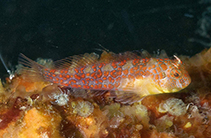
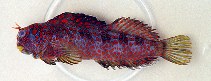
Ραχιαίες άκανθες (συνολικά) : 12; Μαλακές ραχιαίες ακτίνες (συνολικά) : 12; Εδρικές άκανθες: 2; Μαλακές εδρικές ακτίνες: 14. Head and usually pectoral fin base have orange spots on dark background. Black spot on side of head behind eye (Ref. 26938). Gill opening extending ventrally to below level of ventralmost pectoral-fin ray; segmented dorsal-fin rays 11 or 12; segmented pelvic-fin rays 4; last dorsal-fin spine 3.7 to 7.5% SL (Ref. 10696).
Body shape (shape guide): elongated.
Adults live in attached, empty barnacle shells in clear waters, usually on pilings, buoys and rock ledges at or near surface. Recorded from oil platforms. Oviparous. Eggs are demersal and adhesive (Ref. 205), and are attached to the substrate via a filamentous, adhesive pad or pedestal (Ref. 94114). Larvae are planktonic, often found in shallow, coastal waters (Ref. 94114).
Life cycle and mating behavior
Γεννητική Ωρίμανση | Αναπαραγωγή | Γεννοβολία | Αβγά | Γονιμότητα | Προνύμφες
Oviparous, distinct pairing (Ref. 205).
Robins, C.R. and G.C. Ray, 1986. A field guide to Atlantic coast fishes of North America. Houghton Mifflin Company, Boston, U.S.A. 354 p. (Ref. 7251)
IUCN Red List Status (Ref. 130435: Version 2025-1)
Threat to humans
Harmless
Human uses
Εργαλεία
Special reports
Download XML
Διαδικτυακές πηγές
Estimates based on models
Preferred temperature (Αναφ.
123201): 24 - 28.2, mean 27.1 °C (based on 416 cells).
Phylogenetic diversity index (Αναφ.
82804): PD
50 = 0.5000 [Uniqueness, from 0.5 = low to 2.0 = high].
Bayesian length-weight: a=0.00776 (0.00356 - 0.01695), b=3.00 (2.81 - 3.19), in cm total length, based on LWR estimates for this (Sub)family-body shape (Ref.
93245).
Τροφικό Επίπεδο (Αναφ.
69278): 2.9 ±0.2 se; based on size and trophs of closest relatives
Ελαστικότητα (Αναφ.
120179): Υψηλό, ελάχιστος χρόνος για διπλασιασμό πληθυσμού < 15 μήνες (Preliminary K or Fecundity.).
Fishing Vulnerability (Ref.
59153): Low vulnerability (10 of 100).
🛈
Nutrients (Ref.
124155): Calcium = 640 [371, 1,528] mg/100g; Iron = 1.96 [1.09, 3.53] mg/100g; Protein = 17.4 [16.3, 18.4] %; Omega3 = 0.141 [0.066, 0.294] g/100g; Selenium = 29.1 [12.9, 68.4] μg/100g; VitaminA = 36.5 [11.1, 125.9] μg/100g; Zinc = 2.95 [1.96, 4.39] mg/100g (wet weight);