



Nemacheilus masyae Smith, 1933
Arrow loach
Carica il tuo foto e Video
Immagini | Google image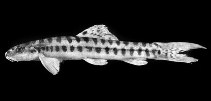 Nemacheilus masyae
Immagine di Ott, G.
Immagini | Google image
Immagine di Ott, G.
Classificazione / Nomi Nomi Comuni | Sinonimi | Catalog of Fishes(Genere, Specie) | ITIS | CoL | WoRMS | Cloffa
> Cypriniformes (Carps) > Nemacheilidae (Brook loaches)
Etymology: Nemacheilus: Greek, nema, -atos = filament + Greek, cheilos = lip (Ref. 45335); masyae: Named for a man.
Eponymy: Luang Masya Chitrakarn (1896–1965), also known as Prasop Teeranunt, was a Thai ichthyologist and illustrator of fishes, renowned for his skill with both brush and pen who worked for the Siamese Department of Fisheries. [...] (Ref. 128868), visit book page.
More on author: Smith.
Etymology: Nemacheilus: Greek, nema, -atos = filament + Greek, cheilos = lip (Ref. 45335); masyae: Named for a man.
Eponymy: Luang Masya Chitrakarn (1896–1965), also known as Prasop Teeranunt, was a Thai ichthyologist and illustrator of fishes, renowned for his skill with both brush and pen who worked for the Siamese Department of Fisheries. [...] (Ref. 128868), visit book page.
More on author: Smith.
Ambiente: milieu / zona climatica / distribuzione batimetrica / gamma di distribuzione Ecologia
; acqua dolce benthopelagico. Tropical
Distribuzione Territories | Aree FAO | Ecosistemi | Presenze | Mappa dei ritrovamenti | Introduzioni | Faunafri
Asia: western Malaysia, Peninsular Thailand, the Meklong and part of the Mae Nam Chao Phraya basins (Ref. 39226). Likely to occur in the Mekong basin (Ref. 12693).
Dimensione / Peso / Età
Breve descrizione Chiavi di identificazione | Morfologia | Morfometria
Raggi dorsali molli (totale) : 13; Raggi anali molli: 8. Distinguished from all other species of nemacheilines in Indochinese area by its color pattern consisting of a light background with 14-18 dark blotches along sides and 12-17 dark saddles along the back, a black spot at posterior extremity of lateral line and a black spot on anterior dorsal rays at about one fourth of ray length. From the closely related N. pallidus, it is distinguished by a slender body (body depth 12.6-17.6% SL versus 14.8-19.1), eye situated more on the top of head (interorbital width 4.9-6.8% SL, versus 5.7-8.0; and darker and wider markings (spots and saddles usually wider than interspaces, versus thinner).
Body shape (shape guide): eel-like.
Body shape (shape guide): eel-like.
Inhabits shallow depths of 2 m or less in rivers and streams with moderate current and muddy to sandy bottoms (Ref. 12693). Occurs in forest streams flowing clear and slightly black waters, as well as in turbid waters (Ref. 39226). Feeds on insect larvae and aquatic invertebrates (Ref. 39226).
Ciclo vitale e comportamento di accoppiamento Maturità | Riproduzione | Deposizione | Uova | Fecondità | Larve
Riferimento principale
Caricare le referenze | Bibliografia | Coordinatore | Collaboratori
Rainboth, W.J., 1996. Fishes of the Cambodian Mekong. FAO species identification field guide for fishery purposes. FAO, Rome, 265 p. (Ref. 12693)
Stato della Lista Rossa IUCN (Ref. 130435: Version 2025-2 (Global))
Least Concern (LC) ; Date assessed: 09 August 2019
CITES
Not Evaluated
Minaccia per l'uomo
Harmless
Usi umani
Pesca: commerciale; Acquario: Commerciale
FAO - Publication: search | FishSource |
Informazioni ulteriori
Ecologia trofica
Articoli alimentari (prede)
Alimentazione
Consumo di cibo
Razioni alimentari
Predatori
Articoli alimentari (prede)
Alimentazione
Consumo di cibo
Razioni alimentari
Predatori
Dinamica della popolazione
Parametri di crescita
Età massima / dimensioni massime
Rapporto lunghezza-peso.
Lunghezza-lunghezza rel.
Lunghezza-frequenze
Conversione di massa
Reclutamento
Abbondanza
Parametri di crescita
Età massima / dimensioni massime
Rapporto lunghezza-peso.
Lunghezza-lunghezza rel.
Lunghezza-frequenze
Conversione di massa
Reclutamento
Abbondanza
Ciclo di vita
Riproduzione
Maturità
Maturità/Gli occhielli sono relativi.
Fecondità
Deposizione
Aggregazioni riproduttive
Uova
Sviluppo delle uova
Larve
Dinamica popolazioni larvali
Riproduzione
Maturità
Maturità/Gli occhielli sono relativi.
Fecondità
Deposizione
Aggregazioni riproduttive
Uova
Sviluppo delle uova
Larve
Dinamica popolazioni larvali
Anatomia
Area branchiale
Cervello
Otolite
Area branchiale
Cervello
Otolite
Fisiologia
Composizione corporea
Nutrienti
Consumo di ossigeno
Tipo di nuoto
Velocità di nuoto
Pigmenti visivi
Suono del pesce
Malattie e parassiti
Tossicità (LC50)
Composizione corporea
Nutrienti
Consumo di ossigeno
Tipo di nuoto
Velocità di nuoto
Pigmenti visivi
Suono del pesce
Malattie e parassiti
Tossicità (LC50)
Genetica
Genome
Genetica
Eterozigosi
Ereditarietà
Diversità genetica
Genome
Genetica
Eterozigosi
Ereditarietà
Diversità genetica
Legato all'uomo
Sistemi di acquacoltura
Profili di acquacoltura
Varietà
Casi di Ciguatera
Francobolli, monete, materiale vario.
Sistemi di acquacoltura
Profili di acquacoltura
Varietà
Casi di Ciguatera
Francobolli, monete, materiale vario.
Strumenti
Libro elettronico | Giuda pratica | Chiavi di identificazione | Generatore frequenze di lunghezza | Strumento Parametri Biologici | Mappa dei ritrovamenti |
Cattura-MSY |
Rapporti speciali
Controllo della manutenzione dell'acquario | Verificare la presenza di schede informative sulle specie | Verifica delle schede informative sull'acquacoltura
Scarica XML
Fonti Internet
AFORO (otoliths) | Aquatic Commons | BHL | Cloffa | Websites from users | Check FishWatcher | CISTI | Catalog of Fishes: Genere, Specie | DiscoverLife | ECOTOX | FAO - Publication: search | Faunafri | Fishipedia | Fishtrace | GloBI | Google Books | Google Scholar | Google | IGFA World Record | OneZoom | Open Tree of Life | Otolith Atlas of Taiwan Fishes | PubMed | Reef Life Survey | Socotra Atlas | TreeBase | Tree of Life | Wikipedia: Go, ricerca | World Records Freshwater Fishing | Zoobank | Record zoologico
Stime basate su modelli
Indice di diversità filogenetica (Fonte Biblio. 82804): PD50 = 0.5000 [Uniqueness, from 0.5 = low to 2.0 = high].
Bayesian length-weight: a=0.00148 (0.00056 - 0.00392), b=3.07 (2.84 - 3.30), in cm total length, based on LWR estimates for this (Sub)family-body shape (Ref. 93245).
Livello trofico (Fonte Biblio. 69278): 3.0 ±0.31 se; based on food items.
Resilienza (Fonte Biblio. 120179): Medio, tempo minimo di raddoppiamento della popolazione 1.4 - 4.4 anni (Preliminary K or Fecundity.).