



Tor tambroides (Bleeker, 1854)
Thai mahseer
Uploaden van uw Foto's en video's
Afbeeldingen | Google afbeelding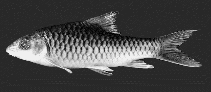 Tor tambroides
Afbeelding van Roberts, T.R.
Afbeeldingen | Google afbeelding
Afbeelding van Roberts, T.R.
Classificatie / Namen Lokale namen | Synoniemen | Catalog of Fishes(Genus, Soort(en)) | ITIS | CoL | WoRMS | Cloffa
Milieu: milieu / Klimaatzone / Diepte / verspreidingsgebied Ecologie
; zoet water benthopelagisch. Tropical
Verspreiding Gebieden | FAO regio's | Ecosystemen | Voorkomen | Verspreidingskaart | Introducties | Faunafri
Asia: Chao Phraya and Mekong basins, Malay Peninsula, Sumatra, Java, and Borneo (Ref. 27732). Reported from Myanmar (Ref. 7050), Salween and Maeklong rivers (Ref. 26336).
Lengte bij maturiteit / Grootte / Gewicht / Leeftijd
Maturiteit: Lm 67.8, range 61 - 74.9 cm
Max length : 100.0 cm SL mannelijk / geslacht onbekend; (Ref. 30857)
Max length : 100.0 cm SL mannelijk / geslacht onbekend; (Ref. 30857)
Korte beschrijving Determinatiesleutels | Morfologie | Morfometrie
Dorsale stekels (totaal) : 4; Dorsale zachte stralen (totaal) : 8; Anale stekels: 3; Anale zachte stralen: 5; Wervels: 39 - 41. Has a long more or less square, median lobe on the lower lip reaching an imaginary line between the corners of the mouth (in specimens > about 7 cm SL); upper lip rolled backwards and upwards and with a median lobe projecting upwards; no dark longitudinal stripe along the side in adults; fins blackish in large adults, yellow in juveniles, and usually 4+1/2 scales between the lateral line and the dorsal-fin origin (Ref. 27732); has 9 branched dorsal-fin rays (Ref. 12693); eyes visible in ventral view; body deep and compressed; isthmus with small distinct scales, about 16 scales between isthmus and origin of pelvic fin; gill rakers 20; supero-posterior margin of dorsal fin deeply concave; pelvic fin tip pointed, posterior margin obviously concave; tip of anal fin pointed, extending to the base of caudal fin (Ref. 13848). Also Ref. 35913.
Body shape (shape guide): fusiform / normal.
Body shape (shape guide): fusiform / normal.
Adults inhabit pools and runs over gravel and cobble in rivers flowing through undisturbed forests (Ref. 12693). Juveniles were most commonly collected in or near rapids (Ref. 27732). Found in small rivers and streams during the dry season. Move downstream at the onset of the rainy season, but generally avoid turbid waters. Mature individuals migrate upstream after two months and spawn in July near the mouths of small streams that the young subsequently ascend. Omnivorous, feeding on both animal and vegetable matter, at times consuming toxic fruits in flooded forests, making them temporarily inedible.
Levenscyclus en paargedrag Maturiteit | Voortplanting | Paaien | Eieren | Fecunditeit | Larven
Hoofdreferentie
Upload uw referenties | Referenties | Coördinator | Medewerkers
Kottelat, M., 2001. Fishes of Laos. WHT Publications Ltd., Colombo 5, Sri Lanka. 198 p. (Ref. 43281)
Status op de Rode Lijst van het IUCN (Ref. 130435: Version 2025-2 (Global))
Onvoldoende gegevens (DD) ; Date assessed: 01 August 2018
CITES
Not Evaluated
Gevaar voor de mens
Harmless
Gebruik door de mens
Visserij: commercieel; Aquacultuur: commercieel
FAO - Publication: search | FishSource |
Meer informatie
Trofische ecologie
Voedsel (prooien)
Dieetsamenstelling
Voedselconsumptie
Voedselrantsoenen
Predatoren
Voedsel (prooien)
Dieetsamenstelling
Voedselconsumptie
Voedselrantsoenen
Predatoren
Populatiedynamica
Groeiparameters
Max. leeftijden / maten
Lengte-gewicht rel.
Lengte-lengte rel.
Lengtefrequenties
Massaconversie
Rekrutering
Abundantie
Groeiparameters
Max. leeftijden / maten
Lengte-gewicht rel.
Lengte-lengte rel.
Lengtefrequenties
Massaconversie
Rekrutering
Abundantie
Levenscyclus
Voortplanting
Maturiteit
Rijpheid/kieuwen rel.
Fecunditeit
Paaien
Paaibestanden
Eieren
Ontwikkeling van de eieren
Larven
Larvale populatiedynamiek
Voortplanting
Maturiteit
Rijpheid/kieuwen rel.
Fecunditeit
Paaien
Paaibestanden
Eieren
Ontwikkeling van de eieren
Larven
Larvale populatiedynamiek
Anatomie
Kieuwoppervlak
Hersenen
Otoliet
Kieuwoppervlak
Hersenen
Otoliet
Fysiologie
Lichaamssamenstelling
Voedingsstoffen
Zuurstofverbruik
Type zwemmen
Zwemsnelheid
Visuele pigmenten
Vis geluid
Ziekten en parasieten
Toxiciteit (LC50)
Lichaamssamenstelling
Voedingsstoffen
Zuurstofverbruik
Type zwemmen
Zwemsnelheid
Visuele pigmenten
Vis geluid
Ziekten en parasieten
Toxiciteit (LC50)
Menselijk gerelateerd
Aquacultuursystemen
Aquacultuurprofielen
Kweeklijnen
Ciguatera gevallen
Postzegels, munten, diversen.
Aquacultuursystemen
Aquacultuurprofielen
Kweeklijnen
Ciguatera gevallen
Postzegels, munten, diversen.
Tools
Biologische quiz | E-boek | Veldgids | Determinatiesleutels | Lengtefrequentie Tool | Levenscyclus tool | Verspreidingskaart |
Vangst-MSY |
Speciale rapporten
Bekijk gegevens voor het houden in een aquarium | Bekijk Fact Sheets voor de soort | Bekijk Aquacultuur Fact Sheets
Download XML
Internetbronnen
AFORO (otoliths) | Aquatic Commons | BHL | Cloffa | Websites from users | Bekijk FishWatcher | CISTI | Catalog of Fishes: Genus, Soort(en) | DiscoverLife | ECOTOX | FAO - Publication: search | Faunafri | Fishipedia | Fishtrace | GloBI | Google Books | Google Scholar | Google | IGFA World Record | OneZoom | Open Tree of Life | Otolith Atlas of Taiwan Fishes | PubMed | Reef Life Survey | Socotra Atlas | TreeBase | Tree of Life | Wikipedia: ga naar, zoek | World Records Freshwater Fishing | Zoological Record
Schattingen op basis van modellen
Fylogenetische diversiteitsindex (Ref. 82804): PD50 = 0.5000 [Uniqueness, from 0.5 = low to 2.0 = high].
Bayesian length-weight: a=0.00955 (0.00430 - 0.02123), b=3.02 (2.83 - 3.21), in cm total length, based on LWR estimates for this (Sub)family-body shape (Ref. 93245).
Trofisch niveau (Ref. 69278): 2.0 ±0.00 se; based on food items.
Weerstandsvermogen (Ref. 120179): laag, minimale populatieverdubbelingstijd 4,5-14 jaar (Assuming tm>4; Fec=11,150).