



Sternopygus macrurus (Bloch & Schneider, 1801)
Longtail knifefish
Hochladen Photos und videos
Bilder | Google Bild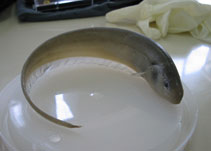 Sternopygus macrurus
Photo von Galtier Delbosc, M.
Bilder | Google Bild
Photo von Galtier Delbosc, M.
Klassifizierung / Names Namen | Synonyme | Catalog of Fishes(Gattung, Arten) | ITIS | CoL | WoRMS | Cloffa
> Gymnotiformes (Knifefishes) > Sternopygidae (Glass knifefishes) > Sternopyginae
Etymology: Sternopygus: Greek, sternon = sternon, + Greek, pyge = tail (Ref. 45335).
More on authors: Bloch & Schneider.
Etymology: Sternopygus: Greek, sternon = sternon, + Greek, pyge = tail (Ref. 45335).
More on authors: Bloch & Schneider.
Umwelt: Milieu / Klimazone / Tiefenbereich / Verbreitungsgebiet Ökologie
; süßwasser benthopelagisch; pH range: 6.0 - 6.5; dH range: 4 - 15. Tropical; 22°C - 28°C (Ref. 2059)
Verbreitung Territorien | FAO Gebiete | Ökosysteme | Vorkommen | Punkt Karte | Einführungen | Faunafri
South America: Magdalena River basin; entire extent of the Amazon and Orinoco River basins below approximately 500 m elevation including Napo River of western Ecuador and Madre de Dios River of Peru; all drainages of the Guianas Shield; Atlantic drainages of northeastern Brazil (Tocantins, Parnaíba, Pindaré, Itapicuru, and Salgado rivers); São Francisco River basin; Rio de Janeiro, Brazil; Paraguay-Paraná River basin.
Länge bei der ersten Reifung / Größe / Gewicht / Alter
Geschlechtsreife: Lm 25.0, range 20 - 30 cm
Max length : 141 cm TL Männchen/unbestimmt; (Ref. 39524)
Max length : 141 cm TL Männchen/unbestimmt; (Ref. 39524)
Kurzbeschreibung Bestimmungsschlüssel | Morphologie | Morphometrie
Afterflossenweichstrahlen: 195 - 300.
Body shape (shape guide): elongated.
Body shape (shape guide): elongated.
Occurs in swamps, creeks, and river with lentic waters. Preys on small invertebrates, particularly the larvae of aquatic insects (Ref. 12225). Breeds before the start of the rainy season (Ref. 10645) or during the rainy season, with a fecundity count of 6473 eggs (Ref. 10643). Males persistently defend their territory and apparently make electric signals (by increased electric organ discharge (EOD) rates and interruptions thereof) to females passing by to draw in a spawning partner (Ref. 10605). Mature females' EODs are of higher frequencies than mature males (Ref. 10645). Plasma androgens modulate the EOD frequency during the breeding season (Ref. 10767). Embryos hatch on day 4; larvae begin to feed on day 11. The electric organ and electroreceptors are both present in the larva at the time of first exogenous feeding (Ref. 10605). Seems to reach sexual maturity at 1 year of age, based on breeding experiments (Ref. 10011).
Lebenszyklus und Paarungsverhalten Geschlechtsreife | Fortpflanzung | Ablaichen | Eier | Fruchtbarkeit | Larven
Eggs of 3 mm diameter are deposited among plants. Larvae hatch after 4 days and start feeding after 11 days.
Hauptreferenz
Laden Sie Ihre Referenzen hoch | Referenzen | Koordinator : Albert, James S. | Partner
Ortega, H. and R.P. Vari, 1986. Annotated checklist of the freshwater fishes of Peru. Smithson. Contrib. Zool. (437):1-25. (Ref. 6329)
IUCN Rote Liste Status (Ref. 130435: Version 2025-2 (Global))
nicht bedroht (LC) ; Date assessed: 03 December 2020
CITES
Not Evaluated
Bedrohung für Menschen
Harmless
Nutzung durch Menschen
Fischereien: kommerziell; Aquarium: Kommerziell
FAO - Publication: search | FishSource |
Mehr Information
Trophische Ökologie
Lebensmittel (Beutetiere)
Nahrungszusammensetzung
Nahrungsaufnahme
Lebensmittelrationen
Räuber
Lebensmittel (Beutetiere)
Nahrungszusammensetzung
Nahrungsaufnahme
Lebensmittelrationen
Räuber
Populationsdynamik
Wachstumsparameter
Max. Alter/Größen
Länge-Gewicht-Rel.
Länge-Länge-Verhältnis.
Längenhäufigkeiten
Massenkonvertierung
Rekrutierung
Dichte
Wachstumsparameter
Max. Alter/Größen
Länge-Gewicht-Rel.
Länge-Länge-Verhältnis.
Längenhäufigkeiten
Massenkonvertierung
Rekrutierung
Dichte
Lebenszyklus
Fortpflanzung
Geschlechtsreife
Reifung/Kiemen rel.
Fruchtbarkeit
Ablaichen
Laichaggregationen
Eier
Eientwicklung
Larven
Larven Pop.Dyn.
Fortpflanzung
Geschlechtsreife
Reifung/Kiemen rel.
Fruchtbarkeit
Ablaichen
Laichaggregationen
Eier
Eientwicklung
Larven
Larven Pop.Dyn.
Anatomie
Kiemenoberfläche
Gehirn
Otolith
Kiemenoberfläche
Gehirn
Otolith
Physiologie
Körperliche Zusammensetzung
Nährstoffe
Sauerstoffverbrauch
Schwimmart
Schwimmgeschwindigkeit
Visuelle Pigmente
Fischgeräusche
Krankheiten und Parasiten
Toxizität (LC50s)
Körperliche Zusammensetzung
Nährstoffe
Sauerstoffverbrauch
Schwimmart
Schwimmgeschwindigkeit
Visuelle Pigmente
Fischgeräusche
Krankheiten und Parasiten
Toxizität (LC50s)
Menschenbezogen
Aquakultur-Systeme
Aquakultur Profile
Zuchtlinien
Ciguatera-Fälle
Briefmarken, Münzen, Verschiedenes.
Aquakultur-Systeme
Aquakultur Profile
Zuchtlinien
Ciguatera-Fälle
Briefmarken, Münzen, Verschiedenes.
Tools
Zusatzinformationen
Download XML
Zusammenfassung | Punktdaten | Namen | Photos
Internet Quellen
AFORO (otoliths) | Aquatic Commons | BHL | Cloffa | Websites from users | FishWatcher Einträge suchen | CISTI | Catalog of Fishes: Gattung, Arten | DiscoverLife | ECOTOX | FAO - Publication: search | Faunafri | Fishipedia | Fishtrace | GloBI | Google Books | Google Scholar | Google | IGFA World Record | OneZoom | Open Tree of Life | Otolith Atlas of Taiwan Fishes | PubMed | Reef Life Survey | Socotra Atlas | TreeBase | Tree of Life | Wikipedia: Gehe zu, Suchen | World Records Freshwater Fishing | Zoologischer Rekord
Schätzungen auf der Grundlage von Modellen
Phylogenetischer Diversitätsindex (Ref. 82804): PD50 = 0.5010 [Uniqueness, from 0.5 = low to 2.0 = high].
Bayesian length-weight: a=0.00309 (0.00180 - 0.00531), b=2.84 (2.69 - 2.99), in cm total length, based on LWR estimates for this species & (Sub)family-body (Ref. 93245).
Trophische Ebene (Ref. 69278): 3.2 ±0.40 se; based on food items.