



Adicionar o seu Fotografias e vídeos
Fotografias | Selos, moedas, diversos. | Imagem do Google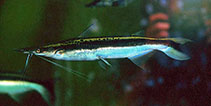 Sorubim lima
Fotografia de JJPhoto
Fotografias | Selos, moedas, diversos. | Imagem do Google
Fotografia de JJPhoto
Classificação / Nomes Nomes comuns | Sinónimos | Catalog of Fishes(Género, Espécies) | ITIS | CoL | WoRMS | Cloffa
> Siluriformes (Catfishes) > Pimelodidae (Long-whiskered catfishes)
Etymology: Sorubim: Brazilian local name, sorubim (Ref. 45335); lima: Name from Latin 'lima' meaning file, referring to the ventrally exposed premaxillary tooth patch (Ref. 57983).
More on authors: Bloch & Schneider.
Etymology: Sorubim: Brazilian local name, sorubim (Ref. 45335); lima: Name from Latin 'lima' meaning file, referring to the ventrally exposed premaxillary tooth patch (Ref. 57983).
More on authors: Bloch & Schneider.
Ambiente: milieu / zona climática / intervalo de profundidade / gama de distribuição Ecologia
; Água doce demersal; pH range: 6.5 - 7.8; dH range: ? - 20; potamódromo (Ref. 138143). Tropical; 23°C - 30°C (Ref. 1672); 8°N - 11°S
Distribuição Territórios | Áreas FAO | Ecossistemas | Ocorrências | Mapa dos pontos | Introduções | Faunafri
South America: Amazon, Orinoco, Paraná and Parnaíba River basins. Syntopic with S. elongatus in the Orinoco basin and with S. elongatus and S. maniradii in the upper Amazon drainage of Brazil, Ecuador, Peru, and Bolivia (Ref. 57983).
Comprimento na primeira maturidade / Tamanho / Peso / Idade
Maturidade: Lm 23.2 range ? - ? cm
Max length : 54.2 cm TL macho/indeterminado; (Ref. 79585); peso máx. Publicado: 1.3 kg (Ref. 40637)
Max length : 54.2 cm TL macho/indeterminado; (Ref. 79585); peso máx. Publicado: 1.3 kg (Ref. 40637)
Descrição breve Chaves de identificação | Morfologia | Morfometria
Espinhos dorsais (total) : 2; Raios dorsais moles (total) : 6; Raios anais moles: 19 - 22. Distinguished from S. elongatus by having modally 9 pectoral rays; 21 anal-fin rays; 16 gill rakers; large vomerine tooth patches, almost always fused; a more robust, deeper head and body; body somewhat compressed laterally; mental barbels equal or anterior to gular apex. Differs from S. cuspicaudus in having rounded caudal fin lobes and more robust body; from S. trigonocephalus by premaxillary tooth patch length being 1.5 to 2.5 times its width; trenchantly differs from S. maniradii in having only 13-18 gill rakers. Additionally, other distinguishing characters include, pelvic fins that contact or nearly reach anal fin origin when depressed and presence of thin plates or ossicles (highly variable in shape) extending vertically on anterior lateral line in most large adults (Ref. 57983).
Body shape (shape guide): elongated.
Body shape (shape guide): elongated.
Adults occur in schools and are mainly nocturnal. They feed primarily on fishes and crustaceans (Ref. 9084).
Ciclo de vida e comportamento de acasalamento Maturidade | Reprodução | Desova | Ovos | Fecundidade | Larvas
Verify.
Referência principal
Carregar as suas referências | Referências | Coordenador | Colaboradores
Lundberg, J.G. and M.W. Littmann, 2003. Pimelodidae (Long-whiskered catfishes). p. 432-446. In R.E. Reis, S.O. Kullander and C.J. Ferraris, Jr. (eds.) Checklist of the Freshwater Fishes of South and Central America. Porto Alegre: EDIPUCRS, Brasil. (Ref. 36506)
Categoria na Lista Vermelha da IUCN (Ref. 130435: Version 2025-2 (Global))
Preocupação menor (LC) ; Date assessed: 07 November 2018
CITES
Not Evaluated
Ameaça para o homem
Harmless
Utilização humana
Pescarias: pouco comercial; Aquário: Espécies comerciais
FAO - Sistemas de aquacultura: produção; ; Publication: search | FishSource |
Mais informação
Ecologia Trófica
Produtos alimentares (presas)
Composição da dieta
Consumo alimentar
Rações alimentares
Predadores
Produtos alimentares (presas)
Composição da dieta
Consumo alimentar
Rações alimentares
Predadores
Dinâmica das populações
Parâmetros de crescimento
Idades / tamanhos máximos
Comprimento-peso rel.
Comprimento-comprimento rel.
Frequência de comprimento
Conversão de massa
Recrutamento
Abundância
Parâmetros de crescimento
Idades / tamanhos máximos
Comprimento-peso rel.
Comprimento-comprimento rel.
Frequência de comprimento
Conversão de massa
Recrutamento
Abundância
Ciclo de vida
Reprodução
Maturidade
Maturidade/Rel. das guelras
Fecundidade
Desova
Agregações de desova
Ovos
Desenvolvimento dos ovos
Larvas
Dinâmica larvar
Reprodução
Maturidade
Maturidade/Rel. das guelras
Fecundidade
Desova
Agregações de desova
Ovos
Desenvolvimento dos ovos
Larvas
Dinâmica larvar
Anatomia
Área branquial
Cérebro
Otólitos
Área branquial
Cérebro
Otólitos
Fisiologia
Composição corporal
Nutrientes
Consumo de oxigénio
Tipo de natação
Velocidade de natação
Pigmentos visuais
Som de peixe
Doenças e Parasitas
Toxicidade (LC50s)
Composição corporal
Nutrientes
Consumo de oxigénio
Tipo de natação
Velocidade de natação
Pigmentos visuais
Som de peixe
Doenças e Parasitas
Toxicidade (LC50s)
Relacionado com o ser humano
Sistemas de aquacultura
Perfis para aquacultura
Estirpes
Casos de Ciguatera
Selos, moedas, diversos.
Sistemas de aquacultura
Perfis para aquacultura
Estirpes
Casos de Ciguatera
Selos, moedas, diversos.
Ferramentas
Questionário orgânico | E-book | Guia de campo | Ferramenta auxiliar de frequências de comprimento | Ferramenta sobre a história de vida | Mapa dos pontos |
Captura-MSY |
Relatórios especiais
Descarregue XML
Fontes da internet
AFORO (otoliths) | Aquatic Commons | BHL | Cloffa | Websites from users | Consultar FishWatcher | CISTI | Catalog of Fishes: Género, Espécies | DiscoverLife | ECOTOX | FAO - Sistemas de aquacultura: produção; ; Publication: search | Faunafri | Fishipedia | Fishtrace | GloBI | Google Books | Google Scholar | Google | IGFA World Record | Bases de dados nacionais | OneZoom | Open Tree of Life | Otolith Atlas of Taiwan Fishes | Aquários públicos | PubMed | Reef Life Survey | Socotra Atlas | TreeBase | Árvore da vida | Wikipedia: ir para, procurar | World Records Freshwater Fishing | Registo zoológico
Estimativas baseadas em modelos
Índice de diversidade filogenética (Ref. 82804): PD50 = 0.5312 [Uniqueness, from 0.5 = low to 2.0 = high].
Bayesian length-weight: a=0.00468 (0.00311 - 0.00702), b=3.13 (3.01 - 3.25), in cm total length, based on LWR estimates for this species & Genus-body shape (Ref. 93245).
Nível Trófico (Ref. 69278): 4.1 ±0.71 se; based on food items.
Generation time: 4.1 ( na - na) years. Estimated as median ln(3)/K based on 1 growth studies.
Resiliência (Ref. 120179): Médio, tempo mínimo de duplicação da população 1,4 - 4,4 anos (K=0.27).
Nutrientes (Ref. 124155): Calcium = 95.5 [37.7, 231.7] mg/100g; Iron = 1.28 [0.70, 2.50] mg/100g; Protein = 16.7 [14.8, 18.9] %; Omega3 = 0.307 [0.130, 0.720] g/100g; Selenium = 76.9 [33.5, 186.9] μg/100g; VitaminA = 33.4 [13.1, 77.6] μg/100g; Zinc = 1.27 [0.90, 1.77] mg/100g (wet weight); based on nutrient studies.