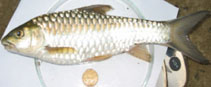
分類 / Names
俗名 | 同種異名 | Catalog of Fishes(屬, 種) | ITIS | CoL | WoRMS | Cloffa
Teleostei >
Cypriniformes (Carps)
鯉形目 (Carps) >
Cyprinidae (Minnows or carps)
鯉科 (Minnows or carps) > Torinae
Etymology: Neolissochilus: Greek, neos = new + Greek,lissos = smooth + Greek, cheilos = lip (Ref. 45335).
More on author: McClelland.
Issue
Genus Eschmeyer, pers. comm.
Environment: milieu / climate zone / 深度上下限 / distribution range
生態學
; 淡水 底中水層性; 河川洄游 (Ref. 51243). 熱帶
Asia: India, Bangladesh, Nepal, Myanmar, Thailand, Malaysia, Indonesia and China. Also in Bhutan (Ref. 40882), Pakistan and Viet Nam (Ref. 3443).
亞洲: 印度,孟加拉,尼泊爾,緬甸,泰國,馬來西亞,印尼與中國。
Length at first maturity / 大小 / 重量 / 年齡
成熟度: Lm ?, range 23 - ? cm
Max length : 120 cm TL 雄魚/尚未辨別雌雄; (Ref. 4537); 最大體重: 11.0 kg (Ref. 4832)
Adults occur in fast flowing streams and rivers with rocky bottom (Ref. 41236), mainly in the middle of streams. Omnivorous. Adults feed mainly on filamentous green algae, lesser on chironomid larvae, crustaceans and water beetles (Ref. 40961). They migrate upstream during the breeding season where spawning takes place on stones and gravel (Ref. 41864). Spawning occur from April to October with a peak in August to September. Males mature at 9 cm. Flesh is considered delicious and market demand is great.
出現於快速地流動溪流與河川有岩石的底部.(參考文獻 41236) 主要生活在溪流中游中。 雜食性。 主要吃絲狀的綠藻,較少吃寶刀魚仔魚,甲殼動物與水蟲。 (參考文獻 40961) 在繁殖季節的時候向上游迴游在哪裡產卵在石頭與礫石上發生.(參考文獻 41864) 產卵從四月到十月在八月到九月具有一個高峰。 雄性在 9 公分時成熟。 肉一般認為可口的與市場要求是大的。
Life cycle and mating behavior
成熟度 | 繁殖 | 產卵場 | 卵 | 孕卵數 | 仔魚
亞洲: 印度,孟加拉,尼泊爾,緬甸,泰國,馬來西亞,印尼與中國。
Talwar, P.K. and A.G. Jhingran, 1991. Inland fishes of India and adjacent countries. vol 1. A.A. Balkema, Rotterdam. i-liv + 1-541, 1 map (Ref. 4832)
IUCN 瀕危狀態 (Ref. 130435: Version 2025-1)
近危 (NT) ; Date assessed: 09 October 2009
人類使用
漁業: 商業性; 養殖: 商業性; 游釣魚種: 是的
工具
特別的報告
下載 XML
網路資源
Estimates based on models
Phylogenetic diversity index (參考文獻
82804): PD
50 = 0.5000 [Uniqueness, from 0.5 = low to 2.0 = high].
Bayesian length-weight: a=0.00977 (0.00520 - 0.01838), b=3.02 (2.86 - 3.18), in cm total length, based on LWR estimates for this species & (Sub)family-body (Ref.
93245).
營養階層 (參考文獻
69278): 3.0 ±0.37 se; based on food items.
回復力 (參考文獻
120179): 中等的, 族群倍增時間最少 1.4 - 4.4年 (tm=3).
Fishing Vulnerability (Ref.
59153): High to very high vulnerability (72 of 100).
🛈
Nutrients (Ref.
124155): Calcium = 221 [44, 1,161] mg/100g; Iron = 1.68 [0.63, 3.64] mg/100g; Protein = 18 [16, 20] %; Omega3 = 0.419 [0.187, 0.938] g/100g; Selenium = 96.4 [42.5, 194.0] μg/100g; VitaminA = 32.4 [14.7, 67.5] μg/100g; Zinc = 1.77 [0.90, 3.10] mg/100g (wet weight); based on
nutrient studies.