



Paraplotosus albilabris (Valenciennes, 1840)
Whitelipped eel catfish
Waarneming toevoegen in Fish Watcher
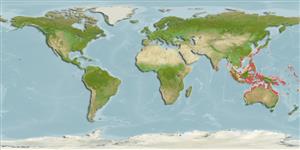
| Native range | All suitable habitat | Point map | Year 2050 |
|
| This map was computer-generated and has not yet been reviewed. |
| Paraplotosus albilabris AquaMaps Data sources: GBIF OBIS |
Uploaden van uw Foto's en video's
Afbeeldingen | Google afbeelding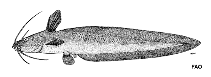 Paraplotosus albilabris
Afbeelding van FAO
Afbeeldingen | Google afbeelding
Afbeelding van FAO
Classificatie / Namen Lokale namen | Synoniemen | Catalog of Fishes(Genus, Soort(en)) | ITIS | CoL | WoRMS | Cloffa
> Siluriformes (Catfishes) > Plotosidae (Eeltail catfishes)
Etymology: Paraplotosus: Greek, para = in the side of + Greek, plotos = swimming (Ref. 45335).
More on author: Valenciennes.
Etymology: Paraplotosus: Greek, para = in the side of + Greek, plotos = swimming (Ref. 45335).
More on author: Valenciennes.
Milieu: milieu / Klimaatzone / Diepte / verspreidingsgebied Ecologie
marien; brak water rifbewoner; diepte 1 - 12 m (Ref. 90102). Tropical
Verspreiding Gebieden | FAO regio's | Ecosystemen | Voorkomen | Verspreidingskaart | Introducties | Faunafri
Indo-West Pacific: Indo-Australian Archipelago.
Grootte / Gewicht / Leeftijd
Maturiteit: Lm ? range ? - ? cm
Max length : 134 cm TL mannelijk / geslacht onbekend; (Ref. 2334); common length : 40.0 cm TL mannelijk / geslacht onbekend; (Ref. 9801)
Max length : 134 cm TL mannelijk / geslacht onbekend; (Ref. 2334); common length : 40.0 cm TL mannelijk / geslacht onbekend; (Ref. 9801)
Korte beschrijving Determinatiesleutels | Morfologie | Morfometrie
Dorsale stekels (totaal) : 1; Dorsale zachte stralen (totaal) : 104 - 115; Anale stekels: 0; Anale zachte stralen: 90 - 100. Differs from Paraplotosus butleri in having a shorter dorsal fin and shorter nasal barbels, rounded pectoral fin shape, fewer upper procurrent caudal fin rays, and fewer gill rakers. Differs from P. muelleri in having a shorter dorsal fin and smaller eye (Ref. 31103). Color highly variable, ranging from pale grey or yellowish brown to dark brown, nearly blackish, sometimes with pronounced dark mottling; generally whitish on belly and ventral part of head; fins brown to blackish, frequently darker than body (Ref. 31103).
Body shape (shape guide): elongated; Cross section: circular.
Body shape (shape guide): elongated; Cross section: circular.
In tropical areas, inhabits clear and turbid coral reefs; usually found in areas with mixed sand, weed, and coral areas (Ref. 31103). May be seen resting on sand bottoms under ledges or around coral bommies (Ref. 31103). Adults solitarily or in small groups. Presumably nocturnal (Ref. 31103). Feeds on gastropod mollusks and crustaceans (Ref. 31103). Spines associated with anterior fins have potent venom (Ref. 9801).
Levenscyclus en paargedrag Maturiteit | Voortplanting | Paaien | Eieren | Fecunditeit | Larven
Hoofdreferentie
Upload uw referenties | Referenties | Coördinator | Medewerkers
Allen, G.R., 1998. A review of the marine catfish genus Paraplotosus (Plotosidae) with the description of a new species from north-western Australia. Raf. Bull. Zool. 46(1):123-134. (Ref. 31103)
Status op de Rode Lijst van het IUCN (Ref. 130435: Version 2025-2 (Global))
Niet bedreigd (LC) ; Date assessed: 18 August 2023
CITES
Not Evaluated
Gevaar voor de mens
Venomous (Ref. 9801)
Gebruik door de mens
Visserij: van minder commercieel belang
FAO - Publication: search | FishSource |
Meer informatie
Trofische ecologie
Voedsel (prooien)
Dieetsamenstelling
Voedselconsumptie
Voedselrantsoenen
Predatoren
Voedsel (prooien)
Dieetsamenstelling
Voedselconsumptie
Voedselrantsoenen
Predatoren
Populatiedynamica
Groeiparameters
Max. leeftijden / maten
Lengte-gewicht rel.
Lengte-lengte rel.
Lengtefrequenties
Massaconversie
Rekrutering
Abundantie
Groeiparameters
Max. leeftijden / maten
Lengte-gewicht rel.
Lengte-lengte rel.
Lengtefrequenties
Massaconversie
Rekrutering
Abundantie
Levenscyclus
Voortplanting
Maturiteit
Rijpheid/kieuwen rel.
Fecunditeit
Paaien
Paaibestanden
Eieren
Ontwikkeling van de eieren
Larven
Larvale populatiedynamiek
Voortplanting
Maturiteit
Rijpheid/kieuwen rel.
Fecunditeit
Paaien
Paaibestanden
Eieren
Ontwikkeling van de eieren
Larven
Larvale populatiedynamiek
Anatomie
Kieuwoppervlak
Hersenen
Otoliet
Kieuwoppervlak
Hersenen
Otoliet
Fysiologie
Lichaamssamenstelling
Voedingsstoffen
Zuurstofverbruik
Type zwemmen
Zwemsnelheid
Visuele pigmenten
Vis geluid
Ziekten en parasieten
Toxiciteit (LC50)
Lichaamssamenstelling
Voedingsstoffen
Zuurstofverbruik
Type zwemmen
Zwemsnelheid
Visuele pigmenten
Vis geluid
Ziekten en parasieten
Toxiciteit (LC50)
Genetica
genoom
Genetica
Heterozygositeit
Erfelijkheid
Genetische diversiteit
genoom
Genetica
Heterozygositeit
Erfelijkheid
Genetische diversiteit
Menselijk gerelateerd
Aquacultuursystemen
Aquacultuurprofielen
Kweeklijnen
Ciguatera gevallen
Postzegels, munten, diversen.
Aquacultuursystemen
Aquacultuurprofielen
Kweeklijnen
Ciguatera gevallen
Postzegels, munten, diversen.
Tools
Speciale rapporten
Bekijk gegevens voor het houden in een aquarium | Bekijk Fact Sheets voor de soort | Bekijk Aquacultuur Fact Sheets
Download XML
Internetbronnen
AFORO (otoliths) | Aquatic Commons | BHL | Cloffa | Websites from users | Bekijk FishWatcher | CISTI | Catalog of Fishes: Genus, Soort(en) | DiscoverLife | ECOTOX | FAO - Publication: search | Faunafri | Fishipedia | Fishtrace | GloBI | Google Books | Google Scholar | Google | IGFA World Record | OneZoom | Open Tree of Life | Otolith Atlas of Taiwan Fishes | PubMed | Reef Life Survey | Socotra Atlas | TreeBase | Tree of Life | Wikipedia: ga naar, zoek | World Records Freshwater Fishing | Zoological Record
Schattingen op basis van modellen
Gewenste temperatuur (Ref. 123201): 24.2 - 29.3, mean 28.5 °C (based on 2310 cells).
Fylogenetische diversiteitsindex (Ref. 82804): PD50 = 0.6250 [Uniqueness, from 0.5 = low to 2.0 = high].
Bayesian length-weight: a=0.00468 (0.00210 - 0.01040), b=3.06 (2.86 - 3.26), in cm total length, based on LWR estimates for this (Sub)family-body shape (Ref. 93245).
Trofisch niveau (Ref. 69278): 3.4 ±0.54 se; based on food items.
Weerstandsvermogen (Ref. 120179): laag, minimale populatieverdubbelingstijd 4,5-14 jaar (Preliminary K or Fecundity.).
Voedingsstoffen (Ref. 124155): Calcium = 26.6 [11.5, 53.2] mg/100g; Iron = 0.437 [0.248, 0.789] mg/100g; Protein = 17.4 [15.5, 19.6] %; Omega3 = 0.0738 [, ] g/100g; Selenium = 37.8 [19.2, 80.7] μg/100g; VitaminA = 42.4 [14.3, 124.5] μg/100g; Zinc = 1.12 [0.77, 1.59] mg/100g (wet weight); based on nutrient studies.