



Cnidoglanis macrocephalus (Valenciennes, 1840)
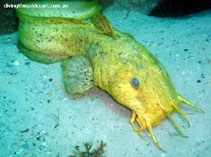
Estuary cobbler
Ajouter votre observation dans Fish Watcher
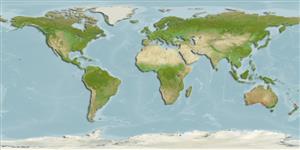
| Native range | All suitable habitat | Point map | Year 2050 |
|
| This map was computer-generated and has not yet been reviewed. |
| Cnidoglanis macrocephalus AquaMaps Data sources: GBIF OBIS |
Classification / Noms Noms communs | Synonymes | Catalog of Fishes(Genre, Espèce) | ITIS | CoL | WoRMS | Cloffa
> Siluriformes (Catfishes) > Plotosidae (Eeltail catfishes)
Etymology: Cnidoglanis: Greek, knide = nettle + Greek, glanis = a fish that can eat the bait without touching the hook; a cat fish (Ref. 45335).
More on author: Valenciennes.
Etymology: Cnidoglanis: Greek, knide = nettle + Greek, glanis = a fish that can eat the bait without touching the hook; a cat fish (Ref. 45335).
More on author: Valenciennes.
Environnement : milieu / zone climatique / profondeur / gamme de distribution Écologie
marin; saumâtre démersal; profondeur 1 - 30 m (Ref. 6390). Temperate; 28°S - 37°S
Distribution Territoires | Zones FAO | Écosystèmes | Occurrences | Carte par point | Introductions | Faunafri
Indo-Pacific: endemic to Australia. Present along both eastern and western Australian coasts, from Kirra in southern Queensland to Jervis Bay in New South Wales, and from Kingston in South Australia to the Houtman Abrolhos in Western Australia. Distributional range extension to the Duck River in Tasmania (Ref. 7300) needs verification.
Longueur à la première maturité / Taille / Poids / Âge
Maturité: Lm ?, range 41 - ? cm
Max length : 91.0 cm SL mâle / non sexé; (Ref. 33840); poids max. publié: 2.5 kg (Ref. 6390); âge max. reporté: 13 années (Ref. 6390)
Max length : 91.0 cm SL mâle / non sexé; (Ref. 33840); poids max. publié: 2.5 kg (Ref. 6390); âge max. reporté: 13 années (Ref. 6390)
Description synthétique Clés d'identification | Morphologie | Morphométrie
Épines dorsales (Total) : 1; Rayons mous dorsaux (Total) : 105 - 134; Épines anales: 0; Rayons mous anaux: 95 - 112; Vertèbres: 77 - 78.
Body shape (shape guide): elongated.
Body shape (shape guide): elongated.
An inshore marine species which lives in shallow bays and sandy inlets near river mouths (Ref. 2156). Found most frequently over sand, rocks and weeds in clear to turbid waters. By day, cobblers are most often found in holes and on ledges in banks (Ref. 6390). They are opportunistic feeders, primarily feeding at night. Food consists of bivalve and univalve mollusks, crustaceans (small prawns and amphipods), polychaete worms, algae and organic debris (Ref. 26551). Juveniles eat more crustaceans, often from among drifting macrophytic algae (Ref. 26548). Adults feed mainly on mollusks and polychaetes (Ref. 6390). They are prey to birds such as cormorants and pelicans (Ref. 26548). Presence of sharp spines on the dorsal and pectoral fins can inflict painful wounds (Ref. 2156).
Cycle de vie et comportement reproducteur Maturité | Reproduction | Frai | Œufs | Fécondité | Larves
Males guard the eggs between their pelvic fins for an unknown period in the nest which the male have constructed. The drift weeds found in inshore marine waters, protected inshore marine environments and estuaries act as nursery areas. Cobbler enter these areas during their first year of life and often remain there for long periods (Refs. 26548, 26549).
Référence principale
Téléchargez vos références | Références | Coordinateur | Collaborateurs
Paxton, J.R., D.F. Hoese, G.R. Allen and J.E. Hanley, 1989. Pisces. Petromyzontidae to Carangidae. Zoological Catalogue of Australia, Vol. 7. Australian Government Publishing Service, Canberra, 665 p. (Ref. 7300)
Statut dans la liste rouge de l'IUCN (Ref. 130435: Version 2025-2 (Global))
Données manquantes (DD) ; Date assessed: 04 February 2009
CITES
Not Evaluated
Menace pour l'homme
Venomous (Ref. 2156)
Utilisations par l'homme
Pêcheries: intérêt commercial mineur; pêche sportive: oui
FAO - Publication: search | FishSource |
Plus d'informations
Écologie trophique
Aliments (proies)
Composition du régime alimentaire
Consommation alimentaire
Rations alimentaires
Prédateurs
Aliments (proies)
Composition du régime alimentaire
Consommation alimentaire
Rations alimentaires
Prédateurs
Dynamique des populations
Paramètres de croissance
Âges / tailles maximales
Longueur-poids rel.
Rel. longueur-longueur.
Fréquences de longueurs
Conversion de masse
Recrutement
Abondance
Paramètres de croissance
Âges / tailles maximales
Longueur-poids rel.
Rel. longueur-longueur.
Fréquences de longueurs
Conversion de masse
Recrutement
Abondance
Anatomie
Surface branchiale
Cerveau
Otolithe
Surface branchiale
Cerveau
Otolithe
Physiologie
Composition corporelle
Nutriments
Consommation d'oxygène
Type de natation
Vitesse de nage
Pigments visuels
Son de poisson
Maladies et parasites
Toxicité (CL50)
Composition corporelle
Nutriments
Consommation d'oxygène
Type de natation
Vitesse de nage
Pigments visuels
Son de poisson
Maladies et parasites
Toxicité (CL50)
Génétique
génôme
Génétique
Hétérozygotie
Héritabilité
Diversité génétique
génôme
Génétique
Hétérozygotie
Héritabilité
Diversité génétique
Liées à l'homme
Systèmes d'aquaculture
Profils d'aquaculture
Souches
Cas de ciguatera
Timbres, pièces de monnaie, divers
Systèmes d'aquaculture
Profils d'aquaculture
Souches
Cas de ciguatera
Timbres, pièces de monnaie, divers
Outils
E-book | Guide de terrain | Générateur de fréquences de longueur | Outil de dynamique de population | Carte par point |
Capture-MSY |
Articles particuliers
Télécharger en XML
Sources Internet
AFORO (otoliths) | Aquatic Commons | BHL | Cloffa | Websites from users | FishWatcher | CISTI | Catalog of Fishes: Genre, Espèce | DiscoverLife | ECOTOX | FAO - Publication: search | Faunafri | Fishipedia | Fishtrace | GloBI | Google Books | Google Scholar | Google | IGFA World Record | OneZoom | Open Tree of Life | Otolith Atlas of Taiwan Fishes | PubMed | Reef Life Survey | Socotra Atlas | TreeBase | Arbre de Vie | Wikipedia: aller à, chercher | World Records Freshwater Fishing | Zoological Record
Estimations basées sur des modèles
Température préférée (Réf. 123201): 16.8 - 22.3, mean 18.2 °C (based on 192 cells).
Indice de diversité phylogénétique (Réf. 82804): PD50 = 1.0000 [Uniqueness, from 0.5 = low to 2.0 = high].
Bayesian length-weight: a=0.00468 (0.00210 - 0.01040), b=3.06 (2.86 - 3.26), in cm total length, based on LWR estimates for this (Sub)family-body shape (Ref. 93245).
Niveau trophique (Réf. 69278): 2.8 ±0.32 se; based on food items.
Generation time: 5.5 ( na - na) years. Estimated as median ln(3)/K based on 2 growth studies.
Résilience (Réf. 120179): Milieu, temps minimum de doublement de population : 1,4 à 4,4 années (tm=2-3; tmax=13; Fec=300).
Nutriments (Ref. 124155): Calcium = 35.7 [16.7, 57.7] mg/100g; Iron = 0.342 [0.202, 0.584] mg/100g; Protein = 16.6 [14.7, 18.7] %; Omega3 = 0.351 [0.187, 0.639] g/100g; Selenium = 14.9 [7.3, 31.5] μg/100g; VitaminA = 7.42 [2.66, 21.37] μg/100g; Zinc = 0.641 [0.445, 0.923] mg/100g (wet weight);