



Mycteroperca bonaci (Poey, 1860)
Black grouper
Envoyez vos Photos et vidéos
Images | vidéos | Sons | Images Google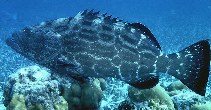 Mycteroperca bonaci
Photo de Randall, J.E.
Images | vidéos | Sons | Images Google
Photo de Randall, J.E.
Classification / Noms Noms communs | Synonymes | Catalog of Fishes(Genre, Espèce) | ITIS | CoL | WoRMS | Cloffa
> Perciformes/Serranoidei (Groupers) > Epinephelidae (Groupers)
Etymology: Mycteroperca: Greek, mykter, -eros = nose + Greek, perke = perch (Ref. 45335).
More on author: Poey.
Etymology: Mycteroperca: Greek, mykter, -eros = nose + Greek, perke = perch (Ref. 45335).
More on author: Poey.
Environnement : milieu / zone climatique / profondeur / gamme de distribution Écologie
marin récifal; profondeur 60 - 250 m (Ref. 89707). Subtropical; 33°N - 27°S, 95°W - 33°W (Ref. 5222)
Distribution Territoires | Zones FAO | Écosystèmes | Occurrences | Carte par point | Introductions | Faunafri
Western Atlantic: Bermuda and Massachusetts, USA to southern Brazil, including the southern Gulf of Mexico and the Caribbean. Adults are unknown from the northeastern coast of the USA.
Longueur à la première maturité / Taille / Poids / Âge
Maturité: Lm 67.7, range 47 - 95.1 cm
Max length : 150 cm TL mâle / non sexé; (Ref. 40637); common length : 70.0 cm TL mâle / non sexé; (Ref. 5217); poids max. publié: 100.0 kg (Ref. 26340)
Max length : 150 cm TL mâle / non sexé; (Ref. 40637); common length : 70.0 cm TL mâle / non sexé; (Ref. 5217); poids max. publié: 100.0 kg (Ref. 26340)
Description synthétique Clés d'identification | Morphologie | Morphométrie
Épines dorsales (Total) : 11; Rayons mous dorsaux (Total) : 15 - 17; Épines anales: 3; Rayons mous anaux: 11 - 13. Distinguished by the following characteristics: Side body has rectangular dark gray blotches. Outer third of second dorsal, anal and caudal fins black. Edge of preopercle smooth, without pronounced lobe at angle; 17-24 total gill rakers (Ref. 26938); depth of body 3.3-3.5 times in SL; head length 2.5-2.8 times in SL; evenly rounded preopercle, without distinct notch or lobe at the angle; subequal sizes of anterior and posterior nostrils (Ref. 89707).
Body shape (shape guide): fusiform / normal; Cross section: oval.
Body shape (shape guide): fusiform / normal; Cross section: oval.
Minimum depth from Ref. 126840. A solitary species (Ref. 26340) inhabiting rocky and coral reefs (Ref. 9710). Adults feed primarily on fishes; juveniles mainly on crustaceans. Oviparous (Ref. 205). A protogynous hermaphrodite (Ref. 55367). Forms spawning aggregations (Ref. 55367). Common but difficult to approach (Ref. 9710). Marketed fresh and its flesh is of excellent quality.
Cycle de vie et comportement reproducteur Maturité | Reproduction | Frai | Œufs | Fécondité | Larves
A monandric species (Ref. 55367). According to a study in Campeche Bank, females changed sex between 85.5 and 125.0 cm FL, with median length of 103.3 cm FL. At 114.5 cm FL, 50% of the females in the sample had transformed into males. Age at sex change = 15.5 years (Ref. 55367).
Référence principale
Téléchargez vos références | Références | Coordinateur | Collaborateurs
Heemstra, P.C. and J.E. Randall, 1993. FAO Species Catalogue. Vol. 16. Groupers of the world (family Serranidae, subfamily Epinephelinae). An annotated and illustrated catalogue of the grouper, rockcod, hind, coral grouper and lyretail species known to date. Rome: FAO. FAO Fish. Synop. 125(16):382 p. (Ref. 5222)
Statut dans la liste rouge de l'IUCN (Ref. 130435: Version 2025-2 (Global))
Quasi-menacé (NT) (A4bd); Date assessed: 20 November 2016
CITES
Not Evaluated
Menace pour l'homme
Reports of ciguatera poisoning (Ref. 31172)
Utilisations par l'homme
Pêcheries: hautement commercial; pêche sportive: oui; Aquarium: Aquariums publics
FAO - pêcheries: débarquements; Publication: search | FishSource | Sea Around Us
Plus d'informations
Écologie trophique
Aliments (proies)
Composition du régime alimentaire
Consommation alimentaire
Rations alimentaires
Prédateurs
Aliments (proies)
Composition du régime alimentaire
Consommation alimentaire
Rations alimentaires
Prédateurs
Dynamique des populations
Paramètres de croissance
Âges / tailles maximales
Longueur-poids rel.
Rel. longueur-longueur.
Fréquences de longueurs
Conversion de masse
Recrutement
Abondance
Paramètres de croissance
Âges / tailles maximales
Longueur-poids rel.
Rel. longueur-longueur.
Fréquences de longueurs
Conversion de masse
Recrutement
Abondance
Cycle de vie
Reproduction
Maturité
Maturité/épines rel.
Fécondité
Frai
Agrégats de frai
Œufs
Développement de l'œuf
Larves
Dynamique des populations larvaires
Reproduction
Maturité
Maturité/épines rel.
Fécondité
Frai
Agrégats de frai
Œufs
Développement de l'œuf
Larves
Dynamique des populations larvaires
Physiologie
Composition corporelle
Nutriments
Consommation d'oxygène
Type de natation
Vitesse de nage
Pigments visuels
Son de poisson
Maladies et parasites
Toxicité (CL50)
Composition corporelle
Nutriments
Consommation d'oxygène
Type de natation
Vitesse de nage
Pigments visuels
Son de poisson
Maladies et parasites
Toxicité (CL50)
Génétique
génôme
Génétique
Hétérozygotie
Héritabilité
Diversité génétique
génôme
Génétique
Hétérozygotie
Héritabilité
Diversité génétique
Liées à l'homme
Systèmes d'aquaculture
Profils d'aquaculture
Souches
Cas de ciguatera
Timbres, pièces de monnaie, divers
Systèmes d'aquaculture
Profils d'aquaculture
Souches
Cas de ciguatera
Timbres, pièces de monnaie, divers
Outils
Quiz bio | E-book | Guide de terrain | Clés d'identification | Générateur de fréquences de longueur | Outil de dynamique de population | Carte par point |
Capture-MSY |
Articles particuliers
Télécharger en XML
Sources Internet
AFORO (otoliths) | Aquatic Commons | BHL | Cloffa | Websites from users | FishWatcher | CISTI | Catalog of Fishes: Genre, Espèce | DiscoverLife | ECOTOX | FAO - pêcheries: débarquements; Publication: search | Faunafri | Fishipedia | Fishtrace | GloBI | GoMexSI (interaction data) | Google Books | Google Scholar | Google | IGFA World Record | Bases de données nationales | OneZoom | Open Tree of Life | Otolith Atlas of Taiwan Fishes | Aquariums publics | PubMed | Reef Life Survey | Socotra Atlas | TreeBase | Arbre de Vie | Wikipedia: aller à, chercher | World Records Freshwater Fishing | Zoological Record
Estimations basées sur des modèles
Indice de diversité phylogénétique (Réf. 82804): PD50 = 0.5000 [Uniqueness, from 0.5 = low to 2.0 = high].
Bayesian length-weight: a=0.01047 (0.00845 - 0.01298), b=3.05 (3.02 - 3.08), in cm total length, based on LWR estimates for this species (Ref. 93245).
Niveau trophique (Réf. 69278): 4.3 ±0.5 se; based on diet studies.
Résilience (Réf. 120179): Milieu, temps minimum de doublement de population : 1,4 à 4,4 années (K=0.16; tmax=14; Fec=500,000).
Prior r = 0.49, 95% CL = 0.33 - 0.74, Based on 1 data-limited stock assessment.
Nutriments (Ref. 124155): Calcium = 10.6 [6.2, 22.4] mg/100g; Iron = 0.455 [0.225, 0.794] mg/100g; Protein = 19.5 [17.6, 21.1] %; Omega3 = 0.222 [0.129, 0.386] g/100g; Selenium = 27.9 [14.5, 53.2] μg/100g; VitaminA = 43.2 [14.9, 149.7] μg/100g; Zinc = 0.414 [0.279, 0.638] mg/100g (wet weight); based on nutrient studies.