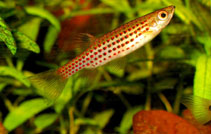
Copella nattereri, Spotted tetra : fisheries, aquarium

Copella nattereri (Steindachner, 1876)

Spotted tetra
Hochladen Photos und videos
Bilder | Google Bild
Image of Copella nattereri (Spotted tetra)
Copella nattereri
Photo von Christoffersen, T.

Klassifizierung / Names Namen | Synonyme | Catalog of Fishes(Gattung, Arten) | ITIS | CoL | WoRMS | Cloffa

> Characiformes (Characins) > Lebiasinidae (Pencilfishes) > Pyrrhulininae
Eponymy: Edward Drinker Cope (1840–1897) was an American palaeontologist, anatomist, herpetologist and ichthyologist. [...] Dr Johann Natterer (1787–1843) was an Austrian naturalist and collector. [...] (Ref. 128868), visit book page.
More on author: Steindachner.

Taxonomic Remarks
The dark spots occurring on most scales of the light colored body, usually appearing black or brown, easily identify this species. The type locality for C. callolepis is given as Amazon, the syntypes are aquarium specimens. The type localities for C. nattereri range from Óbidos on the lower Amazon to the mouth of the Rio Negro on the middle Amazon River, possibly overlapping localities. Examination of the types of both indicate C. callolepis to be a synonym of i>C. nattereri. It occurs in the lower to middle Amazon to the Rio Negro then up that river and into the upper Orinoco basin and from the headwater regions of the Rio Branco in Guyana. Eschmeyer, 1998:1156; Géry, 1977:142.

Umwelt: Milieu / Klimazone / Tiefenbereich / Verbreitungsgebiet Ökologie

; süßwasser benthopelagisch; pH range: 5.8 - 7.5; dH range: ? - 25. Tropical; 23°C - 27°C (Ref. 13371)

Verbreitung Territorien | FAO Gebiete | Ökosysteme | Vorkommen | Punkt Karte | Einführungen | Faunafri

South America: Colombia (Rio Amazonas at Letícia); Brazil (rio Amazonas from mouth of rio Negro to mouth of rio Tapajós); Venezuela (upper and middle rio Orinoco basin); rio Negro basin (Brazil, Venezuela, and Guyana).

Größe / Gewicht / Alter

Geschlechtsreife: Lm ?  range ? - ? cm
Max length : 4.5 cm SL Männchen/unbestimmt; (Ref. 137764); 4.1 cm SL (female)

Kurzbeschreibung Bestimmungsschlüssel | Morphologie | Morphometrie

Rückenflossenweichstrahlen (insgesamt) : 8; Afterflossenweichstrahlen: 9; Wirbelzahl: 32. This species is distinguished from all its congeners by the following characters: with a dark spot on each scale of the flank (vs. none); differs further, except callolepis, by having clear spots (red to purple in life) on the scales of the flank (vs. absence); differs from callolepis by the absence of a conspicuous black longitudinal band (vs. when present, longitudinal band dusky and not conspicuous) (Ref. 137764).
Body shape (shape guide): elongated; Cross section: compressed.

Biologie     Fachlexikon (Englisch) (z.B. epibenthic)

This species is known to deposit eggs on submerged vegetation, which are guarded by the male during incubation (Ref. 137764).

Lebenszyklus und Paarungsverhalten Geschlechtsreife | Fortpflanzung | Ablaichen | Eier | Fruchtbarkeit | Larven

Hauptreferenz Laden Sie Ihre Referenzen hoch | Referenzen | Koordinator : Weitzman, Marilyn | Partner

Marinho, M.M.F. and N.A. Menezes, 2017. Taxonomic review of Copella (Characiformes: Lebiasinidae) with an identification key for the species. PLoS ONE 12(8):e0183069:1-53. (Ref. 137764)

IUCN Rote Liste Status (Ref. 130435: Version 2025-2 (Global))

  nicht bedroht (LC) ; Date assessed: 11 September 2020

CITES

Not Evaluated

CMS (Ref. 116361)

Not Evaluated

Bedrohung für Menschen

  Harmless


Nutzung durch Menschen

Fischereien: weniger kommerziell; Aquarium: Kommerziell
FAO - Publication: search | FishSource |

Mehr Information

Trophische Ökologie
Lebensmittel (Beutetiere)
Nahrungszusammensetzung
Nahrungsaufnahme
Lebensmittelrationen
Räuber
Ökologie
Ökologie
Populationsdynamik
Wachstumsparameter
Max. Alter/Größen
Länge-Gewicht-Rel.
Länge-Länge-Verhältnis.
Längenhäufigkeiten
Massenkonvertierung
Rekrutierung
Dichte
Lebenszyklus
Fortpflanzung
Geschlechtsreife
Reifung/Kiemen rel.
Fruchtbarkeit
Ablaichen
Laichaggregationen
Eier
Eientwicklung
Larven
Larven Pop.Dyn.
Verbreitung
Territorien
FAO Gebiete
Ökosysteme
Vorkommen
Einführungen
BRUVS - Videos
Anatomie
Kiemenoberfläche
Gehirn
Otolith
Physiologie
Körperliche Zusammensetzung
Nährstoffe
Sauerstoffverbrauch
Schwimmart
Schwimmgeschwindigkeit
Visuelle Pigmente
Fischgeräusche
Krankheiten und Parasiten
Toxizität (LC50s)
Genetik
Genom
Genetik
Heterozygotie
Vererbbarkeit
Genetische Vielfalt
Menschenbezogen
Aquakultur-Systeme
Aquakultur Profile
Zuchtlinien
Ciguatera-Fälle
Briefmarken, Münzen, Verschiedenes.
Aufsuchen
Partner
Referenzen
Referenzen

Tools

Zusatzinformationen

Download XML

Internet Quellen

AFORO (otoliths) | Aquatic Commons | BHL | Cloffa | Websites from users | FishWatcher Einträge suchen | CISTI | Catalog of Fishes: Gattung, Arten | DiscoverLife | ECOTOX | FAO - Publication: search | Faunafri | Fishipedia | Fishtrace | GloBI | Google Books | Google Scholar | Google | IGFA World Record | OneZoom | Open Tree of Life | Otolith Atlas of Taiwan Fishes | Öffentliche Aquarien | PubMed | Reef Life Survey | Socotra Atlas | TreeBase | Tree of Life | Wikipedia: Gehe zu, Suchen | World Records Freshwater Fishing | Zoologischer Rekord

Schätzungen auf der Grundlage von Modellen

Phylogenetischer Diversitätsindex (Ref. 82804):  PD50 = 0.5156   [Uniqueness, from 0.5 = low to 2.0 = high].
Bayesian length-weight: a=0.00646 (0.00327 - 0.01276), b=3.06 (2.89 - 3.23), in cm total length, based on LWR estimates for this species & (Sub)family-body (Ref. 93245).
Trophische Ebene (Ref. 69278):  3.3   ±0.4 se; based on size and trophs of closest relatives
Anfälligkeit der Fischerei (Ref. 59153):  Low vulnerability (10 of 100). 🛈
Preiskategorie (Ref. 80766):   Unknown.