Teleostei (teleosts) >
Characiformes (Characins) >
Lebiasinidae (Pencilfishes) > Pyrrhulininae
Eponymy: Edward Drinker Cope (1840–1897) was an American palaeontologist, anatomist, herpetologist and ichthyologist. [...] Dr Johann Natterer (1787–1843) was an Austrian naturalist and collector. [...] (Ref. 128868), visit book page.
More on author: Steindachner.
Issue
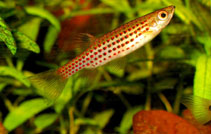
The dark spots occurring on most scales of the light colored body, usually appearing black or brown, easily identify this species. The type locality for C. callolepis is given as Amazon, the syntypes are aquarium specimens. The type localities for C. nattereri range from Óbidos on the lower Amazon to the mouth of the Rio Negro on the middle Amazon River, possibly overlapping localities. Examination of the types of both indicate C. callolepis to be a synonym of i>C. nattereri. It occurs in the lower to middle Amazon to the Rio Negro then up that river and into the upper Orinoco basin and from the headwater regions of the Rio Branco in Guyana. Eschmeyer, 1998:1156; Géry, 1977:142.
Environment: milieu / climate zone / depth range / distribution range
Ecology
Freshwater; benthopelagic; pH range: 5.8 - 7.5; dH range: ? - 25. Tropical; 23°C - 27°C (Ref. 13371)
South America: Colombia (Rio Amazonas at Letícia); Brazil (rio Amazonas from mouth of rio Negro to mouth of rio Tapajós); Venezuela (upper and middle rio Orinoco basin); rio Negro basin (Brazil, Venezuela, and Guyana).
Size / Weight / Age
Maturity: Lm ? range ? - ? cm
Max length : 4.5 cm SL male/unsexed; (Ref. 137764); 4.1 cm SL (female)
Dorsal soft rays (total): 8; Anal soft rays: 9; Vertebrae: 32. This species is distinguished from all its congeners by the following characters: with a dark spot on each scale of the flank (vs. none); differs further, except callolepis, by having clear spots (red to purple in life) on the scales of the flank (vs. absence); differs from callolepis by the absence of a conspicuous black longitudinal band (vs. when present, longitudinal band dusky and not conspicuous) (Ref. 137764).
Body shape (shape guide): elongated; Cross section: compressed.
This species is known to deposit eggs on submerged vegetation, which are guarded by the male during incubation (Ref. 137764).
Life cycle and mating behavior
Maturity | Reproduction | Spawning | Eggs | Fecundity | Larvae
Marinho, M.M.F. and N.A. Menezes, 2017. Taxonomic review of Copella (Characiformes: Lebiasinidae) with an identification key for the species. PLoS ONE 12(8):e0183069:1-53. (Ref. 137764)
IUCN Red List Status (Ref. 130435: Version 2025-2)
Threat to humans
Harmless
Human uses
Fisheries: minor commercial; aquarium: commercial
Tools
Special reports
Download XML
Internet sources