>
Gobiiformes (Gobies) >
Gobiidae (Gobies) > Gobionellinae
Etymology: Schismatogobius: Greek, schisma, -atos = crack, fissure + latin, gobius = gudgeon (Ref. 45335).
More on author: Peters.
Environment: milieu / climate zone / intervalo de profundidade / distribution range
Ecologia
; Água doce demersal; intervalo de profundidade 0 - 1 m (Ref. 125666). Tropical
Asia: Japan, Philippines, and Indonesia.
Tamanho / Peso / Idade
Maturidade: Lm ? range ? - ? cm
Max length : 3.4 cm SL macho/indeterminado; (Ref. 7050); 4.2 cm SL (female)
Descrição breve
Chaves de identificação | Morfologia | Morfometria
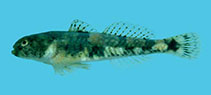
Espinhos dorsais (total) : 7; Raios dorsais moles (total) : 8 - 9; Espinhos anais: 1; Raios anais moles: 9. This species is distinguished by the following characters: pectoral-fin rays 16; body deep (body depth at pelvic-fin origin 19.8-21.9% of SL); trunk relatively long (pre-anal length 57.4-60.1% of SL; pre-anal-fin length 62.2-64.6% of SL); the snout blunt and steep. Colouration: two dark brown, transverse bands on posterior half of the body; pectoral fin with 1-8 black spots along each ray forming vertical bars; in males, the isthmus, gular region, and pelvic fins are densely pigmented; isthmus and gular region of female almost cream or white, usually with a brownish blotch on gular region; pelvic fin almost translucent, but with a few melanophores along soft rays in female; one diamond-shaped dark brown blotch from caudal-fin base to proximal part of caudal fin; posterior half of branched caudal-fin rays with 3-5 small black spots forming thin vertical bars (Ref. 125666).
Body shape (shape guide): fusiform / normal; Cross section: oval.
Collected from the lower freshwater reaches of a stream in Japan,150 m from the upper limit of tidal fluctuations, with S. ninja. It was also observed in two other streams on Okinawa Island, located 50 and 600 m from the upper limit of tidal fluctuations. Found in rapids at depths of 5-30 cm and in one case, was observed to swim away in the middle of the water column against a strong current, a behavior not seen in S. ninja and S. ampluvinculus (Ref. 125666).
Life cycle and mating behavior
Maturidade | Reprodução | Desova | Ovos | Fecundidade | Larvas
Kottelat, M., A.J. Whitten, S.N. Kartikasari and S. Wirjoatmodjo, 1993. Freshwater fishes of Western Indonesia and Sulawesi. Periplus Editions, Hong Kong. 221 p. (Ref. 7050)
Categoria na Lista Vermelha da IUCN (Ref. 130435: Version 2025-1)
Ameaça para o homem
Harmless
Utilização humana
Ferramentas
Relatórios especiais
Descarregue XML
Fontes da internet
Estimates based on models
Phylogenetic diversity index (Ref.
82804): PD
50 = 0.5000 [Uniqueness, from 0.5 = low to 2.0 = high].
Bayesian length-weight: a=0.00977 (0.00444 - 0.02153), b=3.04 (2.85 - 3.23), in cm total length, based on LWR estimates for this (Sub)family-body shape (Ref.
93245).
Nível Trófico (Ref.
69278): 3.2 ±0.5 se; based on size and trophs of closest relatives
Resiliência (Ref.
120179): Elevada, tempo mínimo de duplicação da população menor que 15 meses (Preliminary K or Fecundity.).
Fishing Vulnerability (Ref.
59153): Low vulnerability (10 of 100).
🛈