Environment: milieu / climate zone / εύρος βάθους / distribution range
Οικολογία
Θαλασσινό(ά); Γλυκού νερού; Υφάλμυρο βενθικό(ς). Tropical
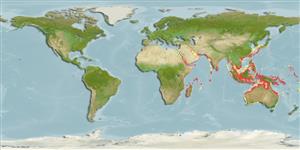
Indo-West Pacific: Persian Gulf to the Indo-Malayan region, northern Australia, Queensland, and north to southern Japan. Has long been confused with Arius thalassinus (Rüppell 1837).
Μέγεθος / Βάρος / Age
Γεννητική Ωρίμανση: Lm ? range ? - ? cm
Max length : 90.0 cm TL αρσενικό/απροσδιόριστο; (Ref. 114032)
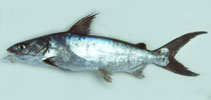
Ραχιαίες άκανθες (συνολικά) : 1; Εδρικές άκανθες: 0; Μαλακές εδρικές ακτίνες: 17 - 21; Σπόνδυλοι: 53 - 58. Dorsomedian head groove bordered posteriorly by slightly raised frontals and forming a "V". Gill rakers usually absent on hind aspect of first 2 gill arches. Caudal fin lobes slender and tapered. Adipose fin short-based and located posteriorly.
Body shape (shape guide): fusiform / normal.
Inhabits coastal waters, from estuaries onto the continental shelf. Found mostly on mudflats; males incubate eggs in its mouth (Ref. 68964). Mainly opportunistic and carnivorous; feeding on sea urchins, crustaceans, fish, prawns, loose scales, and detritus (Ref. 38478). Has a sharp and venomous dorsal and pectoral spines that can inflict extremely painful injuries(Ref. 68964). An important food fish (Ref. 7050).
Life cycle and mating behavior
Γεννητική Ωρίμανση | Αναπαραγωγή | Γεννοβολία | Αβγά | Γονιμότητα | Προνύμφες
Kailola, P.J., 1999. Ariidae (=Tachysuridae): sea catfishes (fork-tailed catfishes). p. 1827-1879. In K.E. Carpenter and V.H. Niem (eds.) FAO species identification guide for fishery purposes. The living marine resources of the Western Central Pacific. Vol. 3. Batoid fishes, chimaeras and bony fishes part 1 (Elopidae to Linophrynidae). FAO, Rome. (Ref. 38478)
IUCN Red List Status (Ref. 130435: Version 2025-1)
Threat to humans
Traumatogenic (Ref. 58010)
Human uses
αλιεία: περιορισμένης εμπορικότητας
Εργαλεία
Special reports
Download XML
Διαδικτυακές πηγές
Estimates based on models
Preferred temperature (Αναφ.
123201): 24.6 - 29.2, mean 28.3 °C (based on 1456 cells).
Phylogenetic diversity index (Αναφ.
82804): PD
50 = 0.6250 [Uniqueness, from 0.5 = low to 2.0 = high].
Bayesian length-weight: a=0.00794 (0.00381 - 0.01658), b=3.08 (2.91 - 3.25), in cm total length, based on LWR estimates for this (Sub)family-body shape (Ref.
93245).
Τροφικό Επίπεδο (Αναφ.
69278): 3.8 ±0.49 se; based on food items.
Ελαστικότητα (Αναφ.
120179): Χαμηλό, ελάχιστος χρόνος για διπλασιασμό πληθυσμού 4,5 - 14 έτη (Preliminary K or Fecundity.).
Fishing Vulnerability (Ref.
59153): High vulnerability (56 of 100).
🛈
Nutrients (Ref.
124155): Calcium = 91.2 [48.0, 192.0] mg/100g; Iron = 0.887 [0.553, 1.489] mg/100g; Protein = 16.9 [15.3, 18.7] %; Omega3 = 0.189 [0.105, 0.341] g/100g; Selenium = 79.8 [41.1, 157.8] μg/100g; VitaminA = 18.9 [8.3, 44.5] μg/100g; Zinc = 1.19 [0.80, 1.81] mg/100g (wet weight);