>
Stomiiformes (Lightfishes and dragonfishes) >
Stomiidae (Barbeled dragonfishes) > Chauliodontinae
Etymology: Chauliodus: Greek, chaulios, chaulos, chaunos = to be with the mouth opened + Greek, odous = teeth (Ref. 45335).
Eponymy: The succession of Danish research vessels named ‘Dana’ seem to have been greatly favoured by describers of fish, and often the etymology includes: “…from which the holotype was collected. [...] (Ref. 128868), visit book page.
More on authors: Regan & Trewavas.
Environment: milieu / climate zone / Tiefenbereich / distribution range
Ökologie
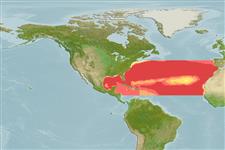
seewasser bathypelagisch; ozeanodrom (Ref. 51243); tiefenbereich 0 - 500 m (Ref. 5951). Deep-water; 42°N - 14°N, 98°W - 5°W
Eastern Atlantic: Portugal south to Cape Verde. Western Atlantic: Gulf of Mexico and eastern Caribbean Sea. Northwest Atlantic: Canada (Ref. 5951).
Size / Gewicht / Alter
Geschlechtsreife: Lm ? range ? - ? cm
Max length : 15.0 cm SL Männchen/unbestimmt; (Ref. 3588)
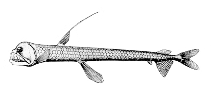
Rückenflossenweichstrahlen (insgesamt) : 6; Afterflossenweichstrahlen: 10 - 11. Dorsal fin posterior. Small photophores between the lateral and ventral rows of large serial organs consistently spaced between successive large organs. Dark, sometimes paler below. Body marked with five rows of hexagonal pigment areas (Ref. 37473).
Body shape (shape guide): elongated.
An oceanic and mesopelagic species (Ref. 3588). May migrate to near-surface waters at night (Ref. 4759). Feeds on fishes and crustaceans (Ref. 4759).
Life cycle and mating behavior
Geschlechtsreife | Fortpflanzung | Ablaichen | Eier | Fecundity | Larven
Parin, N.V., 1990. Chauliodontidae. p. 293-295. In J.C. Quero, J.C. Hureau, C. Karrer, A. Post and L. Saldanha (eds.) Check-list of the fishes of the eastern tropical Atlantic (CLOFETA). JNICT, Lisbon; SEI, Paris; and UNESCO, Paris. Vol. 1. (Ref. 3588)
IUCN Rote Liste Status (Ref. 130435: Version 2025-1)
Bedrohung für Menschen
Harmless
Nutzung durch Menschen
Tools
Zusatzinformationen
Download XML
Internet Quellen
Estimates based on models
Preferred temperature (Ref.
123201): 14.8 - 26.5, mean 20.7 °C (based on 126 cells).
Phylogenetic diversity index (Ref.
82804): PD
50 = 0.5020 [Uniqueness, from 0.5 = low to 2.0 = high].
Bayesian length-weight: a=0.00219 (0.00097 - 0.00495), b=3.16 (2.96 - 3.36), in cm total length, based on LWR estimates for this (Sub)family-body shape (Ref.
93245).
Trophic level (Ref.
69278): 4.0 ±0.66 se; based on food items.
Widerstandsfähigkeit (Ref.
120179): mittel, Verdopplung der Population dauert 1,4 - 4,4 Jahre. (Assuming tmax>3).
Fishing Vulnerability (Ref.
59153): Low vulnerability (10 of 100).
🛈