



分類 / 名前 共通名の | 類義語 | Catalog of Fishes(部類, 種) | ITIS | CoL | WoRMS | Cloffa
> Gonorynchiformes (Milkfishes) > Kneriidae (Shellears)
Etymology: Kneria: From Kner, that studied fishes in the Imperial Museum of Vienna, with Jean Natterer (1817) (Ref. 45335).
Eponymy: Dr Rudolf Kner (1810–1869) was an Austrian zoologist specialising in ichthyology. [...] This is a toponym; the holoypes of these fishes were collected in Katanga Province (formerly part of the Belgian Congo, now the Democratic Republic of Congo). (Ref. 128868), visit book page.
More on author: Poll.
Etymology: Kneria: From Kner, that studied fishes in the Imperial Museum of Vienna, with Jean Natterer (1817) (Ref. 45335).
Eponymy: Dr Rudolf Kner (1810–1869) was an Austrian zoologist specialising in ichthyology. [...] This is a toponym; the holoypes of these fishes were collected in Katanga Province (formerly part of the Belgian Congo, now the Democratic Republic of Congo). (Ref. 128868), visit book page.
More on author: Poll.
環境:環境 / 気候帯 / 深さの範囲 / 分布範囲 生態学
; 新鮮な水 底生の漂泳性. Tropical
分布 領土 | 国連食糧農業機関の区域 | エコシステム | 事件 | 目的のマップ | 導入 | Faunafri
Africa: Munte River system (Lufira River tributary, upper Lualaba drainage) in Democratic Republic of the Congo (Ref. 2970, 45434).
サイズ / 重さ / 年齢
簡単な記述 検索表 | 形態学 | 形態計測学
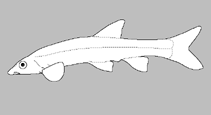
背面の脊椎 (合計) : 0; 背鰭 (合計) : 11; 肛門の骨: 0; 臀鰭: 10; 脊つい: 41. Diagnosis: body depth 18-23.2% of standard length (SL); head length 20.3-24.3% SL; snout rounded, wider than long, 26.1-31.5% head length, 94.4-104.3% eye diameter (ED); eye diameter 26.1-30.2% head length; interorbital distance 100-117.4% ED; preorbital distance 38.9-47.8% ED; mouth ventral, wide; lower lip with weakly developed cutting edge; opercular apparatus (only well dveloped in males) consisting of an opercular suction disc followed by a striated, moderately developed postopercular part with about 12 ridges; dorsal and anal fins with 3 unbranched rays; dorsal fin positioned about 0.9-1.1 times closer to tip of snout than to caudal fin origin, inserted at about the same level as pelvic fins; anal fin about halfway pelvic fins and caudal fin origin; pectoral and pelvic fins with a single unbranched ray; pectoral fin 17.3-19.7% SL; body yellowish, dorsal surfaces darker, brownish; dark lateral band not very distinct (Ref. 2970).
Remark: note that the first column in the comparative table in Ref. 2970 (p. 41) contains the morphometrics for K. katangae and the second for K. paucisquamata, contrarily to what is mentioned above the respective columns (T. Musschoot, pers. comm.).
Body shape (shape guide): elongated; Cross section: circular.
Body shape (shape guide): elongated; Cross section: circular.
Maximum TL was recorded at 5.5 cm (Ref. 2970).
ライフサイクルと交尾行動 成熟 | 繁殖 | 放精 | 卵 | 生産力 | 幼生
主な参考文献
参考文献のアップロード | 参考文献 | コーディネーター | 協力者
Poll, M., 1984. Kneriidae. p. 129-133. In J. Daget, J.-P. Gosse and D.F.E. Thys van den Audenaerde (eds.) Check-list of the freshwater fishes of Africa (CLOFFA). ORSTOM, Paris and MRAC, Tervuren. Vol. 1. (Ref. 3565)
CITES
Not Evaluated
人間に対する脅威
Harmless
人間の用途
FAO - Publication: search | FishSource |
より多くの情報
養殖生態
食料品(獲物)
餌の構成
摂食量
食料配給
捕食動物
食料品(獲物)
餌の構成
摂食量
食料配給
捕食動物
生態学
生態学
生態学
人口動態
成長のパラメーター
最大年齢/サイズ
長さ-重量比。
長短関係。
体長組成
質量変換
補充
豊度
成長のパラメーター
最大年齢/サイズ
長さ-重量比。
長短関係。
体長組成
質量変換
補充
豊度
ライフサイクル
繁殖
成熟
成熟度/エラ
生産力
放精
産卵群
卵
卵の開発
幼生
幼生の動力
繁殖
成熟
成熟度/エラ
生産力
放精
産卵群
卵
卵の開発
幼生
幼生の動力
解剖学
カマ
脳
オトリス
カマ
脳
オトリス
生理学
体組成
栄養素
酸素消費
水泳タイプ
泳ぐ速さ
視覚色素
フィッシュ・サウンド
病気と寄生虫
毒性(LC50)
体組成
栄養素
酸素消費
水泳タイプ
泳ぐ速さ
視覚色素
フィッシュ・サウンド
病気と寄生虫
毒性(LC50)
遺伝子の
ゲノム
遺伝子の
ヘテロ接合性
遺伝
遺伝的多様性
ゲノム
遺伝子の
ヘテロ接合性
遺伝
遺伝的多様性
用具
特記事項
XMLをダウンロードして下さい
インターネットの情報源
AFORO (otoliths) | Aquatic Commons | BHL | Cloffa | Websites from users | Check FishWatcher | CISTI | Catalog of Fishes: 部類, 種 | DiscoverLife | ECOTOX | FAO - Publication: search | Faunafri | Fishipedia | Fishtrace | GloBI | Google Books | Google Scholar | Google | IGFA World Record | OneZoom | Open Tree of Life | Otolith Atlas of Taiwan Fishes | PubMed | Reef Life Survey | Socotra Atlas | TreeBase | 生命の木 | Wikipedia: 行く, 検索する | World Records Freshwater Fishing | Zoobank | 動物に関する記録