>
Cypriniformes (Carps) >
Danionidae (Danios) > Rasborinae
Etymology: Trigonostigma: Greek, tres, tria = three + Greek, gonias= angle, corner + Greek stigma = signal.
Environment: milieu / climate zone / profondeur / distribution range
Écologie
; eau douce benthopélagique; pH range: 5.0 - 7.0; dH range: 5 - 12. Tropical; 22°C - 25°C (Ref. 1672)
Asia: Malay Peninsula: Peninsular Malaysia, Singapore and Indonesia.
Taille / Poids / Âge
Maturité: Lm ? range ? - ? cm
Max length : 5.0 cm TL mâle / non sexé; (Ref. 13061)
Description synthétique
Clés d'identification | Morphologie | Morphométrie
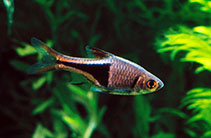
Épines dorsales (Total) : 1; Rayons mous dorsaux (Total) : 7; Épines anales: 1; Rayons mous anaux: 6. This species is shares with T. truncata, presence of a large black axine starting from approximately mid-body with dorsal apex near dorsal-fin origin, ventral apex near pelvic-fin origin, and caudal apex near caudal-fin base. It differs from all its congeners in the following set of characters: a
steep sloping lateral head to pre-dorsal region (shared with T. espei, vs. a gentle sloping lateral profile from posterior of head to predorsal region for T. truncata, T. hengeli, T. somphongsi); terminal mouth (shared with all except truncata with a sub-superior mouth); caudal apex of axine
reaching caudal-fin base (shared with all except truncata with caudal apex not reaching); dorsal and ventral apices of axine originate near to both dorsal-fin and pelvic-fin origins (shared with truncata vs. dorsal apex starting up to 3 scale-width posterior to dorsal-fin origin and ventral apex starting two scale-width after pelvic-fin origin in espei, hengeli, while axine is reduced to thick black stripe in somphongsi); dorsal fin with distinct orange/red pigments shared with truncata, espei (vs. hengeli, somphongsi with almost hyaline dorsal fin) (Ref. 122370).
Cross section: compressed.
Inhabits forest streams (Ref. 13061). Found in primary peat swamps in larger than 100 fish (Ref. 57235). Feeds on worms, crustaceans and insects (Ref. 7020). Eggs spawned at the underside of broad leaves and similar structures (Ref. 38434). Aquarium keeping: in groups of 5 or more individuals; minimum aquarium size 60 cm (Ref. 51539). Previously known as "Rasbora" but revised as separated genus by Kottelat & Witte (1999) (Ref. 57235).
Life cycle and mating behavior
Maturité | Reproduction | Frai | Œufs | Fécondité | Larves
Tan, H.H., 2020. Trigonostigma truncata, a new species of harlequin rasbora from Malay Peninsula (Teleostei: Danionidae). Raff. Bull. Zool. 68:421-433. (Ref. 122370)
Statut dans la liste rouge de l'IUCN (Ref. 130435: Version 2025-1)
Menace pour l'homme
Harmless
Utilisations par l'homme
Pêcheries: hautement commercial; Aquarium: hautement commercial
Outils
Articles particuliers
Télécharger en XML
Sources Internet
Estimates based on models
Phylogenetic diversity index (Réf.
82804): PD
50 = 0.5312 [Uniqueness, from 0.5 = low to 2.0 = high].
Bayesian length-weight: a=0.01995 (0.00906 - 0.04395), b=3.01 (2.83 - 3.19), in cm total length, based on all LWR estimates for this body shape (Ref.
93245).
Niveau trophique (Réf.
69278): 3.3 ±0.40 se; based on food items.
Résilience (Réf.
120179): Haut, temps minimum de doublement de population inférieur à 15 mois (Preliminary K or Fecundity.).
Fishing Vulnerability (Ref.
59153): Low vulnerability (10 of 100).
🛈