



Rypticus saponaceus (Bloch & Schneider, 1801)
Greater soapfish
Masukkan pemerhatian anda di Fish Watcher
| Native range | All suitable habitat | Point map | Year 2050 |

|
| This map was computer-generated and has not yet been reviewed. |
| Rypticus saponaceus AquaMaps Data sources: GBIF OBIS |
muatnaik fotos/gambar dan video
Gambar | video | Suara-suara | imej Google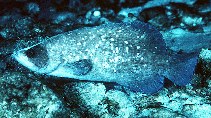 Rypticus saponaceus
foto/gambar oleh Randall, J.E.
Gambar | video | Suara-suara | imej Google
foto/gambar oleh Randall, J.E.
klasifikasi / Nama Nama-nama umum | Sinonim (persamaan) | Catalog of Fishes(Marga, Jenis) | ITIS | CoL | WoRMS | Cloffa
> Perciformes/Serranoidei (Groupers) > Grammistidae (Soapfishes)
Etymology: Rypticus: Greek, ryptikos, -e, -on = easy to wash (Ref. 45335).
More on authors: Bloch & Schneider.
Etymology: Rypticus: Greek, ryptikos, -e, -on = easy to wash (Ref. 45335).
More on authors: Bloch & Schneider.
Lingkungan: lingkungan / zona iklim / kisaran kedalaman / jangkauan distribusi Ekologi
laut berasosiasi dengan karang; kisaran kedalaman 1 - 70 m (Ref. 58047), usually 2 - 35 m (Ref. 40849). Tropical; 33°N - 35°S, 98°W - 19°E
Penyebaran Wilayah | Daerah-daerah FAO | Ekosistem | Kemunculan | peta titik | Introduksi | Faunafri
Western Atlantic: Bermuda and southern Florida, USA to Brazil. Eastern Atlantic: Mauritania to Angola, including St. Paul's Rocks (Ref. 13121), Cape Verde, St. Helena and Ascension islands. One record from Cape of Good Hope, South Africa (Ref. 7320).
Ukuran / Berat / umur
Kematangan: Lm ? range ? - ? cm
Max length : 35.0 cm TL jantan/; (Ref. 26999); common length : 25.0 cm TL jantan/; (Ref. 3632)
Max length : 35.0 cm TL jantan/; (Ref. 26999); common length : 25.0 cm TL jantan/; (Ref. 3632)
deskripsi pendek Kunci identifiaksi (pengenalan) | Morfologi | Morfometrik
Duri punggung (Keseluruhan (total)) : 3; duri punggung lunak (Keseluruhan (total)) : 23 - 25. Pale spots about the size of the pupil or smaller on body and some on dorsal fin (Ref. 13442).
Body shape (shape guide): fusiform / normal.
Body shape (shape guide): fusiform / normal.
Maximum depth from Ref. 126840. A solitary species (Ref. 26340) inhabiting shallow water on bottoms with eroded limestone or mixed sand and rocks, as well as around reefs. Often found lying motionless against rocks (Ref. 13121). Secretes copious mucus which makes its surface slimy and when disturbed the slime turns into a soapy foam. The mucus has been shown to contain a toxic protein (Ref. 3632). Nocturnal, frequently seen around the bases of coral colonies and near mouths of caves (Ref. 26938).
Siklus hidup dan perilaku kawin Kematangan | Reproduksi, perkembang biakan | Pemijahan | telur-telur | Fekunditas | Larva
rujukan utama
Unggah referensi Anda | Acuan | Koordinator | mitra
Robins, C.R. and G.C. Ray, 1986. A field guide to Atlantic coast fishes of North America. Houghton Mifflin Company, Boston, U.S.A. 354 p. (Ref. 7251)
Status IUCN Red List (Ref. 130435: Version 2025-2 (Global))
kurang bimbang (LC) ; Date assessed: 23 August 2012
CITES
Not Evaluated
ancaman kepada manusia
Other
penggunaan manusia
Perikanan: perikanan swasembada; Akuarium: Komersial
FAO - Publication: search | FishSource | Laut di Sekitar Kita
informasi lanjut
Dinamika populasi
Parameter pertumbuhan
Maks. usia / ukuran
Panjang-berat rel.
Panjang-panjang rel.
ukuran frekuensi
Konversi massa
pemulihan
Kelimpahan
Parameter pertumbuhan
Maks. usia / ukuran
Panjang-berat rel.
Panjang-panjang rel.
ukuran frekuensi
Konversi massa
pemulihan
Kelimpahan
Siklus hidup
Reproduksi, perkembang biakan
Kematangan
Kedewasaan / insang rel.
Fekunditas
Pemijahan
Agregasi pemijahan
telur-telur
pekembangan telor
Larva
Dinamika larva
Reproduksi, perkembang biakan
Kematangan
Kedewasaan / insang rel.
Fekunditas
Pemijahan
Agregasi pemijahan
telur-telur
pekembangan telor
Larva
Dinamika larva
Anatomi
Area insang
Otak
Otolith
Area insang
Otak
Otolith
Fisiologi
Komposisi tubuh
Nutrisi
Konsumsi oksigen
Jenis renang
Kecepatan berenang
Pigmen visual
Suara ikan
Penyakit & Parasit
Toksisitas (LC50)
Komposisi tubuh
Nutrisi
Konsumsi oksigen
Jenis renang
Kecepatan berenang
Pigmen visual
Suara ikan
Penyakit & Parasit
Toksisitas (LC50)
Genetika
genom
Genetika
Heterozigositas
Diturunkan
Keanekaragaman Genetik
genom
Genetika
Heterozigositas
Diturunkan
Keanekaragaman Genetik
Yang berhubungan dengan manusia
Sistem akuakultur
profil budidaya air
Strain
Kasus Ciguatera
Perangko, koin, dll.
Sistem akuakultur
profil budidaya air
Strain
Kasus Ciguatera
Perangko, koin, dll.
Alat, peralatan
Kuis organik | E-book | Penuntun lapangan | Kunci identifiaksi (pengenalan) | tanda freqkuenci panjang | peringkat sejarah hidup | peta titik |
Tangkap-MSY |
laporan khas
muat turun XML
Sumber internet
AFORO (otoliths) | Aquatic Commons | BHL | Cloffa | Websites from users | semak peneliti ikan | CISTI | Catalog of Fishes: Marga, Jenis | DiscoverLife | ECOTOX | FAO - Publication: search | Faunafri | Fishipedia | Fishtrace | GloBI | GoMexSI (interaction data) | Google Books | Google Scholar | Google | IGFA World Record | Pangkalan data nasional | OneZoom | Open Tree of Life | Otolith Atlas of Taiwan Fishes | PubMed | Reef Life Survey | Socotra Atlas | TreeBase | Tree of Life | Wikipedia: pergi, Cari | World Records Freshwater Fishing | Catatan Zoologi
Estimasi berdasarkan model
Suhu yang disukai (Acuan 123201): 23.4 - 28, mean 26.5 °C (based on 708 cells).
Indeks keanekaragaman filogenetik (Acuan 82804): PD50 = 0.5005 [Uniqueness, from 0.5 = low to 2.0 = high].
Bayesian length-weight: a=0.01148 (0.00441 - 0.02989), b=3.06 (2.84 - 3.28), in cm total length, based on LWR estimates for this (Sub)family-body shape (Ref. 93245).
Tingkat Trofik (Acuan 69278): 4.1 ±0.5 se; based on diet studies.
Nutrisi (Ref. 124155): Calcium = 42.1 [24.7, 79.4] mg/100g; Iron = 0.521 [0.280, 0.880] mg/100g; Protein = 18.6 [16.9, 20.3] %; Omega3 = 0.161 [0.109, 0.241] g/100g; Selenium = 31.1 [18.7, 55.6] μg/100g; VitaminA = 112 [39, 351] μg/100g; Zinc = 1.07 [0.74, 1.50] mg/100g (wet weight);