This website uses cookies to enhance your browsing experience and ensure the functionality of our site. For more detailed information about the types of cookies we use and how we protect your privacy, please visit our Privacy Information page..
×
Cookie Settings
This website uses different types of cookies to enhance your experience. Please select your preferences below:
分類 / Names 共通名の | 類義語 | Catalog of Fishes(部類, 種) | ITIS | CoL | WoRMS | Cloffa
> Siluriformes (Catfishes) > Siluridae (Sheatfishes)
Etymology: Wallago:wallago;Bleeker, in 1851, took the Indian fish name, gave it generic range and used it connection with a new species. The name is "walaga" in Telugu / Tamil (Ref. 45335). Eponymy: Lieutenant-Colonel J M van Leer was a Dutch army physician who was a colleague of Bleeker’s. He was for a time the Directing Surgeon at Samarang, East Sumatra. He provided the holotypes of these species. (Ref. 128868), visit book page. More on author: Bleeker.
Environment: milieu / climate zone / 深さの範囲 / distribution range 生態学
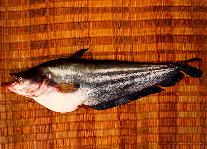
背面の脊椎 (合計) : 1; 背鰭 (合計) : 4; 臀鰭: 60 - 75. Differs from all other congeners by having a jet black pectoral-fin membranes. Branchiostegal rays 15-18 (Ref. 2091). Corner of mouth reaching only to anterior margin of eye (Ref. 7050). Body shape (shape guide): elongated.
Adults inhabit large streams and rivers (Ref. 12455). Fry occur at the mouth of small streams connected to larger rivers, where the bottom is muddy and with overhanging vegetation (Ref. 56749). Feeds on prawns (Ref. 56749). Oviparous, distinct pairing possibly like other members of the same family (Ref. 205). Fishermen along Kapuas in Indonesia observed that it used to form large migratory schools in Kapuas mainstream but such schools had become less noticeable, and this was attributed to intensive gill netting. Usually consumed fresh or processed as salted fish (Ref. 56749). Reaches more than 150 cm TL (Ref. 7050).
Life cycle and mating behavior 成熟 | 繁殖 | 放精 | 卵 | 生産力 | 幼生
Phylogenetic diversity index (参照 82804): PD50 = 0.5312 [Uniqueness, from 0.5 = low to 2.0 = high].
Bayesian length-weight: a=0.00562 (0.00279 - 0.01132), b=3.00 (2.83 - 3.17), in cm total length, based on LWR estimates for this (Sub)family-body shape (Ref. 93245).
栄養段階 (参照 69278): 4.5 ±0.80 se; based on food items.